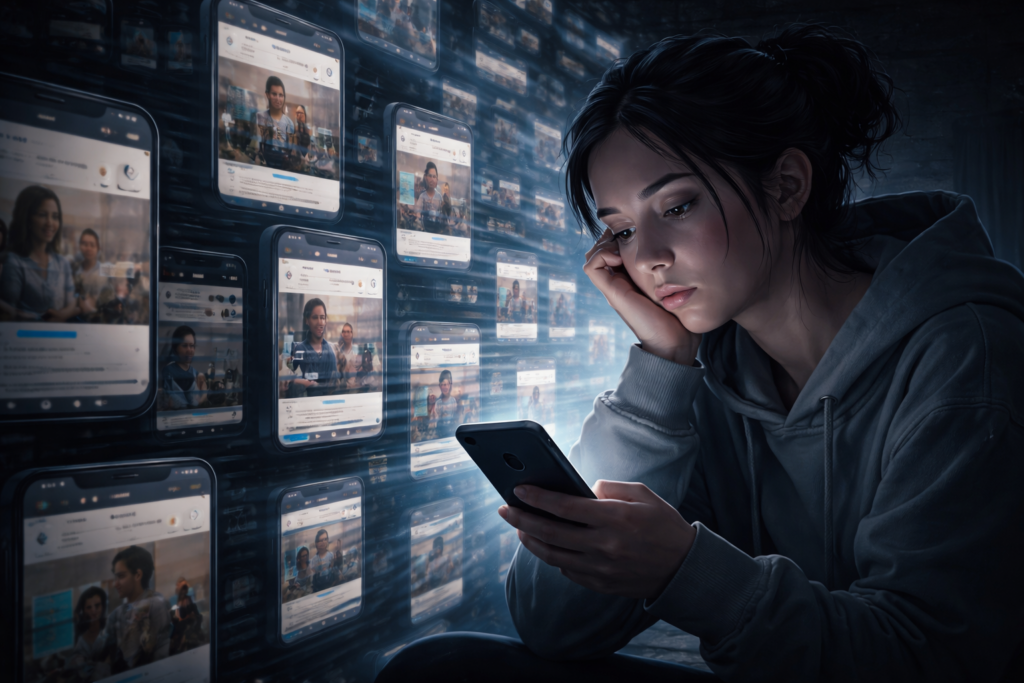
Why Nothing Feels New on the Internet AnymoreEverywhere you turn, there’s an overwhelming amount of content saturation. We’re flooded with the same themes, formats, and trends, making it hard to find anything truly fresh. Algorithms also play a big role in this; they show us what’s popular, often leading us to the same recycled ideas. This cycle makes it feel like new content is rare, even though there may be original voices out there. In a sea of sameness, anything unique shines brighter, reminding us that creativity is still alive, just waiting for its moment.
There was a time when opening the internet felt like stepping into something unknown. You didn’t know what you were going to find, and that was the point. Now, you open an app, scroll for a few seconds, and it already feels like you’ve seen everything before. Different creators, different accounts, but somehow the same content. The same jokes, the same edits, the same structure. It’s not that the internet is empty. It’s just starting to feel predictable.
What’s happening is not a lack of creativity. It’s a loop. Platforms today are built to reward what already works. The moment something performs well, it gets copied, repeated, and pushed harder. A format goes viral, and within hours, hundreds of versions of it appear. Over time, originality gets buried under efficiency. It’s faster to repeat a proven idea than to try something new that might fail. This creates a strange environment where everything looks active but feels stagnant.
Content is being produced at a massive scale, but most of it follows the same patterns. Even creators who want to try something different often don’t, because the system quietly discourages it. If something new doesn’t get engagement quickly, it disappears. Not because it was bad, but because it didn’t fit the algorithm’s expectations.
The result is a kind of silent boredom. People keep scrolling, but not because they’re interested. It becomes habit. You watch something, and before it even finishes, you already know what’s coming next. There’s no surprise left. And when there’s no surprise, there’s no real connection either. Content becomes something you consume, not something you experience.
This also changes how creativity itself works online. Instead of asking “what can I create,” the question becomes “what will perform.” That small shift matters. It slowly turns creativity into strategy. Ideas are shaped not by curiosity, but by what is likely to get views. Over time, everything starts to look the same because everything is being optimized for the same outcome.
But this doesn’t mean the internet has run out of ideas. It hasn’t. New thinking still exists. Different perspectives still exist. The problem is visibility. Original ideas take time to be understood, and the current system doesn’t give them that time. It favors instant reaction over slow appreciation. So the new doesn’t disappear. It just stays hidden. That’s why, when you do come across something that feels different, it stands out immediately. Not because it’s loud or dramatic, but because it feels real. It doesn’t follow the usual rhythm. It doesn’t try to fit into a trend. And in a space where everything is trying to look familiar, that difference becomes noticeable.
The internet didn’t become boring by accident. It became efficient. And in that process, it lost some of the unpredictability that made it interesting in the first place. What we’re seeing now is not the end of creativity, but a shift in what gets rewarded.