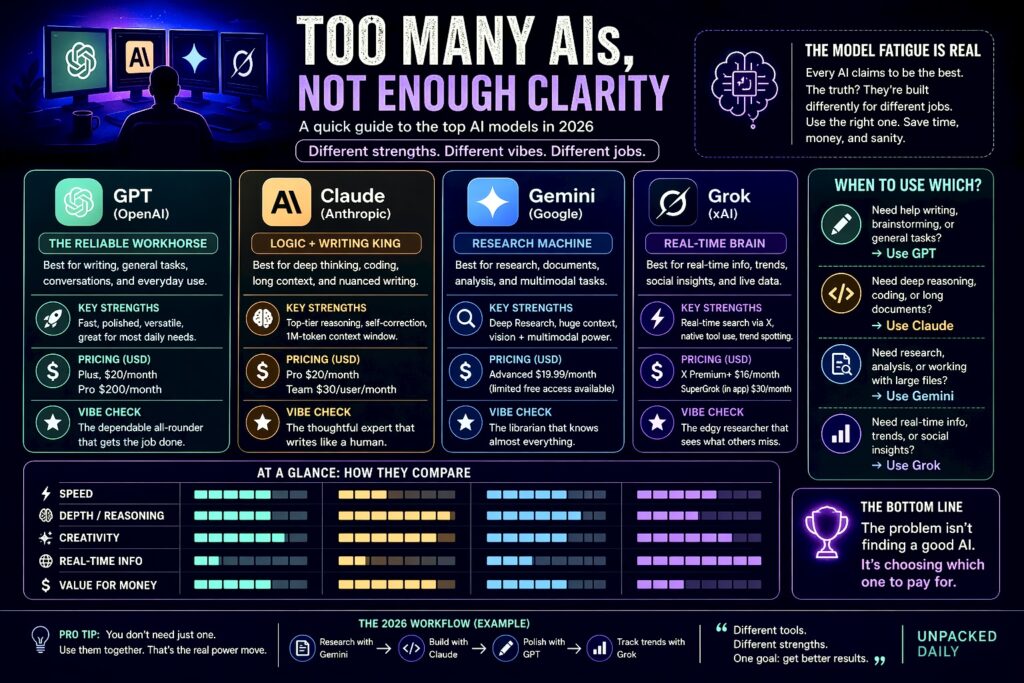
Everyone’s Using AI. So Am I. It’s 2:00 AM on a Tuesday in April 2026, and I am staring at four different browser tabs, feeling a very specific, very modern kind of exhaustion. My screen is a glow of purple, blue, and black logos—GPT, Claude, Gemini, and Grok. If you’d told me three years ago that my biggest headache wouldn’t be a lack of tools but an overwhelming surplus of “Ph.D.-level experts” fighting for my $20-a-month subscription, I’m not sure I would have believed you.
We have officially entered the era of “Model Fatigue.” It’s not that the AI isn’t working; it’s that every single model currently on the market is promising to “help you learn, plan, and build like never before”. We are drowning in “frontier intelligence,” yet finding the right tool for a simple Tuesday afternoon task feels like trying to pick a favorite child—except these children cost $200 a month and sometimes act like “overworked secretaries”.

If you’re researching these for your own content, you don’t need a dry technical manual. You need the “vibe check.” You need to know why OpenAI’s pricing feels like an economic experiment, why Claude is currently the “king of logic,” and why Grok knows things about X (the platform) before they even hit the news. Here is the deep dive into the 2026 AI landscape, written from the trenches.
The Identity Crisis: When Everyone is “The Best”
In the early days, the choice was simple: use ChatGPT. But as of mid-2025, the market exploded. By August 2025, ChatGPT hit 700 million weekly active users, and the competition reached a fever pitch. Today, every major provider uses the same marketing playbook. Google calls Gemini 3.1 Pro a “smarter model” for complex tasks. Anthropic pitches Claude 4.7 as a “step-change improvement” in agentic coding. xAI claims Grok 4 is simply “the most intelligent model in the world”.
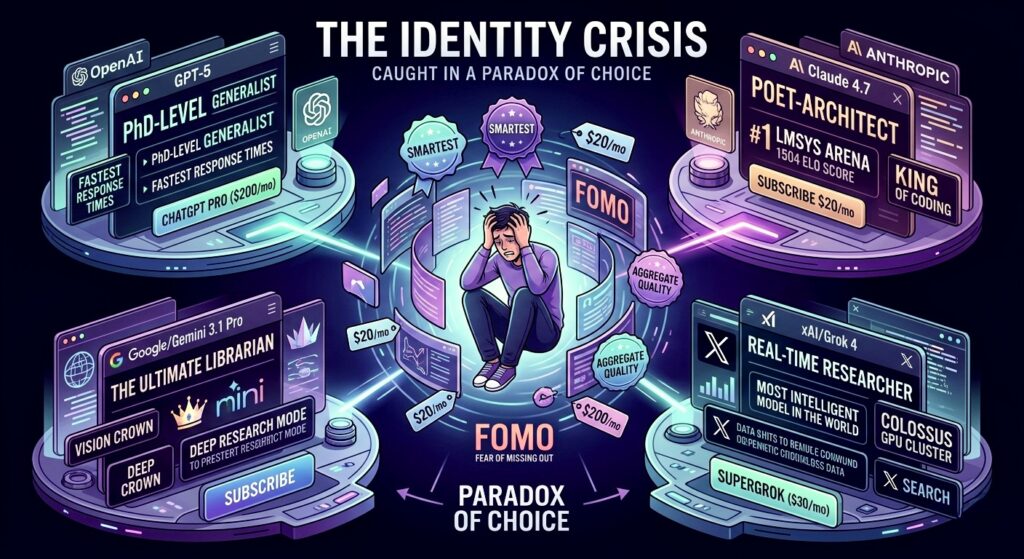
When everyone claims to be the smartest, the differences become invisible to the casual user. This creates a “paradox of choice” where we subscribe to everything out of a fear of missing out (FOMO) on that one extra bit of reasoning power. In fact, a March 2026 economic study suggests that this isn’t an accident—it’s “Menu Pricing”. Providers are intentionally creating these confusing tiers to screen us, figuring out exactly how much we’re willing to pay for “aggregate quality”.
1. OpenAI: The Benchmark (The Legacy of GPT-5)
OpenAI remains the “incumbent,” but their path hasn’t been without drama. After a “rocky path” that saw some internal models fail to meet expectations, GPT-5 finally launched on August 7, 2025. It was marketed as a “PhD-level” assistant, boasting faster response times and better writing skills.
The Vibe: It’s the reliable, high-throughput generalist. However, interestingly, many users in late 2025 actually complained that GPT-5 felt “flatter” and “less creative” than its predecessor, GPT-4o. Some users even called it a “corporate beige zombie” because it lacked the “warmth” of previous versions. Sam Altman had to publicly apologize and roll out a “personality update” to make the model feel “nicer”.
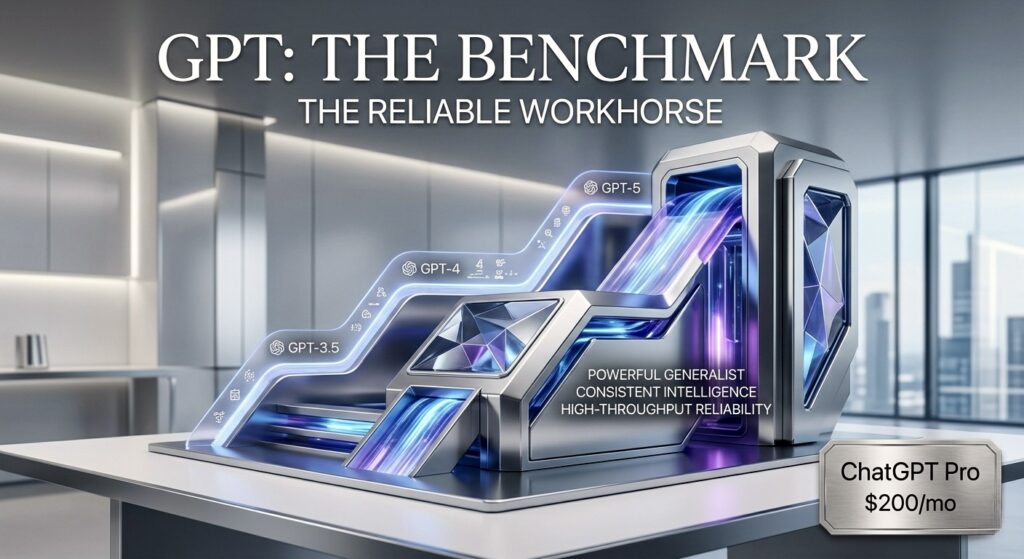
- The Versions: We’ve moved from GPT-3.5 (the 2022 spark) to the unified GPT-5 system, which includes “main,” “mini,” and the heavy-duty “thinking” models.
- The Price of Genius: OpenAI introduced ChatGPT Pro at $200/month in December 2024. This is for the “power users” who need “o1 Pro mode”—a setting where the model uses massive extra computation to solve “impossible” problems, cutting major errors by 34%.
2. Anthropic: The Poet-Architect (Claude 4.7)
If OpenAI is the corporate titan, Anthropic’s Claude is the “creative director.” As of April 6, 2026, Claude Opus 4.6 Thinking officially claimed the #1 spot on the LMSYS Chatbot Arena with a 1504 Elo score, becoming the first model to decisively break the 1500 barrier.
The Vibe: Claude is where you go when you care about nuance, logic, and self-correction. It is currently the “Global King” of the coding arena, with the Claude 4.6 family occupying the entire top three slots for programming tasks.
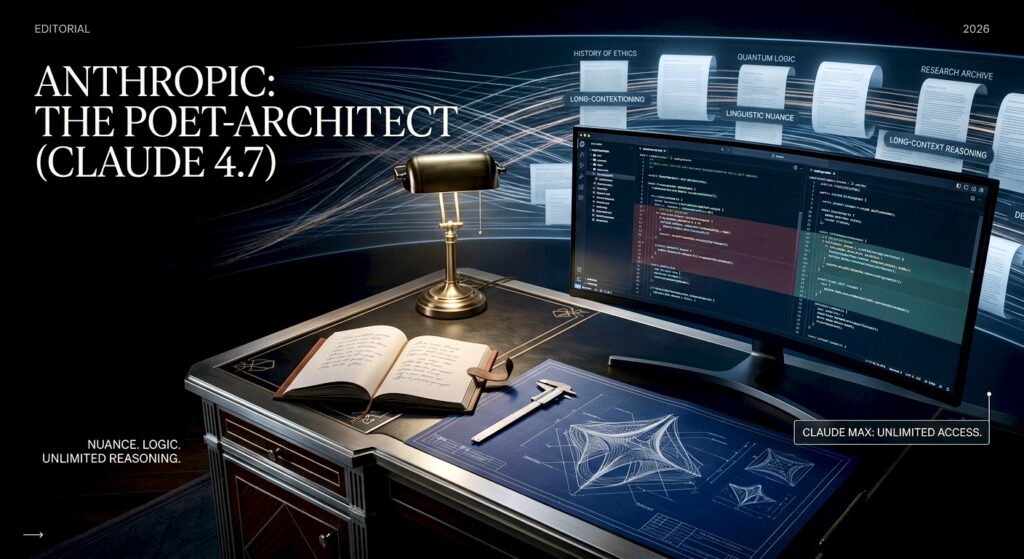
- Model Lineup: You have Haiku 4.5 (fast/cheap), Sonnet 4.6 (the smart middle), and Opus 4.7 (the beast for complex reasoning).
- Daily-Use Fit: I use Claude when I need a piece of writing that doesn’t sound like it was written by a robot. It has a 1-million-token context window, meaning it can digest an entire library of your research without forgetting the first page.
3. Google: The Information Sponge (Gemini 3.1)

Google’s Gemini 3.1 Pro is the ultimate “librarian.” If you have 2,000 pages of legal documents or a three-hour video to analyze, Gemini is the only one that doesn’t blink.
The Vibe: It feels like the smartest person in the room who also has access to every book ever written. Its Deep Research mode is a “rabbit hole finder”—it scours the web, creates an outline for your approval, and then generates a scholarly report.
- Strengths: It currently holds the “Vision crown” for multimodal tasks, outperforming both Claude and GPT in spatial reasoning.
- Access: Google has been aggressive with free access, offering limited Deep Research queries even to non-subscribers.
4. xAI: The “Real-Time” Researcher (Grok 4)
Elon Musk’s Grok 4 (released July 10, 2025) has become a serious disruptor by leveraging the Colossus 200,000 GPU cluster—the largest of its kind.
The Vibe: Grok is the “edgy” researcher who stays up all night on social media. Because it has native tool use and real-time search integration with X, it can find viral trends and community “vibe checks” that haven’t hit the news cycles yet.
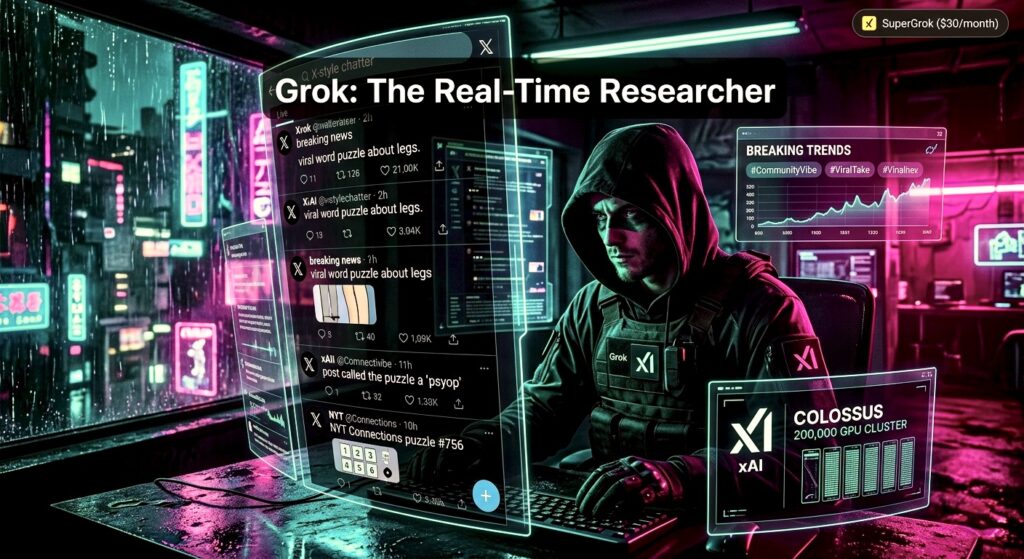
- The “Psyop” Example: In one famous test, a user asked Grok to find a viral word puzzle about “legs” from a few days prior. Grok “thought” for a minute, searched X, identified it was a complaint about NYT Connections puzzle #756, and even found the exact viral post with 21,000 likes that called the game a “psyop”.
- Grok 4 Heavy: This is their new $30/month tier (SuperGrok) that uses “parallel test-time compute” to consider multiple hypotheses at once.
The Comparison: Speed vs. Depth vs. Vibe
To make this practical, let’s look at how these four handled the same “Deep Research” query: “Explore how time travel is portrayed in film and what it says about our fears”.
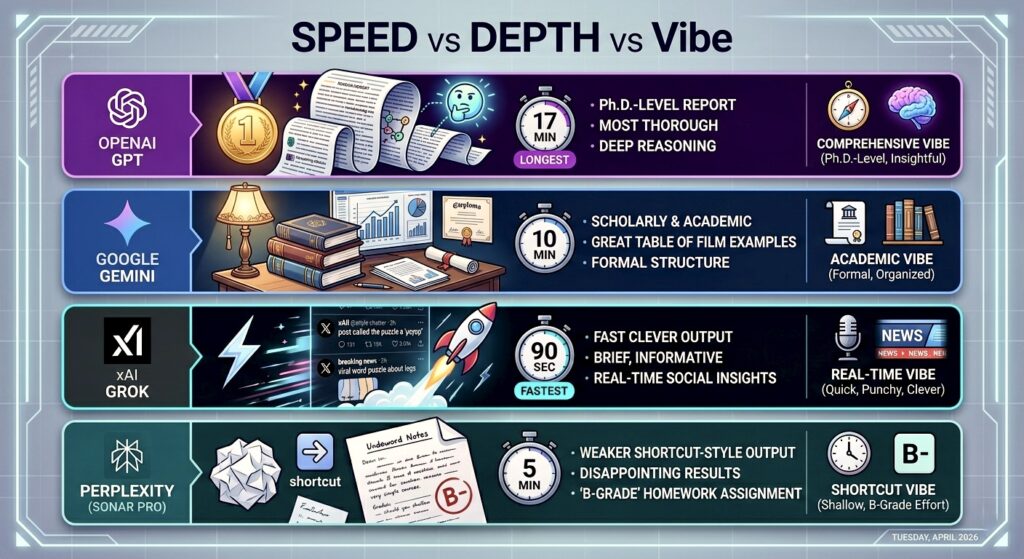
- ChatGPT (The Winner): It took the longest (17 minutes) but delivered a “PhD-level” report that was the most thorough and interesting to read.
- Gemini: Took 10 minutes. It was very scholarly and “academic,” providing a great table of film examples, but it felt a bit more formal.
- Grok: The speed king. It finished in just 90 seconds. The report was brief but surprisingly “clever” and informative.
- Perplexity (Sonar Pro): Only took 5 minutes, but the results were “disappointing”—like a homework assignment turned in by a kid who just wanted to get it done.
Real-World Experience: My 2:00 AM Workflow
When I’m creating content, I no longer use just one model. I’ve become an “AI Conductor.”
- I start with Gemini 3.1 Pro to do the heavy research—dumping 50 different sources into its massive context window.
- I take that research to Claude 4.7 Opus to help me find the “voice.” Claude is the only one that understands when I say, “Make this sound less like a Wikipedia entry and more like a conversation over coffee”.
- I use Grok 4 to see if there are any fresh memes or viral takes on the topic so my content feels “current”.
- Finally, I use GPT-5’s Advanced Voice to “talk through” the final draft while I’m away from my desk, letting it suggest edits in real-time.
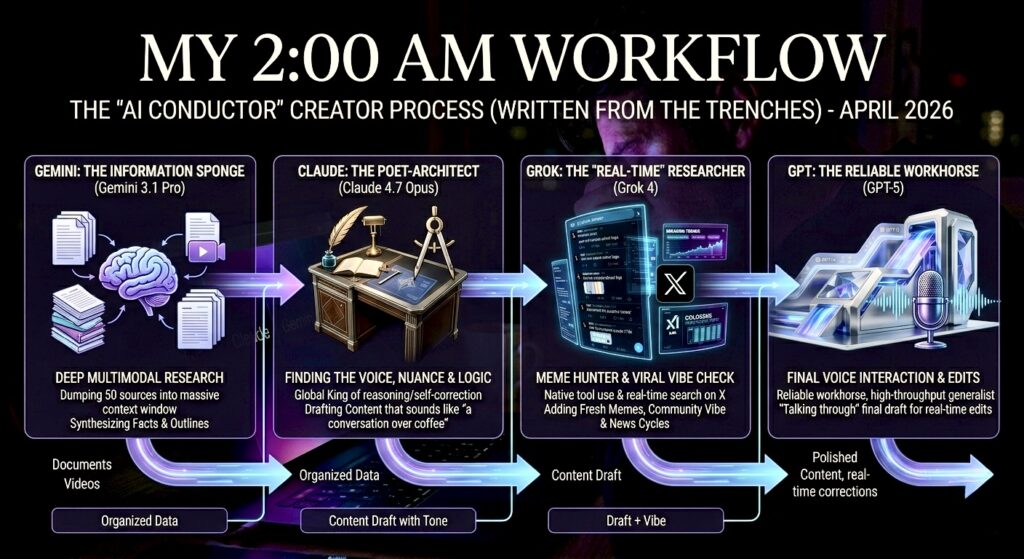
This “multi-homing” is the new reality. We are dependent on these tools, but the lack of clarity on which one is “best” means we end up paying for three different subscriptions just to cover our bases.
The Frustration: Subscription Fatigue and “Markup” Economics
This brings us to the real struggle: Subscription Fatigue. We aren’t just paying for AI anymore; we’re paying for a “menu” of token budgets.
- Individual Users: You’re likely paying $20/month for “Plus” or “Advanced” access. But you’re constantly hit with “rate limits” that bump you down to a “mini” model when the servers get busy.
- The $200 Tier: This is the new “status symbol” for researchers. OpenAI’s Pro and Anthropic’s Max tiers are designed for people who need “unlimited” access to the absolute top-tier reasoning models.
- The “Opt-Out” Privacy Trap: If you’re on a Free or Plus plan, your data is likely being used to train the next model unless you manually dive into the privacy settings to opt out. Only the Business and Enterprise tiers ($25-$30+/user) guarantee privacy by default.
Conclusion: The Future of the “Vibe”
As we move further into 2026, the battle isn’t about benchmarks anymore—it’s about how the AI feels. We’ve reached a point where “science and rigor feel almost insignificant” compared to whether a chatbot is actually helpful and intuitive in our daily lives.
We are no longer struggling with a lack of tools; we are struggling with the noise of perfection. Every model is a “team of Ph.D. level experts”, but sometimes you just need a tool that doesn’t act like an “overworked secretary”.
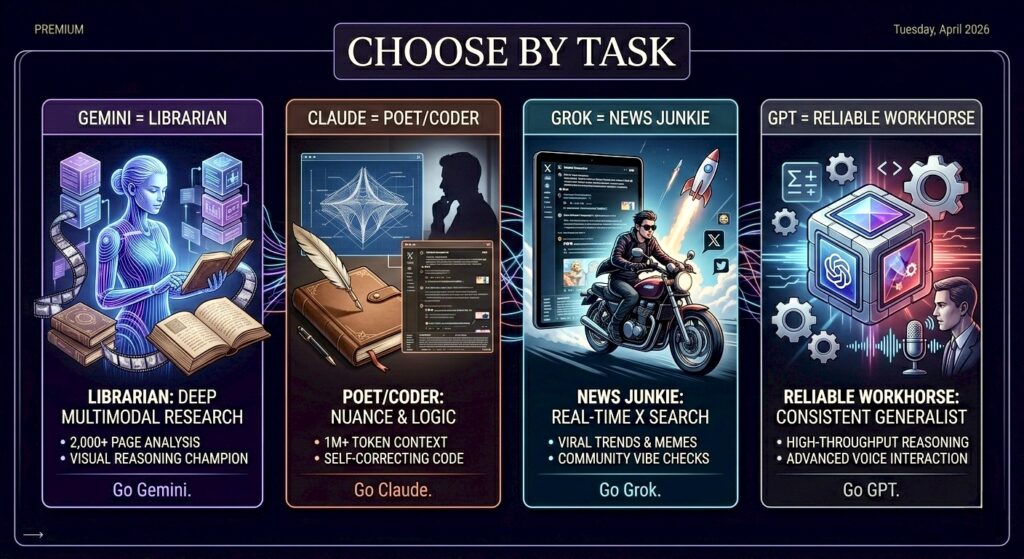
Choose your model based on the task:
- Need a Librarian? Go Gemini.
- Need a Poet/Coder? Go Claude.
- Need a News Junkie? Go Grok.
- Need a Reliable Workhorse? Go GPT.
Just keep an eye on your credit card statement—those $200 “Pro” reasoning modes add up fast.
FAQ: Quick Answers for the Overwhelmed
Q: Is GPT-5 actually better than GPT-4o?
A: Technically, yes. It has better coding and “PhD-level” reasoning. However, users found it “colder” and more concise, leading OpenAI to release “warmth” updates to make it feel more human.
Q: Why would anyone pay $200/month for ChatGPT Pro?
A: It’s for the “o1 Pro” mode. If you’re a data scientist or researcher, this mode uses massive compute to solve high-complexity problems that regular models might hallucinate on.
Q: Which model is best for privacy?
A: If you’re an individual, you must manually opt out of training on ChatGPT and Claude. For guaranteed “no training” data privacy, you generally need to move to ChatGPT Business ($25/user) or Enterprise.
Q: Does Grok really have an advantage with real-time data?
A: Yes. Because it’s trained on the Colossus GPU cluster and has a “live search API” for X and the web, it can analyze social media trends in seconds.
Related Reads
Choosing the right AI is one problem. Knowing how to use it is another:
We Are Entering the “Assign, Don’t Do” Era