Unpacked Daily / Hardware
7,000mAh Phone Batteries Have a Catch Nobody Put on the Box
Chinese phone makers are putting huge batteries into slim phones. The trick is real. So is the engineering problem hiding behind it.
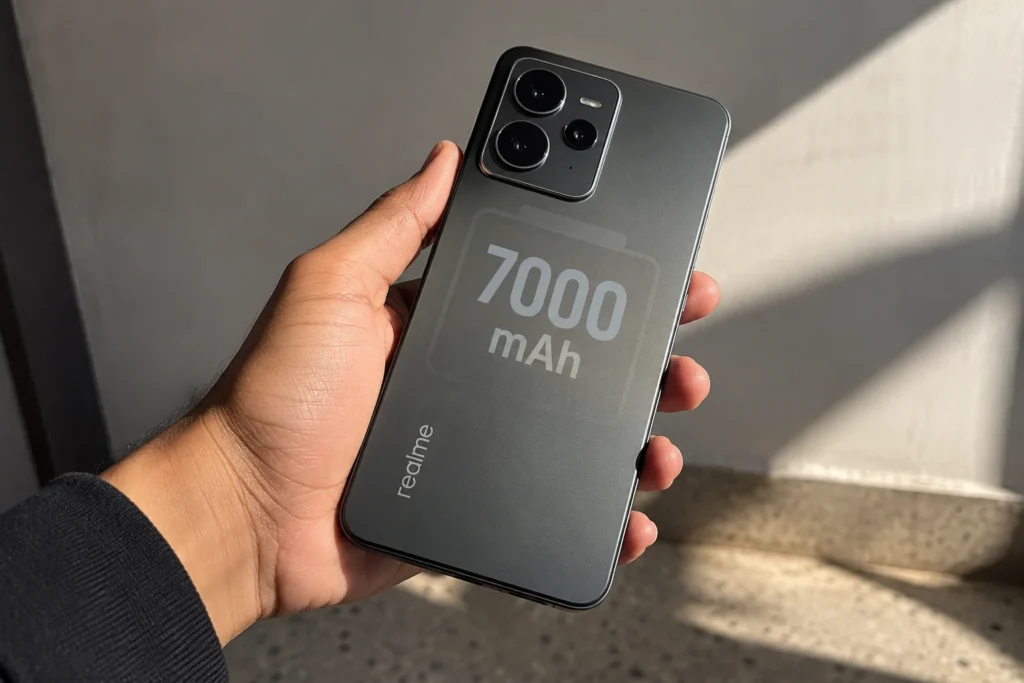
For years, 5,000mAh was the unofficial ceiling for many mainstream flagship phones. Manufacturers wanted longer battery life, but adding capacity usually meant adding thickness and weight. So the industry leaned on more efficient chips, brighter displays that used less power, and software that tried to stretch every last percentage point.
120W wired charging
80W wired charging
100W wired charging
120W wired charging
These are not rugged bricks with oversized bodies. They are premium phones using newer battery designs to store more charge inside a similar amount of space. The change is mostly down to silicon-rich anodes, marketed under names such as silicon-carbon, silicon anode, or a brand-specific label.
That sounds like a straightforward win until you look inside the cell. Silicon can store far more lithium than graphite, but it also expands dramatically as it charges. That puts extra stress on the material and makes long-term stability harder to manage.
We looked at the wider shift toward battery chemistry and thermal design in our earlier piece on the new smartphone hardware race. This time, the question is narrower: what does this battery jump cost, and what can we actually prove about its lifespan?
Product capacities and charging speeds are manufacturer-listed specifications. Real charging power varies with temperature, battery level and usage.
The paperwork
The cycle rating that looked like proof
There is a useful place to look when a phone maker’s battery claims start sounding vague: the European Union’s product energy labels. Under EU Regulation 2023/1669, smartphone batteries are tested for how many charge and discharge cycles they can complete before their remaining capacity reaches 80% of the rated capacity.
In July 2026, Android Authority reported that the Galaxy Z Fold8, Z Fold8 Ultra and Z Flip8 were listed in the 1,200-cycle category. Their predecessors, the Z Fold7 and Z Flip7, had been listed at 2,000 cycles.
At first glance, that looks like a 40% drop. It is a real difference in the declared categories, but it is not proof that silicon-carbon has cut real-world battery life by 40%.
The detail that changes the story is the Galaxy S26 series. Those phones use conventional battery chemistry, yet their listed rating is also 1,200 cycles, according to the same report. The S25 generation had been listed at 2,000. That means chemistry alone cannot explain the difference in Samsung’s published figures.
The EU label also does not promise that a battery will hit 80% capacity exactly on its 1,200th charge. The regulation says the measured result is rounded down to full hundreds and shown as a minimum, such as “≥ 1,200”. The label describes a standardized lab result using the manufacturer’s charging algorithm and the operating system installed for the product model.
Inside the cell
Why silicon stores more power, and why it fights back
A phone battery has two electrodes, an anode and a cathode. A separator keeps them apart, while the electrolyte lets lithium ions move between them. When you charge the phone, lithium ions move into the anode. When you use the phone, they move back toward the cathode and release energy through the circuit. For decades, graphite has been the standard anode material because it can store lithium repeatedly without falling apart too quickly.
Graphite’s limitation is capacity. Its theoretical capacity is about 372 milliamp-hours per gram of active anode material. Silicon is different. A recent technical review of silicon anodes puts pure silicon’s theoretical capacity at roughly 3,579 mAh per gram.
That is almost ten times the capacity per gram of the active anode material. It does not mean a whole phone battery can hold ten times as much energy. The cathode, electrolyte, separator, metal foils and protective packaging still take up space and weight. Even so, adding silicon can let engineers store more energy in a similar footprint.
The catch is mechanical. As silicon absorbs lithium, its volume can increase by roughly 300%, depending on the material and charging conditions. The entire battery does not triple in size. The expansion happens inside the silicon particles, at a scale too small to see but large enough to stress the surrounding structure.
Repeated expansion and contraction creates three connected problems:
The third problem is easy to miss. A thin protective layer called the solid-electrolyte interphase, or SEI, forms on the anode. The layer is necessary, but when silicon expansion keeps cracking it open, new surfaces react and more material gets used up. That can reduce the lithium available for normal charging and discharging and gradually lower capacity.
This is why silicon’s theoretical capacity is not the same thing as a finished battery’s real-world performance. The hard part is not making silicon hold lithium once. It is getting it to do that again and again without losing too much of the cell along the way.
The engineering compromise
Silicon-carbon is a fix for the problem, not an escape from it
Phone makers are not simply swapping graphite for a block of pure silicon. Commercial cells use composite materials and several techniques to keep the anode working as the silicon expands. The exact recipe differs by supplier and manufacturer, and the public specifications rarely reveal the full design.
Some of the tools engineers can use are straightforward in principle, even if they are hard to get right at scale:
There is no single silicon percentage that defines every silicon-carbon phone battery. The labels themselves vary. iQOO calls the iQOO 15 a silicon-anode battery, while OnePlus uses the name Silicon NanoStack. These names tell you the broad direction of the technology, not the complete chemistry inside each cell.
One concrete example is the realme GT 8 Pro, whose official product page advertises 16% silicon content alongside a 7,000mAh battery and 120W charging. That is a manufacturer claim about its own product, not proof that 16% is the universal recipe or the ideal percentage for every phone.
That is the point worth holding onto. Silicon-carbon makes a higher-capacity battery possible in a limited space, but the anode, charging system, internal layout and heat controls have to work together. A better material does not remove the need for careful engineering. It gives engineers a different set of problems to solve.
The daily stress test
Heat matters, but the charger wattage is not the whole story
Silicon-rich anodes have to manage extra mechanical stress. Add heat and the job gets harder. High temperatures speed up unwanted reactions inside lithium-ion cells, including the reactions that grow the SEI layer and consume electrolyte. The same broad warning applies to conventional lithium-ion batteries too. Silicon does not get a monopoly on battery aging.
Now look at the charging numbers advertised on current high-capacity phones:
Those numbers are maximum advertised charging rates, not a constant flow of power into the cell from 0% to 100%. The phone adjusts charging as the battery fills, and it can reduce power when conditions are too hot. The charging protocol, cell design and software all affect how much heat builds up.
India adds a real-world complication. A phone already warmed by direct sun, navigation, mobile data and a long gaming session has less room to shed heat when you plug it in. That does not mean a 7,000mAh phone will fail after three years. It means the phone’s thermal design and charging controls matter just as much as the headline number.
These commercial batteries are too new for broad, independent, multi-year comparisons across phone brands and usage patterns. Without that data, it is not responsible to claim that every silicon-carbon battery hits a sudden degradation cliff after 500 or 1,000 charges, or that every 120W phone will age faster than every slower-charging phone.
The practical advice is not to fear fast charging. It is to avoid stacking unnecessary heat on top of heat. If a phone is already hot from gaming or sitting in the sun, give it time to cool before a fast charge. If slower charging overnight suits your routine, use it. These are sensible habits for any lithium-ion phone, not a special ritual that silicon-carbon demands.
What the numbers mean
A battery can lose 20% and still hold more charge than a smaller new one
Compare a phone with a 7,300mAh battery against one with a 5,000mAh battery. The larger cell starts with 46% more nominal capacity. That is not a small upgrade. If the phones use similar amounts of energy, the larger battery has more room to lose capacity before the difference becomes invisible in daily use.
That maths is useful, but it is not a prediction of screen time. A phone’s display, processor, modem, software and signal strength all affect how quickly it uses energy. Milliamp-hours are also a capacity figure, not a complete measure of energy density or real-world runtime.
It still changes the way to think about battery aging. A larger battery does not have to stay at 100% health to remain useful. If the cell degrades to 80%, a 7,300mAh battery has a nominal 5,840mAh left. A 5,000mAh battery at the same percentage has 4,000mAh left.
That does not cancel out a lower cycle rating, and it does not tell us how quickly either phone will reach 80%. The cycle label, the battery’s starting capacity and the way the phone uses power answer different questions. Treating one number as the whole story is how battery marketing gets away with making complicated things sound simple.
If you replace your phone every two or three years, a larger battery can be a very practical benefit. If you keep it for four or five years, pay more attention to the manufacturer’s battery warranty, local replacement service, charging behaviour and any published endurance testing. There is not enough independent long-term data yet to promise that every current silicon-rich battery will behave the same way.
The market split
Why some brands are pushing capacity while others are more cautious
For brands fighting over Android flagship buyers, a 7,000mAh battery is an easy advantage to explain. You do not need a benchmark chart to understand a phone that lasts longer between charges. If silicon-rich anodes help deliver that capacity without making the phone much thicker, the technology has an immediate benefit that shoppers can feel.
What aggressive adopters gain
OnePlus, OPPO, realme and iQOO are using silicon-rich battery designs to raise capacity while keeping high charging speeds.
- A bigger battery in the same general phone format
- More time between charges for heavy users
- A clear spec-sheet advantage against smaller batteries
What cautious design can protect
Battery capacity is only one part of a phone’s design. The cell must also meet heat, safety, cost, reliability and repair expectations across its intended life.
- More conservative charging or material choices
- More room for validation and thermal control
- Less reliance on an unproven long-term assumption
It is tempting to turn this into a simple story where Chinese brands innovate and Apple or Samsung refuse to move. That is too easy. Samsung has already introduced silicon-carbon anodes in its 2026 Galaxy Z foldables. In its own engineering interview, Samsung says the material is more reactive and that it redesigned the wider battery system to improve stability under high-voltage conditions and manage heat.
At the same time, Samsung’s regular Galaxy S26 phones have not followed the huge 7,000mAh capacity trend. That is a design choice we can observe, but we cannot claim to know the full internal reason. Apple and Samsung sell phones across many markets, product categories and support periods. Capacity, thickness, charging speed, thermal behaviour, sourcing, validation and warranty exposure all compete for the same design budget.
The important detail is that Samsung’s foldables use a 45W charging system, while some Chinese flagships advertise 100W or 120W. That is not a clean laboratory comparison between battery chemistries. The phones differ in size, cell layout and design goals, so charging wattage alone cannot tell us which battery will last longer.
The number on the box is only half the story
A 7,000mAh phone battery is not a gimmick. It is a real improvement, and silicon-rich anodes are a big reason manufacturers can fit that much capacity into a normal phone. The trade-off is that silicon puts more mechanical stress on the cell, so the material, charging system and thermal controls have to be designed around it.
The public evidence does not support a neat claim that these batteries all hit a three-year cliff. The EU cycle labels raise a useful question, but the published ratings for Samsung’s conventional-battery S26 phones and its new foldables show why the difference cannot be blamed on silicon-carbon alone. We need independent, long-term comparisons before anyone can confidently say how today’s phones will age after years of real use.
For buyers, the sensible view is simple. Enjoy the extra capacity, do not treat peak charging wattage as a lifespan score, and do not assume the biggest battery on the shelf is automatically the best engineered one. In battery design, more capacity is a genuine win. Keeping that capacity useful for years is the harder part.
Sources and further reading
Manufacturer specifications, the EU regulation and technical reviews are linked throughout the article. The main references are collected here for readers who want to check the underlying details.
- European Commission Delegated Regulation 2023/1669, including the standardized battery endurance test and cycle-rating rules.
- Android Authority: Samsung’s 2026 foldable cycle ratings, including the comparison with previous foldables and the Galaxy S26 series.
- Technical review: Nanostructured Silicon Anodes for Lithium-Ion Batteries, covering theoretical capacity, expansion and degradation mechanisms.
- Samsung Mobile Press: Engineering behind the latest Galaxy Z series, including Samsung’s comments on silicon-carbon and battery-system design.
- OnePlus 15 official specifications, OPPO Find X9 official specifications, iQOO 15 official specifications and realme GT 8 Pro official specifications.
- Design of Electrodes and Electrolytes for Silicon-Based Anode Lithium-Ion Batteries, a review of material and design approaches to improving silicon-anode stability.