AI DECISION MAKING
AI is already making more decisions around us than most people realise. It decides which post appears in front of you, whether a payment looks suspicious, which route is likely to be faster, and which products are worth showing you.
But there is a problem with saying “AI makes decisions better than humans.” It sounds simple, but it is not really true. AI can be much better at some decisions and surprisingly bad at others.
The difference usually comes down to the kind of decision being made. Give AI a clear target, a large amount of useful data and a problem that repeats again and again, and it can be extremely good at it. Give it a messy situation with missing information, unusual circumstances or a question about what is actually right, and humans still have a very different advantage.
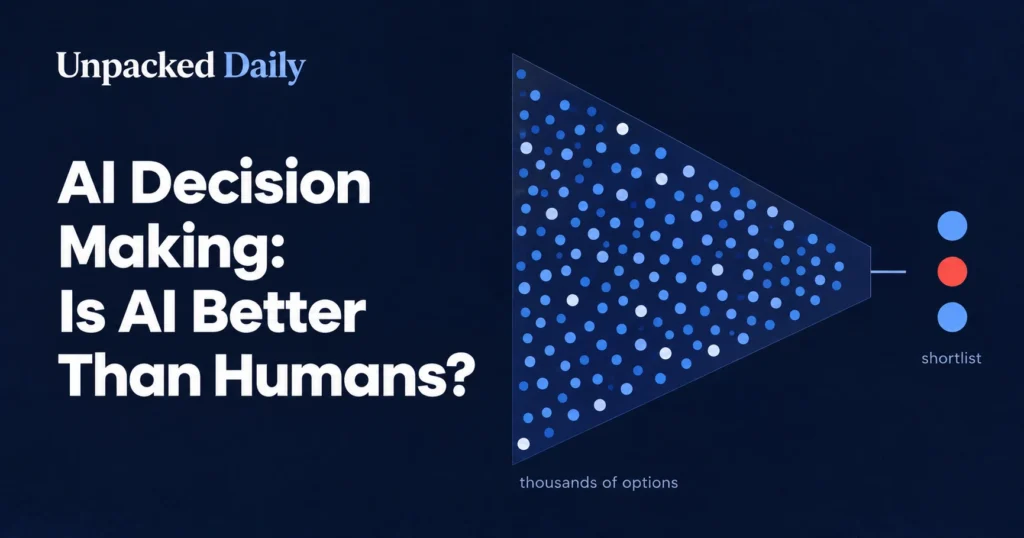
AI is not replacing human judgement everywhere. It is becoming very good at narrowing thousands of possibilities down to a few likely choices. The interesting question is what happens after that.
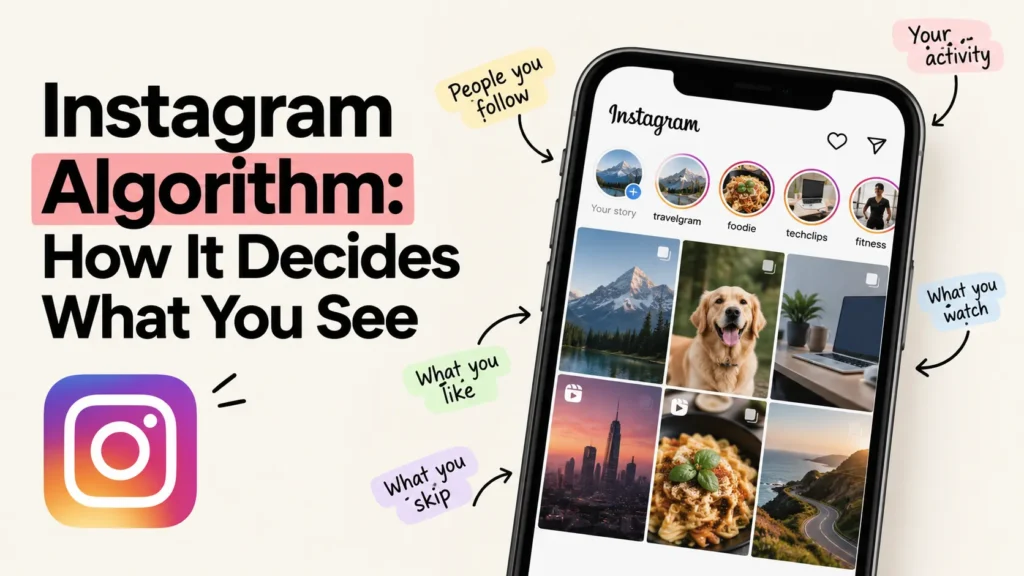
That is also why your feed can feel strangely personal. We recently looked at how Instagram decides what you see. This is the same basic idea in a different form: the system studies signals, predicts what is likely to matter to you, and puts some choices in front of others.
AI decision making is mostly a prediction loop
AI does not sit there thinking about a problem the way a person does. In most everyday systems, it is doing something much more specific: looking at information, estimating what is likely to happen, and choosing the option that best fits its goal.
Look at information about the situation.
Find patterns in similar situations.
Estimate which outcome is most likely.
Put the highest-scoring option first.
Imagine a bank checking a card payment. The system is not asking, “Do I like this purchase?” It is asking a narrower question: “How much does this payment look like the kind of payment that turns out to be fraud?”
That distinction matters. AI can be excellent when the question is clearly defined. It becomes much less reliable when the real question is unclear.
Suppose there are 50,000 possible products you could buy. An AI system may reduce that huge list to 20 products you are likely to click. You still made the final choice, but the system made the first and much bigger decision: what you got to choose from.

AI wins when the problem is narrow, repetitive and data-heavy
This is where the original claim has some truth. Humans are flexible, but we are not built to examine millions of pieces of information every second. A computer is.
Speed
Fraud systems can inspect a transaction almost instantly. Mastercard says some of its transaction models make decisions in around 10 milliseconds on-premise and roughly 100–120 milliseconds in the cloud.
Scale
A person may be able to compare ten or twenty things carefully. A computer can compare thousands of possibilities without getting tired halfway through.
Pattern spotting
AI can look through huge collections of past examples and find small patterns that are easy to miss when a human is looking at one case at a time.
Medical diagnosis gives us a useful reality check. AI can be impressive in narrow image-based tasks, but the broader claim that AI doctors are simply better than human doctors does not hold up. A 2025 review of 83 studies found that generative AI did not outperform physicians overall and performed worse than expert physicians.
That is the important part. Being very good at one kind of decision does not automatically make a system good at all decisions.
AI often makes the first decision, not the final one
This is probably the easiest way to understand AI decision making in daily life. You open an app thinking you are choosing something, but the system has already removed most of the options before you arrive.
Instagram is a good example. Meta said in 2025 that Instagram had scaled its recommendation system to more than 1,000 models. These systems rank posts, notifications and other content based on predictions about what is likely to matter to a person.
So when a Reel appears near the top of your feed, the important decision was already made before your thumb reached it. You are still deciding whether to watch it, but you did not decide that it should be shown to you first.
This is also why understanding how web tracking works matters. The more information a system has about what you do, the more it can personalise the shortlist.
AI becomes weaker when the decision itself is unclear
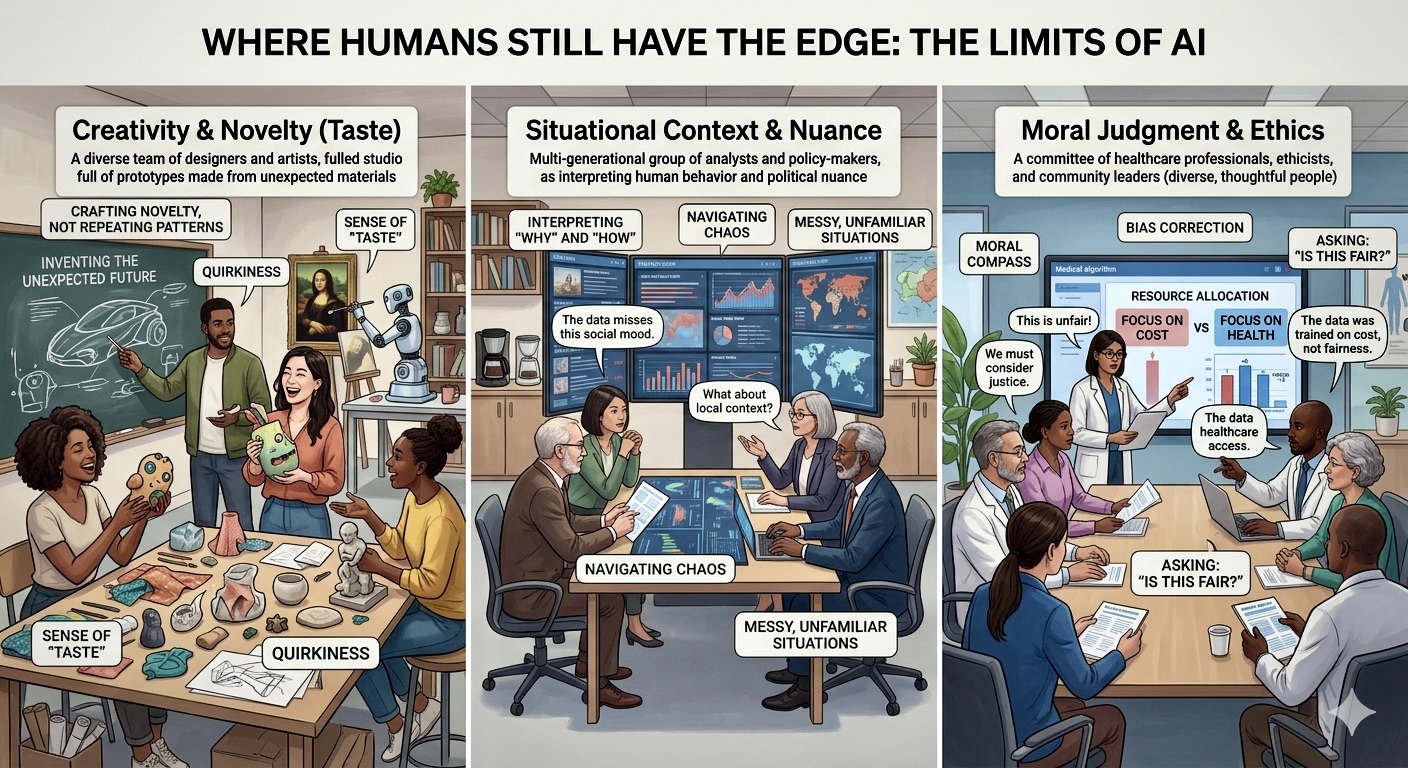
The biggest weakness of AI is not that it cannot process enough information. It is that information does not always tell you what the right answer should be.
If the information going in is wrong or incomplete, the result can be wrong too.
A system can follow its target perfectly while still solving the wrong problem.
A situation unlike its previous examples can leave the system with little to rely on.
Some decisions are not about prediction. They are about what should happen.
Consider a simple example. An AI may be very good at predicting which applicant looks most likely to repay a loan based on past records. But that does not answer the bigger question of whether the way those records were collected was fair.
This is why bias is such a serious problem. NIST warns that bias can enter AI systems through data, people, organisations and the way the system is used. The computer can make the final decision extremely quickly while carrying forward a problem that existed long before the AI saw it.
The real problem starts when we stop checking the choice
AI does not need to completely replace human decision making to change it. It only needs to become the first answer we see.
“This is probably the best option.”
“Looks right to me.”
The suggestion quietly becomes the decision.
This is where the conversation changes from “Is AI smarter?” to “How much control are we willing to give it?”
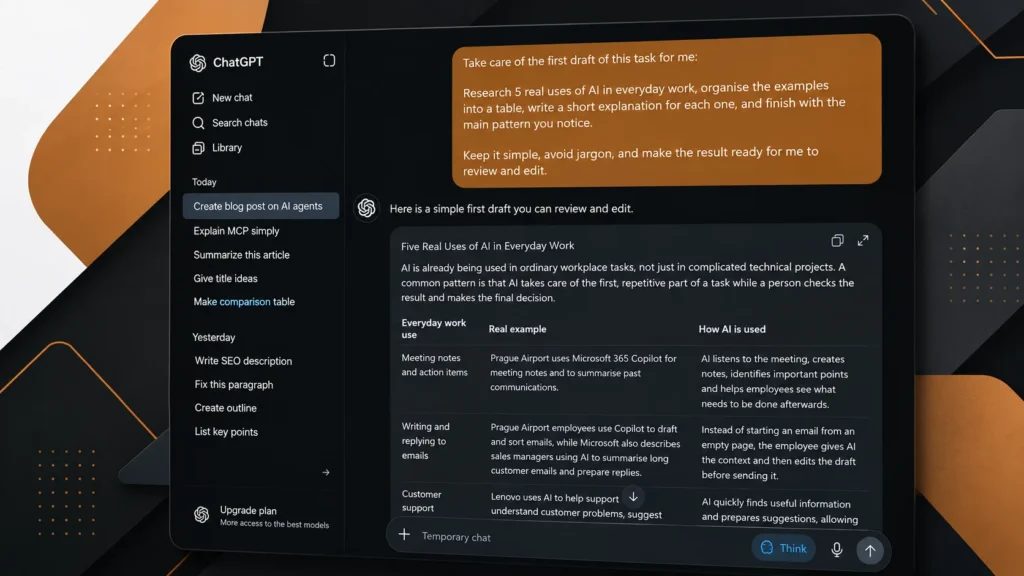
We are already moving in that direction at work. Instead of doing every task ourselves, people increasingly give AI systems parts of the job and review what comes back. We explored this shift in “Assign, Don’t Do.”
That model makes sense when the human still understands the job well enough to notice when something looks wrong. It becomes dangerous when the person simply trusts the system because the system is faster.
The best setup is usually AI first, human when it matters
The answer is not to stop using AI. That would miss the point. The useful thing is to give AI the parts of decision making it is genuinely good at and keep humans involved where judgement, context and responsibility matter.
Large amounts of information, repeated checks, fast comparisons and pattern spotting.
Important choices, unusual situations, unclear goals and decisions that affect people directly.
A good example is medical work. Research published in 2026 found that combining large language models with healthcare professionals can improve some measures of diagnostic performance, although the results still vary and the evidence has important limits.
That is probably a better picture of the future than “AI replaces humans.” The useful system is often not AI versus human. It is AI doing the heavy checking while a human decides whether the answer actually makes sense.
AI is very good at reducing a huge problem to a manageable choice. Humans are still better at asking whether that choice is the one we should make.
Sources & fact check