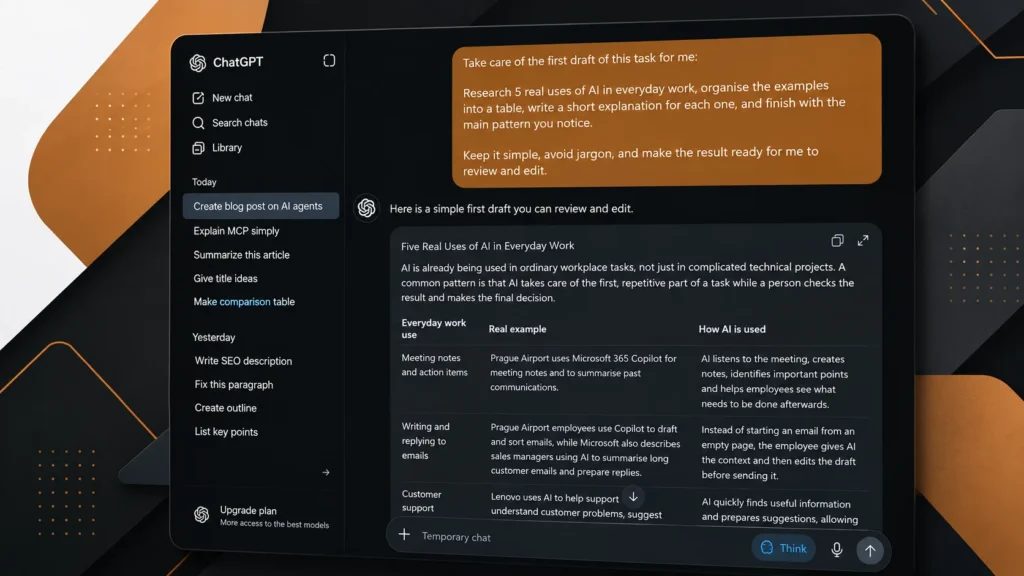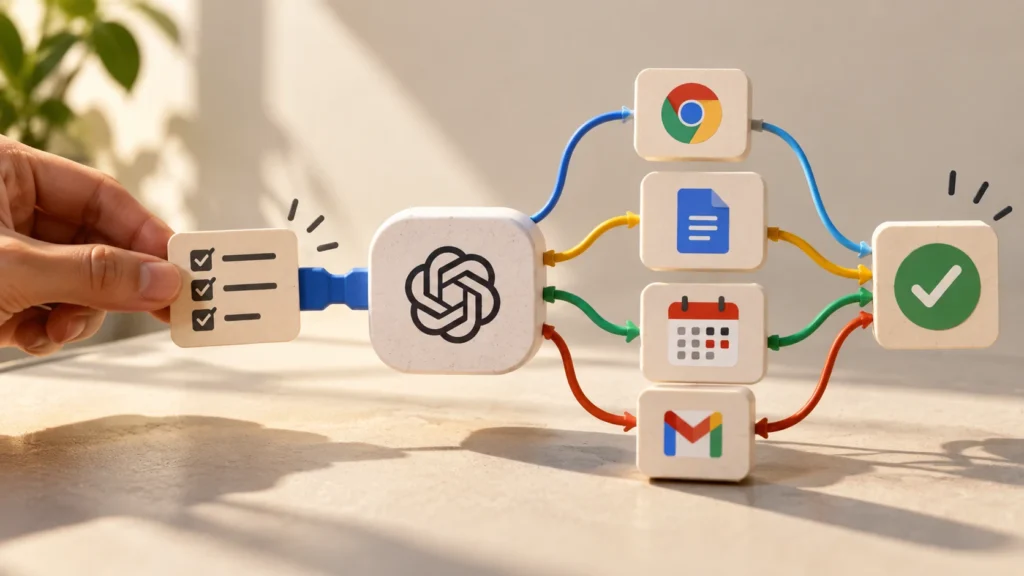
For years, using AI meant asking a question and getting a reply. You still had to open the next app, move the information around, click the buttons and finish the job yourself. AI agents change that part. They can take a goal, work through several steps, use the tools they have access to and keep going until the task is done or they need you to step in.
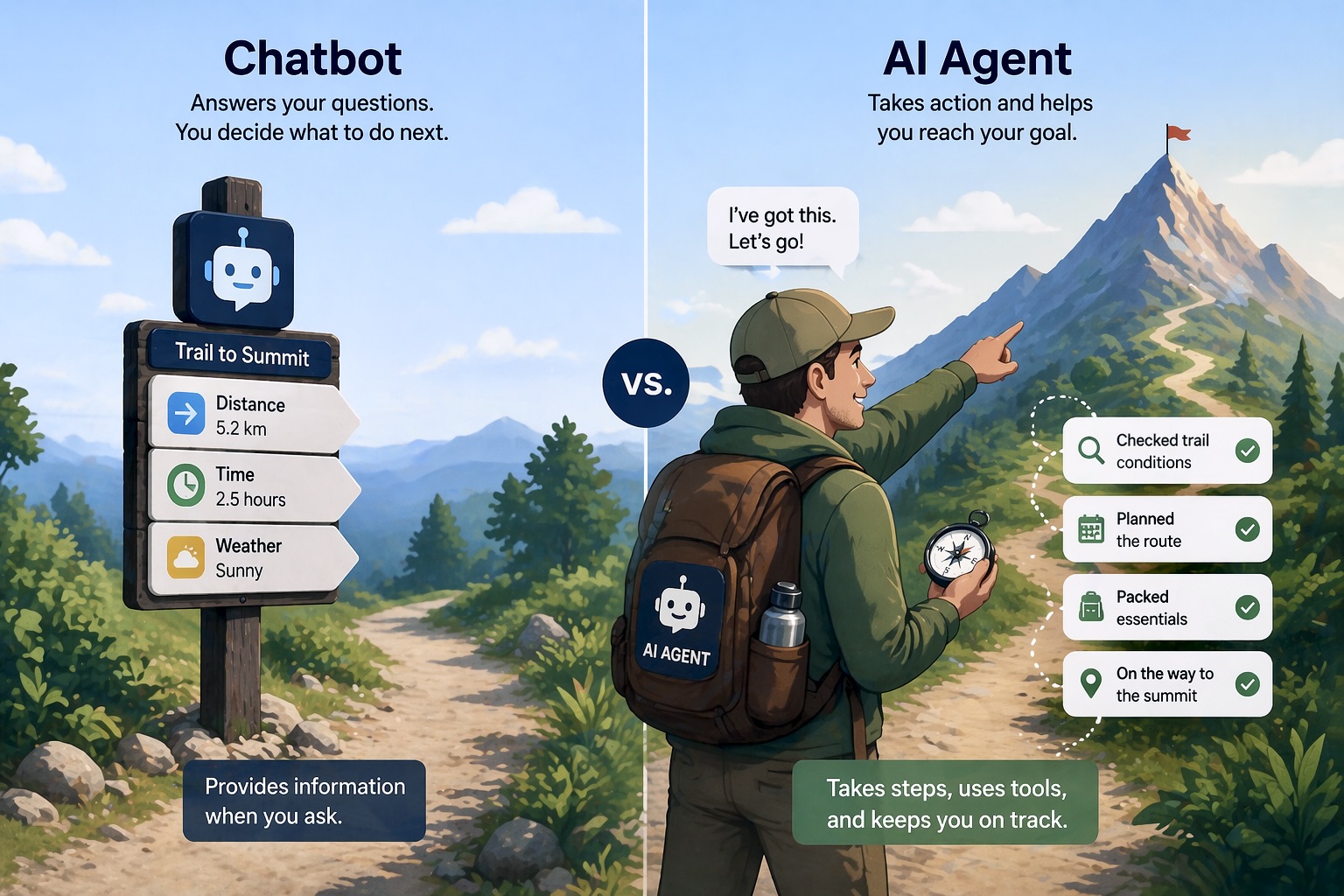
It gives you the information, instructions or draft. You take it from there.
It can use connected tools, carry out actions and check what happened along the way.
AI agents are different because the answer is not always the end of the task. They can plan a job, use tools, check the result and decide what to do next.
- Chatbot: gives you the answer.
- Agent: works toward the result.
- Tools: connect it to files, websites, code and other software.
- Limit: more freedom also means more chances to make a bad decision.
How AI agents actually work
An AI agent does not need to be told every little move. You give it a goal, and it works out the smaller jobs needed to get there. It can then use its tools, look at the result and decide what should happen next.
The last two steps are what make the process interesting. A basic automation follows a fixed path. An agent can react to what it finds along the way. That gives it more freedom, but it also gives it more ways to make a mistake.
Goal first. Action next. Then check what came back. The agent uses that new information to decide whether to continue, change direction or stop.
The system is not just generating another reply. It is using the result of one step to decide what to do next.
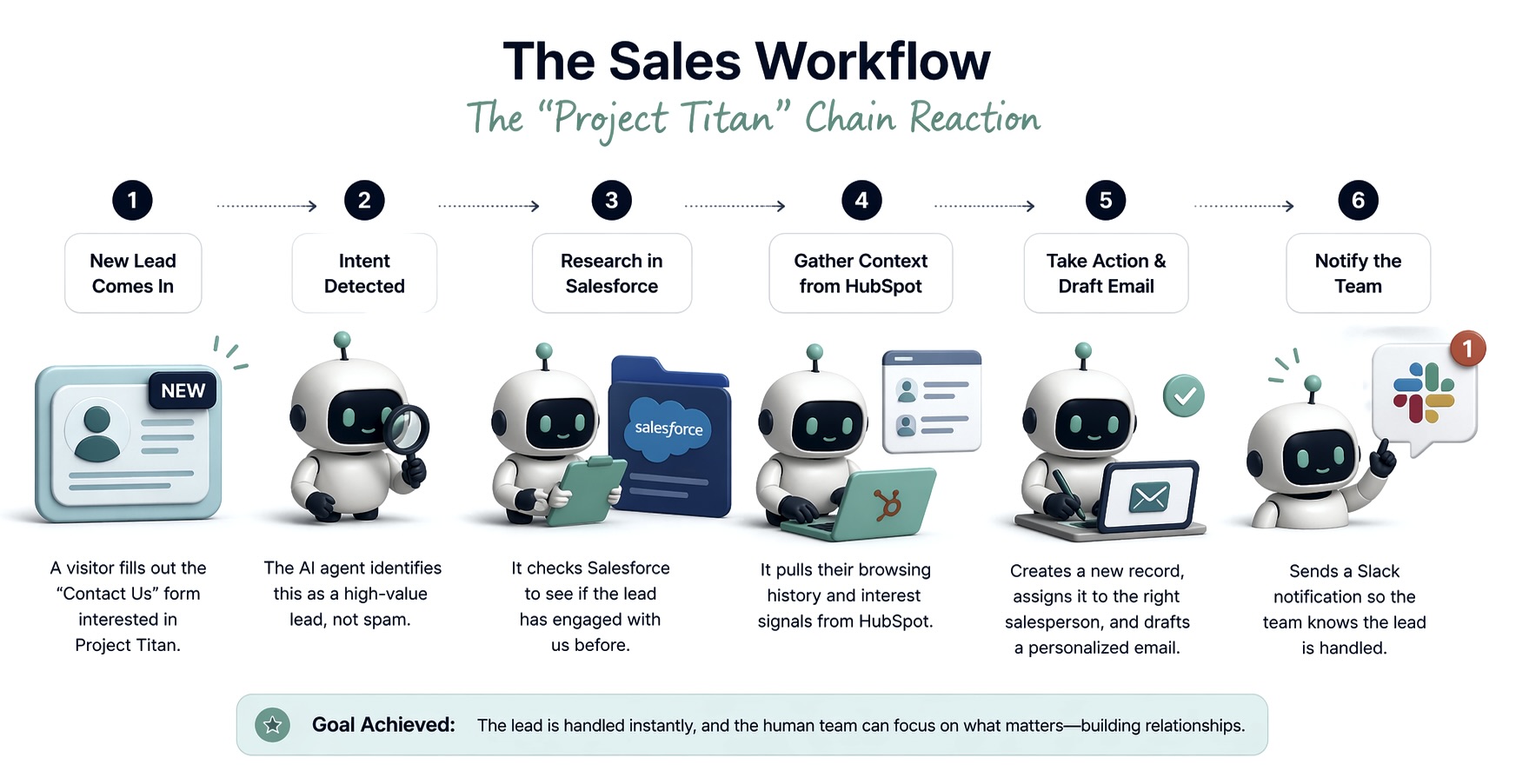
One instruction can become a whole workflow
This is where the difference becomes easier to see. You do not have to spell out every move. You give the system the job, and it works through the smaller pieces needed to finish it.
It checks what the person is asking for and whether the message looks like a genuine lead.
It checks the available customer records for earlier conversations, activity or other useful details.
It gathers the relevant information and works out who should take over the lead.
It creates the record, assigns the lead and prepares the follow-up message.
It updates the team so the next person knows what happened and what still needs attention.
The interesting part: you gave it one outcome. The system handled the smaller jobs in between.
Chatbot vs AI agent: what is actually different?
They can look almost identical on the screen. Both can have a chat box, both can answer questions and both can sound surprisingly capable. The difference shows up when you ask what happens after the answer.
| What you ask | Chatbot | AI agent |
|---|---|---|
| “How do I do this?” | Explains the steps. | Can explain the steps and may carry them out with the right tools. |
| “Find this information.” | Returns an answer. | Can search, gather information and use the result in the next step. |
| “Update this record.” | Usually tells you how. | Can make the change when it has access to the relevant system. |
| “Something went wrong.” | Waits for another message. | Can inspect the result and try a different step. |
| “Finish this task.” | Often needs several prompts. | Can work through a sequence of actions toward the result. |
The simple difference: a chatbot mainly gives you information. An AI agent can use information to decide what should happen next.
What sits inside an AI agent?
You do not need to understand the code behind one to understand the basic setup. An AI agent is a few different pieces working together. Each part has a different job.
The AI model reads the request, understands the situation and decides what should happen next.
Job: understand and decideA larger task gets broken into smaller actions so the system has a path to follow.
Job: break the work downThese let the system reach outside the conversation and work with files, websites, code or other software.
Job: do things outside the chatIt keeps useful information from the current task and, where supported, information from earlier work.
Job: remember what mattersTake one piece away and the whole thing becomes less useful. A model without tools can explain what to do but cannot reach many outside systems. Tools without a way to choose between them are not much help either.
Where AI agents actually make sense
AI agents are not automatically useful just because they can do more things. They make the most sense when a task has several connected steps and someone normally has to keep moving information from one place to another.
The sweet spot is boring work. Repetitive digital jobs, routine checks and tasks that jump between different tools are much easier to hand over than work that needs constant human judgement.
Read the customer’s problem, check their account, find the relevant information and handle the next step instead of sending another generic help page.
An agent can capture a meeting, pull out the action items, prepare a summary and help move those tasks into the next stage of the workflow.
New leads can be checked against existing records, given some context, assigned to the right person and prepared for follow-up.
Take information from an email or file, place it into another system, check that it arrived correctly and continue with the next step.
Scheduling interviews, organising information and helping move routine employee requests through the right process.
Systems can watch for unusual activity, gather the relevant details and trigger the next response when something looks wrong.
The task follows a clear goal, uses several digital steps and has a result that can be checked.
The task depends heavily on personal judgement, unclear situations or decisions where getting it wrong carries serious consequences.
Where AI agents still fall apart
The fact that an AI agent can keep working does not mean it always knows what it is doing. The extra freedom that makes these systems useful also gives them more ways to go wrong.
If the instruction leaves too much open to interpretation, the agent can start making decisions you never intended it to make.
A website gets redesigned, a button moves, a file format changes or a connected service stops behaving the way the system expects.
Everything may be working correctly, but the agent can still choose a poor action because it misunderstood the situation.
A failed step does not always mean the system knows it should stop. It can get stuck repeating the same kind of action.
That last problem is easy to underestimate. When a person makes a mistake inside a workflow, they normally notice something looks wrong and stop. An autonomous system needs its own way of recognising that it has gone off track.
More autonomy needs more control. The bigger the consequence of a bad action, the more sensible it is to keep approvals, limits or a human check around that step.
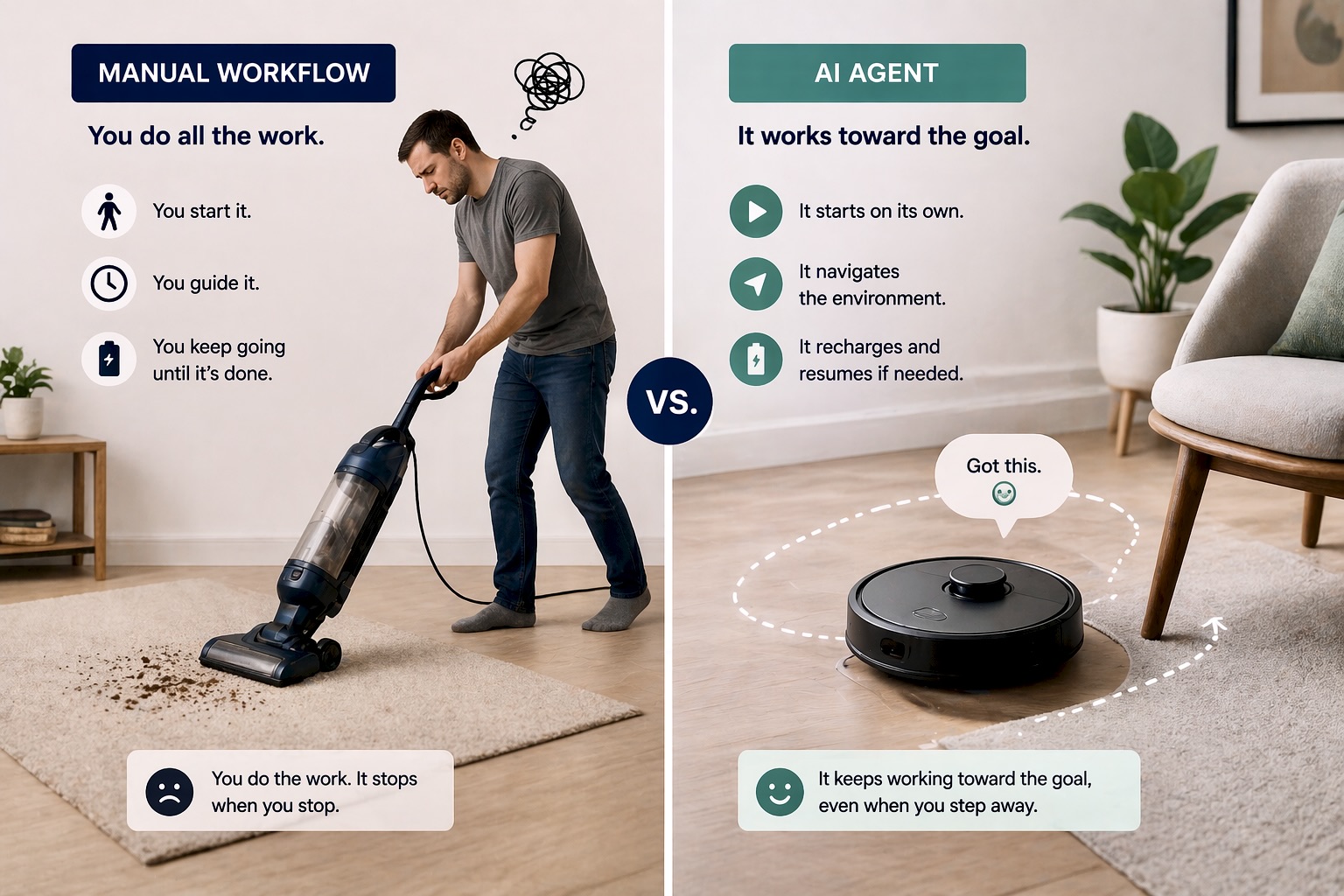
The Roomba analogy makes the idea simple
Think about a normal vacuum cleaner. It can be powerful, but someone has to push it around, decide where it should go and stop when the job is done.
It does the work, but you control every movement.
- You decide where to go.
- You decide when to turn.
- You decide when to stop.
- The tool waits for your next move.
You give it the goal and it handles the smaller decisions.
- It moves through the room on its own.
- It notices things blocking its path.
- It changes direction when needed.
- It keeps going toward the goal.
AI agents work on the same basic idea, except the “room” is software. The agent has a goal, access to certain tools and enough information to decide what to do next. It does not need a person telling it which button to press at every stage.
That is the whole idea: you set the destination. The system works out more of the journey.
What AI agents actually change
The big change is not that AI can write an email, find information or answer a difficult question. It could already do those things.
The change is what happens after that.
An AI agent can take the result of one step and use it to decide what should happen next. It can move through software, use connected tools, check what came back and keep working without needing a new instruction after every small action.
That does not mean these systems can be trusted with everything. They can still misunderstand a request, choose the wrong action or get stuck. The useful part is knowing where that extra freedom helps and where it needs a human watching it.
That is probably the simplest way to look at the whole shift. AI is moving from something you ask to something you can hand a task to.