For seven generations, Samsung pulled off one of the strangest tricks in consumer tech: they convinced people to pay Rs 1.6 lakh for a phone that felt like a Tata Sky remote when folded shut.
If you ever used an older Galaxy Fold from the original disaster with the peeling plastic screen all the way up to recent iterations you know the pain. The cover screen was comical. It was tall, narrow, and so pinched that answering a simple WhatsApp message on the move was an exercise in frustration. Your thumbs were constantly colliding. The keyboard letters were squished together like passengers inside a Rajiv Chowk metro coach at 6 PM. Every time you wanted to type more than three words, you were basically forced to stop walking, pull out your second hand, and unfold the whole contraption.
Meanwhile, Chinese competitors looked at this and asked the obvious question: Why does a folding phone need to look like an awkward sandwich when closed?
When the OnePlus Open and Vivo X Fold came out, they didn’t reinvent the wheel. They simply gave the front screen the proportions of a standard smartphone. You could use it like a normal phone all day, and only unfold it when you actually needed extra room. Suddenly, Samsung looked painfully stubborn and out of touch.
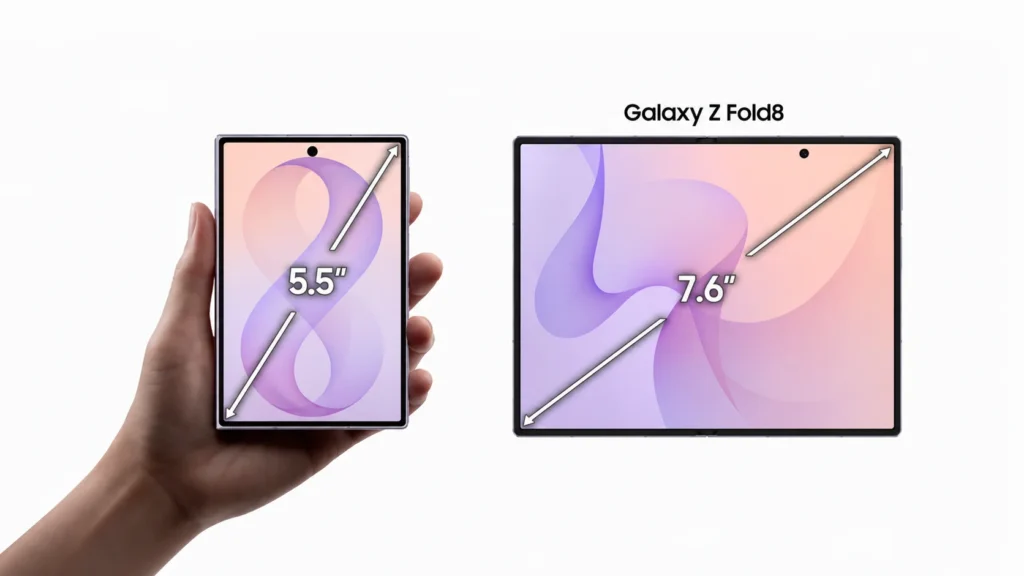
Now, with the Galaxy Fold 8, Samsung has finally thrown in the towel. They scrapped the tall, narrow stick and shifted to a shorter, broader, passport-style form factor. The cover screen sits around a standard 16:10, and the inner unfolding screen lands right on a 4:3 aspect ratio.
It fixes the biggest daily headache of owning a Fold. But it also fundamentally changes what kind of device this is, who it is actually for, and what trade-offs you are forced to swallow.
Why Samsung Resisted for Eight Long Years
To understand why this shift matters, you have to understand why Samsung held on to the old design for so long. It wasn’t just corporate arrogance; it was a mechanical compromise.
When you fold an inner screen in half, the folded device gets twice as thick. In the early days, foldables were thick bricks. Samsung’s logic was simple: if the phone is going to be thick, it has to be narrow so your hand can wrap around it. If they had made the original Fold as wide as a normal phone while it was 16mm thick, it would have felt like holding a real brick from a construction site.
The second reason was hinge engineering. Folding a tall screen vertically puts less physical stress on the hinge and the folding glass than folding a wider panel. So Samsung stayed in their comfort zone. They refined the hinge, trimmed half a millimeter of thickness every year, and told customers that a skinny outer screen was a “feature” designed for quick one-handed glances.
Nobody bought that excuse. In the real world, people don’t use their phones for “quick glances.” We live on our phones. We book cabs, scan QR codes, reply to work threads, check stock prices, and type out essays on WhatsApp. Doing that on a screen as narrow as a tape measure made people hate using the Fold when closed.
It took losing market share in Asia and watching OnePlus eat their lunch in premium enthusiast circles for Samsung to finally rebuild the chassis from scratch.
What the Passport Ratio Fixes in Daily Use
The Fold 8’s new dimensions, especially that 4:3 inner screen, sound like dry spec-sheet numbers, but they completely change how the phone behaves in your hand.
First, your typing accuracy goes back to normal. The outer screen no longer feels like a cramped secondary display; it feels like an actual phone. You can fire off a quick UPI payment at a kirana counter, reply to an email while holding an umbrella, or scroll a feed without feeling claustrophobic.
Second, the inner screen finally makes sense for split-screen multitasking. The older, near-square inner displays had an annoying flaw: when you split them vertically to run two apps side by side, both apps ended up tall and skin-tight. It was like looking at two cramped mobile sites next to each other.
A 4:3 aspect ratio changes the geometry. 4:3 is the classic iPad ratio. When you divide a 4:3 screen down the middle, each half has enough horizontal width to display full mobile interfaces without breaking line wraps or crushing text. You can run Zerodha or Groww on the left side to watch a chart and keep your WhatsApp group open on the right, and neither app looks distorted. You can open Google Sheets next to your email and actually read the cells without zooming in and out every three seconds.
Reading is also vastly superior. PDFs, books, and long-form web pages don’t stretch into awkward wide lines where your eyes get tired tracking from left to right. It handles text like a mini notebook.
The Dirty Secret: The Black Bar Tax on Videos
Every tech reviewer will tell you that a wider screen is a massive win across the board. That is marketing talk. There is a glaring compromise here that nobody likes to admit until they sit down on a flight to watch a movie.
That compromise is video.
Almost all modern video, from YouTube reviews to Netflix web series, is shot in 16:9 widescreen or 21:9 cinematic aspect ratios. A 4:3 screen is closer to an old CRT box television than a modern TV.
When you open a 16:9 video on a 4:3 folding screen, the video cannot fill the canvas. You get massive, thick black bars across the top and bottom. If you watch a widescreen movie, half the screen is just dead black OLED space.
Here is the bitter pill: if you measure the actual diagonal viewable area of a 16:9 video on this new folding screen, it is barely any larger than the video you get on a standard Galaxy S26 Ultra or an iPhone Pro Max. You are carrying a device that costs almost double the price, weighs significantly more, and folds in half, yet you aren’t actually seeing a bigger video picture unless you pinch-to-zoom and crop out a third of the movie frame.
If your primary fantasy of buying a Fold is binge-watching shows in bed or watching cricket matches while commuting, this new ratio does not help you. In fact, it makes the letterboxing worse than before.
Ergonomics and the Pocket Test of Galaxy Fold
There is also the physical reality of carrying it. Making the phone shorter and wider solves the typing problem, but it creates a pocket problem.
The old remote-control Fold slipped easily into narrow jeans pockets because it was slim sideways. The Fold 8, built like a passport, is broad. Even though Samsung made it significantly thinner, the width means it presses against your thigh when you sit down. In loose trousers or a jacket pocket, it’s fine. In regular denim, you know exactly which pocket it’s sitting in at all times.
Then there is the one-handed grip. Because the phone is wider, reaching your thumb across the screen to hit a back button on the opposite corner isn’t effortless anymore. You trade easy one-handed holding for a functional keyboard. Most people will take that trade, but it is a trade nonetheless.
The Indian Reality: Rs 1.6 Lakh and the Fear Factor
Let’s look at the financial reality of this device in India, where spending Rs 1.5 to Rs 2 lakh on a smartphone comes with very specific mental baggage.
When someone in India drops that kind of money on an iPhone Pro Max, they know two things for sure: everyone recognizes it instantly, and five years down the road, it will still have solid resale value on the used market.
Foldables don’t have that luxury. The moment you walk out of the store, the depreciation hits like a truck. And in the back of every buyer’s mind is the nightmare of the inner screen crease and out-of-warranty screen replacement costs. If an iPhone screen cracks, local repair shops can fix it for a reasonable sum. If a folding panel gives out after two years, the official repair bill from Samsung can easily run Rs 40,000 to Rs 50,000, the price of an entire mid-range phone.
The new passport ratio makes the Fold 8 a far more sensible piece of hardware, but it doesn’t change the delicate nature of folding Ultra Thin Glass. You still have to baby it. You still have to worry about dust, sand at the beach, or fingernails pressing too hard into the soft display.
The Verdict
Samsung’s switch to a 4:3 passport shape on the Fold 8 isn’t an act of visionary innovation. It is an admission that their original design philosophy was flawed, and that Chinese competitors were right all along.
By finally killing the TV remote shape, Samsung has stopped pretending this is an entertainment device. They are no longer selling “a phone that turns into a small cinema.”
Instead, the Fold 8 is positioned as what it should have been from day one: a serious, pocketable work tool. It’s for founders, traders, consultants, and power users who spend hours juggling communication, reading documents, and running split-screen apps. For those people, the wider cover screen and the 4:3 canvas are worth every single rupee.
For everyone else who just wants a luxury phone to scroll Instagram, watch videos, and click great photos without worrying about hinges and screen creases, a traditional flat flagship remains the smarter buy. Samsung fixed their design, but the foldable reality hasn’t changed.