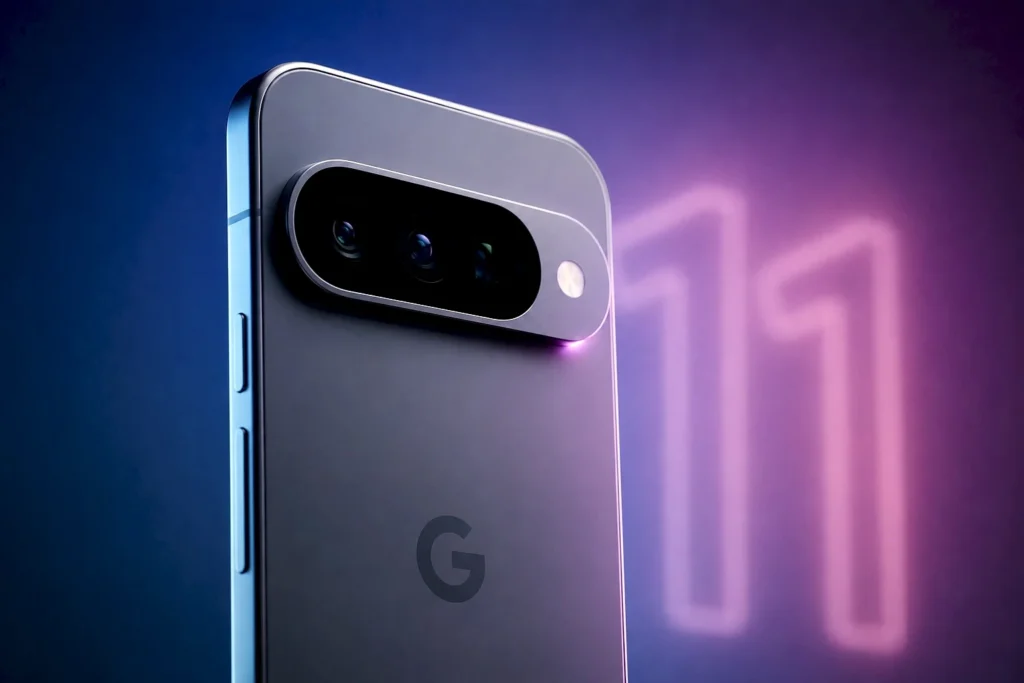
Google is getting ready to launch the Pixel 11 series on August 12, and this time the company is putting even more focus on its own hardware, Gemini and the camera experience. The lineup is expected to include the Pixel 11, Pixel 11 Pro, Pixel 11 Pro XL and Pixel 11 Pro Fold. Here is what we know so far, what could make the new Pixel different from the iPhone and Samsung phones, and where Google still has something to prove.
Google is not trying to hide what it is doing with the Pixel 11.
The company has already started teasing the new phone ahead of its August 12 Made by Google event, and the message is pretty clear. Google wants the Pixel to be more than another Android phone. It wants its own chip, its own software, Gemini and its camera technology to work together in one package.
That makes the Pixel 11 interesting, especially because the competition is getting stronger.
The iPhone has Apple’s own chips, cameras and software working together. Samsung has some of the best Android hardware available, along with its own software and Galaxy features. Google has a different advantage. It controls Android, Search, Photos, Gemini and the Pixel hardware.
The Pixel 11 is basically Google’s chance to put all of that in one place.
📱 Four Pixel 11 Phones Are Expected
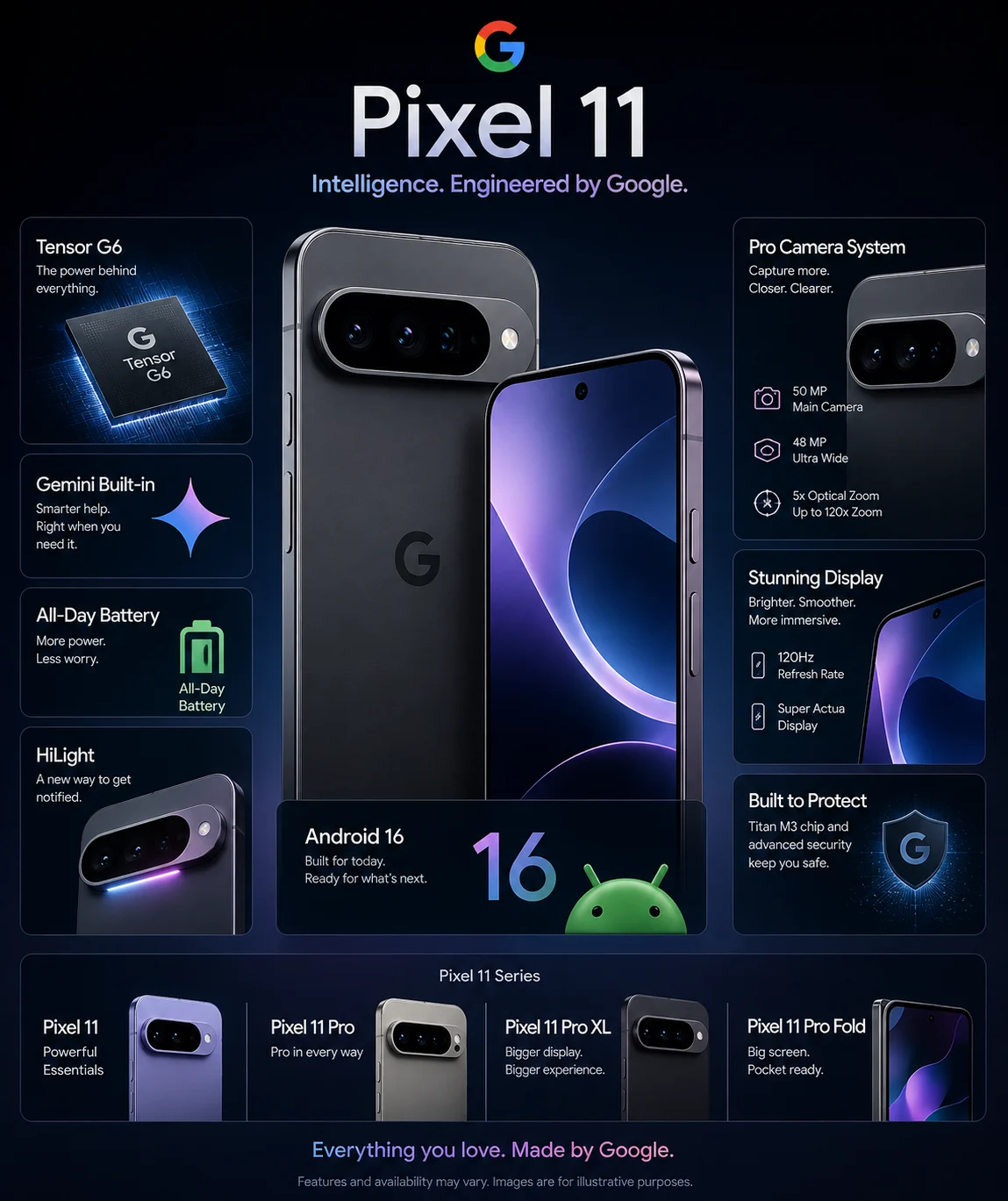
Google has not revealed every detail yet, but the Pixel 11 family is expected to follow the same structure we have seen recently.
There should be a regular Pixel 11, a smaller Pixel 11 Pro, a larger Pixel 11 Pro XL and the Pixel 11 Pro Fold.
The Fold is already part of Google’s teaser campaign, while the other models have appeared through leaks and reports. Google itself has confirmed the Pixel 11 series and the August 12 event, but many of the specifications circulating online are still unconfirmed.
That distinction is important because some of the leaked specifications have changed several times.
So instead of treating every leaked number as final, it is better to look at what Google appears to be changing with the new generation.
⚡ Tensor G6 Could Be the Biggest Upgrade
The biggest change inside the Pixel 11 is expected to be Google’s new Tensor G6 chip.
Tensor has always been a little different from Apple’s A series or Qualcomm’s Snapdragon chips. Google does not need Tensor to win every benchmark. The bigger reason for making its own chip is control.
Google can design the hardware around the things it wants the Pixel to do, especially camera processing, on device features, security and Gemini.
Reports suggest Tensor G6 could be made using a newer 2 nm process and could bring improvements to efficiency and CPU performance. A MediaTek M90 modem and Google’s Titan M3 security chip have also been reported. These details are still based on leaks and should be confirmed at the launch.
This could be more important than a simple benchmark improvement.
If the Tensor G6 can give the Pixel better battery life, less heat and faster everyday performance while handling Google’s software features, that would solve a much bigger problem than simply adding another few points to a benchmark score.
Gaming is still the area I would watch closely.
The Pixel has never been the obvious choice for someone buying a phone mainly for heavy gaming, so if Tensor G6 finally closes some of that gap with Snapdragon and Apple chips, it could change how people look at the Pixel.
📸 The Camera Is Still Google’s Strongest Argument
Google does not need to put the biggest camera sensor on the phone to make Pixel photos look good.
That has been one of the main reasons people buy Pixels for years. Google does a lot of the work through software after you press the shutter.
The Pixel 11 Pro and Pro XL are expected to keep a three camera setup, with a main camera, an ultra wide camera and a periscope telephoto camera. Leaks have also pointed towards up to 120x zoom on the Pro models, although the exact camera hardware and what Google calls that zoom system will need to be confirmed.
This is where the Pixel has a genuine fight with the iPhone.
The iPhone remains extremely strong for video and gives very consistent results across different situations. Samsung has also built a reputation around zoom and camera hardware.
Google’s strength is different.
You take the photo and let the phone do the complicated part.
That approach is one reason Pixel cameras can compete with much more expensive camera hardware.
✨ And Then There Is That New Light
If you have seen the recent Pixel 11 teasers, you may have noticed something unusual around the camera bar.
There is a light.
Leaks have referred to it as HiLight or Pixel Glow, and reports suggest it could act as a notification light, including alerts for calls or messages from selected contacts.
It is a small feature, but I actually like the idea.
Phones have become very good at putting information on the screen. Sometimes you do not need another notification on the display. A small light on the back could tell you that something needs attention without making you pick up the phone.
Whether it becomes genuinely useful or simply becomes another feature people show their friends for five minutes is something we will only know after using it.
🤖 Gemini Is Where Google Has the Biggest Advantage
This is probably the part Google will talk about the most. AI
Gemini is already built into the current Pixel experience, and Google has been moving it beyond a simple question and answer tool.
Recent Pixel updates have added features such as Magic Cue, which can surface useful information based on what is happening in conversations, along with more ways for Gemini to work with Google’s apps.
The Pixel 11 is expected to take this further.
Apple has Siri and Apple Intelligence. Samsung has Galaxy AI. Google has Gemini, Android, Search, Maps, Photos, Gmail and the Pixel itself.
That gives Google a lot of services that can work together.
If you are talking about a restaurant in a message, searching for a place, editing a photo or asking about something on your screen, Google has plenty of information and apps that can potentially work together.
The important word is potentially.
The feature has to work properly and save time. Otherwise, it is just another button in the phone.
Pixel 11 vs iPhone
The Pixel 11 will have a difficult fight with the iPhone, but it does not need to beat Apple everywhere.
| Area | Pixel 11 | iPhone |
|---|---|---|
| Software | Android with Google’s Pixel experience | iOS |
| Processor | Tensor G6 | Apple A series |
| Camera | Strong computational photography | Excellent photos and video |
| Assistant | Gemini | Siri |
| Ecosystem | Google services and Android | Apple devices and services |
The choice will depend heavily on what you already use.
If you have a Mac, Apple Watch and AirPods, moving to Pixel means leaving a very connected ecosystem.
If you already use Google Photos, Gmail, Maps and other Google services every day, Pixel fits naturally into that setup.
There is also the camera question.
If you care heavily about video, the iPhone remains difficult to ignore. If you care more about still photos and Google’s camera processing, Pixel has a very strong case.
Pixel 11 vs Samsung
Samsung is probably the Android phone Google has to worry about most.
A Galaxy Ultra gives you powerful hardware, a large display, multiple cameras, a big battery and a huge number of features.
Pixel takes a simpler route.
Google wants its software to feel closer to the original Android experience, while Samsung adds its own One UI features and tools on top.
This makes the two phones feel quite different even when the basic hardware is similar.
Samsung is the better choice if you want a phone packed with features and hardware options.
Pixel is more appealing if you want Google’s version of Android, Google’s camera processing and Gemini built closely into the phone.
The Pro Fold Is a Different Battle
The Pixel 11 Pro Fold could be the most interesting phone in the entire lineup.
Reports suggest an approximately 8 inch inner display and a 6.4 inch outer display, both with 120 Hz refresh rates. The phone is also expected to use Tensor G6 and could have up to 16 GB of RAM and 1 TB of storage.
The reported camera setup includes a 48 MP main camera, an ultra wide camera and a periscope telephoto camera with 5x optical zoom.
But specifications are not really the main story with a foldable.
The important question is how well Android uses that larger screen.
Can you open two apps and actually make use of the extra space. Does switching between the cover screen and inner display feel natural. Do Google’s own apps take proper advantage of the bigger screen.
Google has more control over Android than almost any other phone maker, so the Fold gives the company a chance to show what that control can actually do.
🧐 So What Is Google Really Trying to Build
The Pixel 11 does not look like Google is trying to win by simply making the fastest phone.
The bigger plan is to connect everything.
Tensor handles the phone’s processing. The cameras use Google’s image processing. Android provides the base. Gemini handles more of the assistant side. Google services provide the information behind many of those features.
That combination is Google’s real advantage.
But it also creates a very simple test.
Do all these things actually makes the phone better to use.
Because nobody buys a phone just to say that it has Gemini, Tensor G6 or a new notification light.
People buy it because they want a phone that takes good photos, lasts through the day, feels fast, does not get in the way and makes everyday tasks easier.
The Pixel 11 has a chance to do all of that.
We will know much more after Google’s August 12 launch, especially about the final specifications, pricing and the features Google has kept hidden so far. Until then, the leaks give us a pretty clear picture of the direction, but not the complete phone.
The Pixel 11 series launches on August 12. Several specifications mentioned above are based on leaks and reports, so the final hardware and features can still be different from what has been reported.