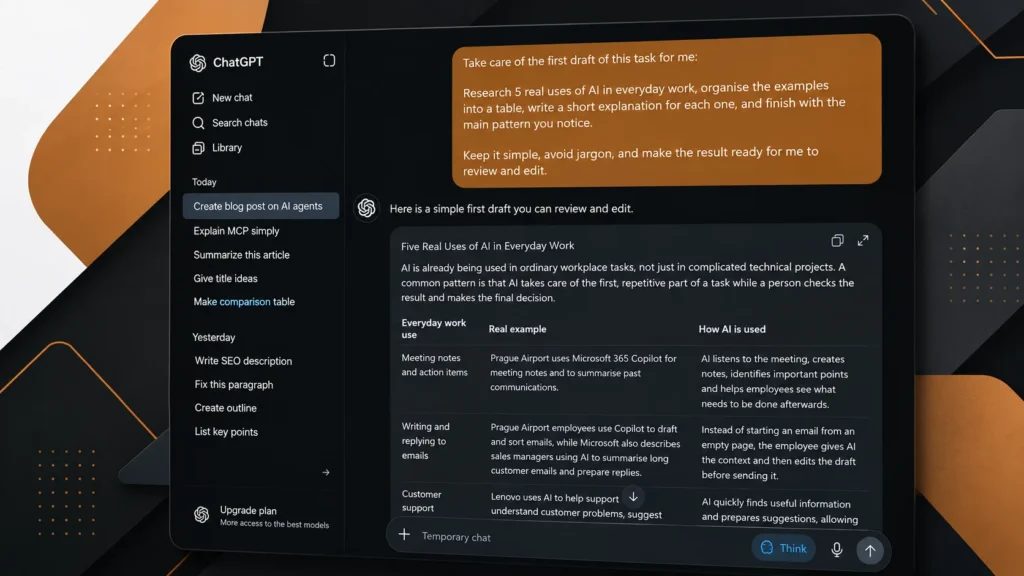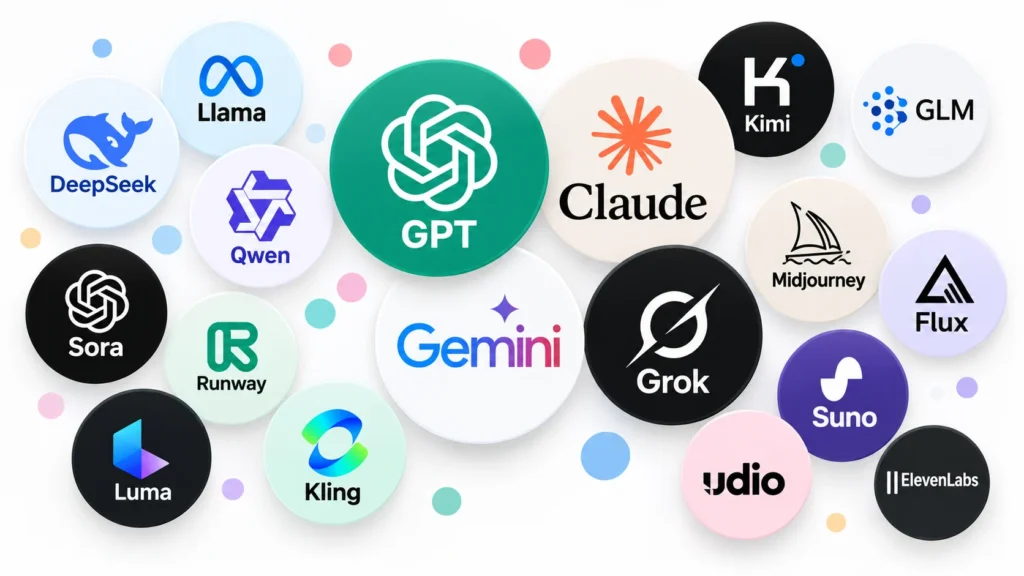
The AI model landscape is bigger than ever. GPT, Claude, Gemini, Grok, DeepSeek, Llama and Qwen all have different strengths, while models like Sora, Flux and Suno focus on video, images and music. This guide breaks down the major AI models and what each one is actually good at.
A couple of years ago, choosing an AI was easy. You opened ChatGPT, typed something, and got your answer.
That doesn’t really work anymore.
The AI market has split into different kinds of models. Some are built to reason through difficult problems. Some are better at coding. Some can operate a computer and complete tasks for you. Others are designed to process enormous amounts of information quickly, while completely different AI models generate images, videos, music and voices.
So asking, “Which AI is the best?” is becoming the wrong question.
A better question is: which AI is best for the job you actually need to do?
One important thing: an AI model is not the same thing as an AI chatbot or an AI agent. A model is the underlying technology, while chatbots and agents are products or systems built around those models.
OpenAI: The general-purpose ecosystem
OpenAI’s lineup now covers several different jobs.
At the top is GPT-6 Astra, built around autonomous computer and browser use. Instead of simply giving you instructions, the idea is that the model can work through a multi-step task using software, websites and tools.
Then there is the GPT-5.6 family. Sol is the heavier reasoning option, Terra is the balanced everyday model, and Luna is designed for fast, inexpensive workloads such as extraction, classification and summarization.
OpenAI’s o-series takes a different approach. Models such as o3, o3-pro and o4-mini are aimed at difficult mathematical, scientific and algorithmic problems where spending more computation on reasoning is useful.
So OpenAI is no longer really selling one AI. It is building an ecosystem of models for different levels of work.
Anthropic: Built for serious work
Claude has developed a particularly strong reputation around software engineering, writing and long-running tasks.
Claude Fable 5 and 5.1 sit toward the agentic end of the lineup, designed for tasks involving multiple applications and extended computer interaction.
Sonnet and Opus are the more general workhorses. These are the kinds of models people turn to when they need detailed writing, coding help, analysis or tool use.
Then there is Haiku, which is much more about speed. When you need thousands of small requests handled quickly, you don’t necessarily need the most powerful model available.
The useful distinction with Claude is not simply intelligence. It is how well the models fit into actual workflows.
Google: Gemini and the context advantage
Google’s Gemini family is especially interesting when the amount of information becomes huge.
Gemini models are designed to work across text, images, audio, video and large documents. Instead of giving an AI one small prompt, you can throw much more material into the conversation and ask it to connect the pieces.
The Pro models sit toward the more capable end, while Flash models focus on speed and efficiency. Flash-Lite and Nano go further toward lightweight and on-device use.
This makes Gemini particularly useful for jobs where the problem isn’t just answering a question. The problem is understanding a lot of information at once.
xAI: Grok
Grok has taken a somewhat different position in the market.
Its strength is closely connected to live information, search, coding and tool use. That makes it useful when the information you’re working with changes quickly or when you need an AI that can interact with external tools rather than simply generate an answer.
Grok is also trying to differentiate itself through a less restrictive conversational style.
In other words, its appeal is not just the underlying model. It is the whole experience around it.
DeepSeek: Efficiency matters
DeepSeek helped prove something important: you don’t always need the biggest and most expensive model to get strong results.
The DeepSeek-R1 series became particularly notable for its reasoning approach, while the newer V-series focuses heavily on efficiency, coding, mathematics and structured tasks.
Much of the interest around DeepSeek comes down to price-performance.
If a model can produce results close to much more expensive systems while costing significantly less to operate, developers have a reason to pay attention.
Meta: Llama and the open model world
Meta’s Llama represents another important direction.
Instead of everything being locked behind a company’s API, open-weight models can be downloaded, modified, fine-tuned and deployed on infrastructure controlled by the developer or company.
Llama 4 Scout and Maverick are examples of this approach.
This matters especially for companies that want more control over their data and infrastructure. A bank, private company or research organization may not want every piece of internal information sent to an external AI service.
Open models give them another option.
Qwen, GLM and Kimi
The open-model ecosystem is much larger than just Llama and DeepSeek.
Alibaba’s Qwen family has become particularly relevant for coding, multilingual applications and tool use. Qwen 2.5-Coder, for example, is focused heavily on software development.
Zhipu AI’s GLM models and Moonshot’s Kimi models are also pushing into reasoning, long-context processing and engineering tasks.
This is important because the AI race is no longer happening between just a handful of American companies. There is now a genuinely global model ecosystem.
Example: You need to build a small app, analyze a 100-page report, and create a promotional video. Instead of asking one AI to do everything, you could use Claude or GPT for coding, Gemini for the long report, and Sora or Runway for the video. The point isn’t to find one AI that does everything. It’s to use the right model for the task.
Then there is generative media AI Models
Not every AI is trying to answer questions.
Sora, Runway, Kling and Luma are competing in video generation, where the goal is to turn text, images or references into moving scenes.
Image generation has its own major players. Flux focuses heavily on visual fidelity and prompt accuracy, while Midjourney has built its reputation around highly stylized and cinematic imagery. Google’s Imagen and OpenAI’s image-generation systems take a more conversational approach.
Audio is another completely separate category.
Suno and Udio can generate complete songs, including vocals and instruments. ElevenLabs is focused on realistic speech and voice generation, pushing AI voices closer to natural conversation.
These systems are not really competitors to GPT or Claude. They solve a different problem.
So which AI Model should you use?
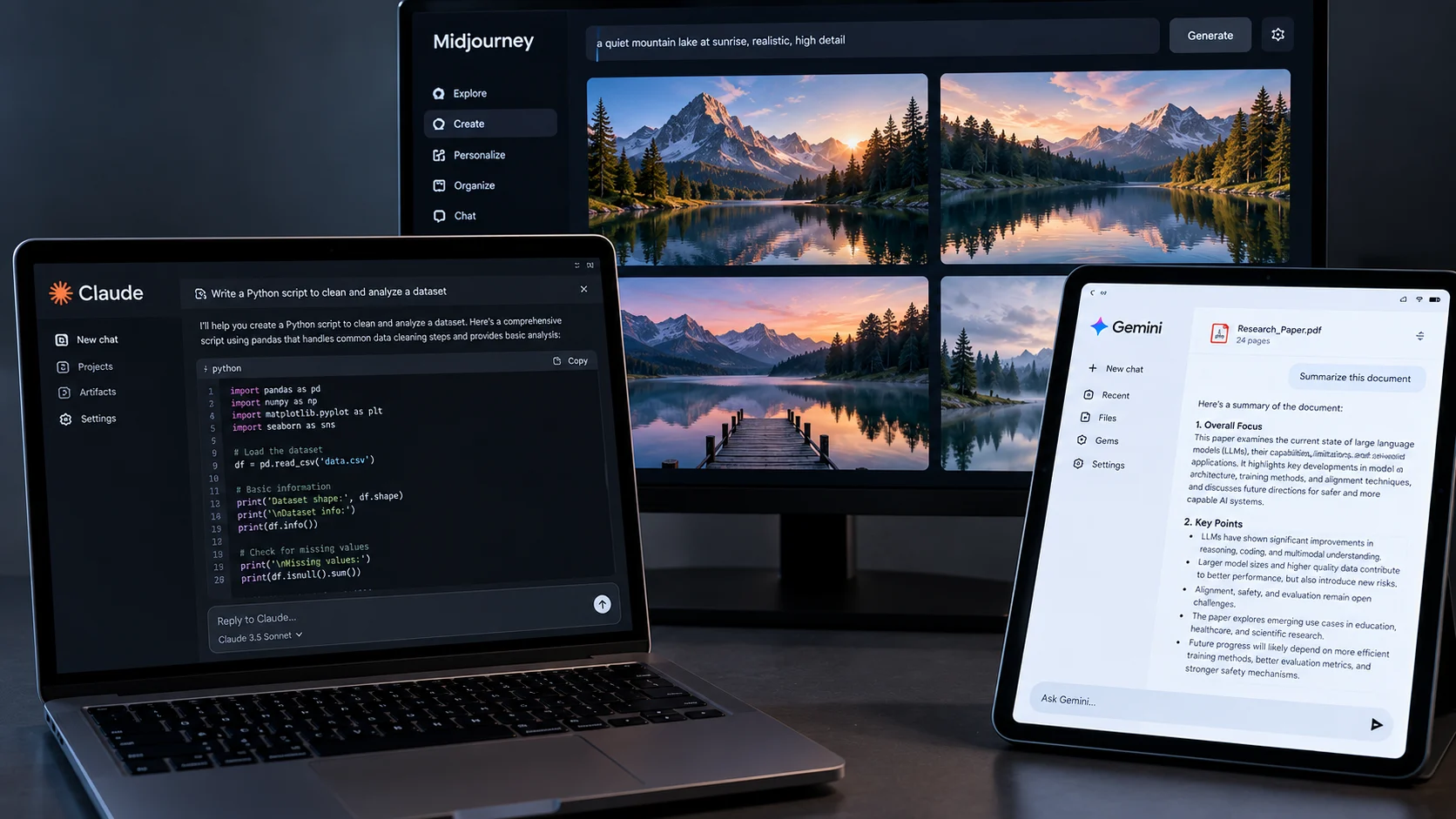
That depends on what you’re doing.
| What you need to do | AI models to consider |
|---|---|
| Difficult reasoning | Dedicated reasoning models |
| Coding & complex workflows | Claude, GPT, Qwen |
| Large documents, video & mixed media | Gemini |
| Open models you can control & deploy yourself | Llama, DeepSeek, Qwen |
| Video generation | Sora, Runway, Kling, Luma |
| Image generation | Flux, Midjourney |
| Music generation | Suno, Udio |
| Realistic AI voices | ElevenLabs |
The interesting part is what happens next.
You don’t always need the most powerful model. For simple tasks, a smaller and faster model can be better because it saves time and money.
AI is slowly moving away from the idea that one giant chatbot should do everything. Instead, we are getting specialized systems that are better at particular jobs, along with agents that can connect those systems together.
So the smartest user may not be the person using the biggest model. It may simply be the person who knows which model to use for which job.