AI agents are the next step in artificial intelligence. Unlike chatbots, they can complete multi-step tasks instead of simply answering questions. This article explains how AI agents work, how they differ from chatbots, and why they matter.
Have you noticed that almost every AI company is suddenly talking about AI agents instead of chatbots? OpenAI, Google, Microsoft, Anthropic, and many startups are all building them. It sounds like just another buzzword, but there is a real difference.
For the last few years, AI chatbots have become good at answering questions, writing emails, explaining concepts, and helping with everyday tasks. But they still rely on you to tell them what to do, one prompt at a time.
AI agents take things a step further. Instead of simply responding to a message, they can understand a goal, plan the steps needed, use different tools, and complete tasks with much less human involvement.
That doesn’t mean AI agents are replacing chatbots overnight. Think of them as the next stage in how AI systems work.
Let’s unpack what AI agents really are, how they work, and why everyone is suddenly talking about them.
What Is an AI Agent?
An AI agent is an AI system that can take a goal, decide what needs to be done, and carry out multiple actions to achieve it.
Instead of only answering a question, an AI agent can:
- Break a task into smaller steps
- Decide which step should happen first
- Use different tools when needed
- Remember information during the task
- Check whether the task is complete
- Adjust if something doesn’t work
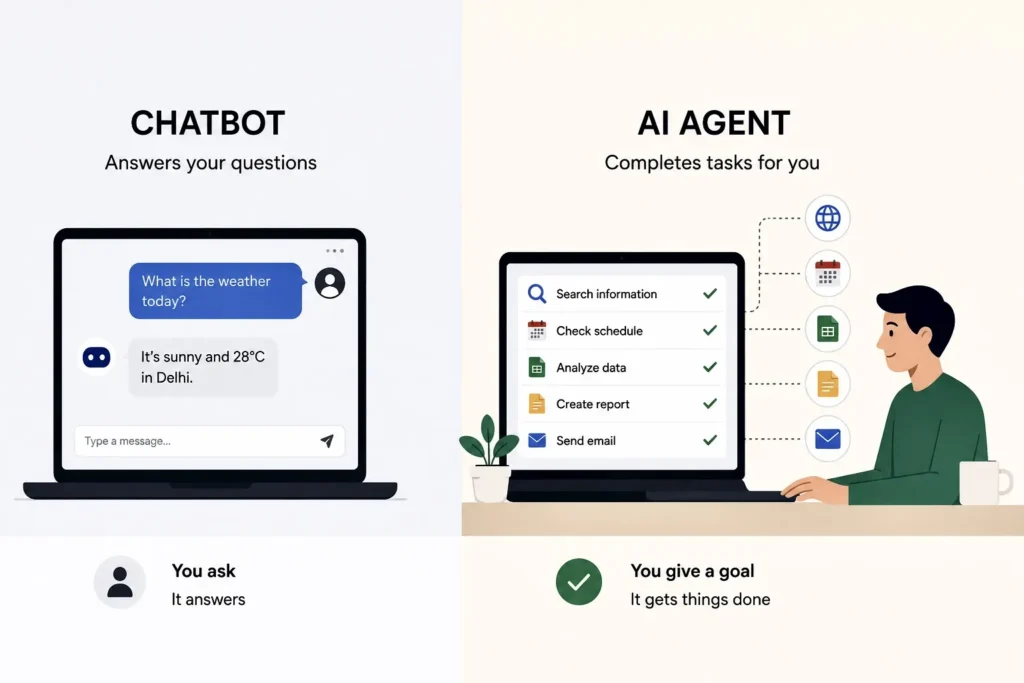
In simple words, a chatbot mostly talks, while an AI agent acts.
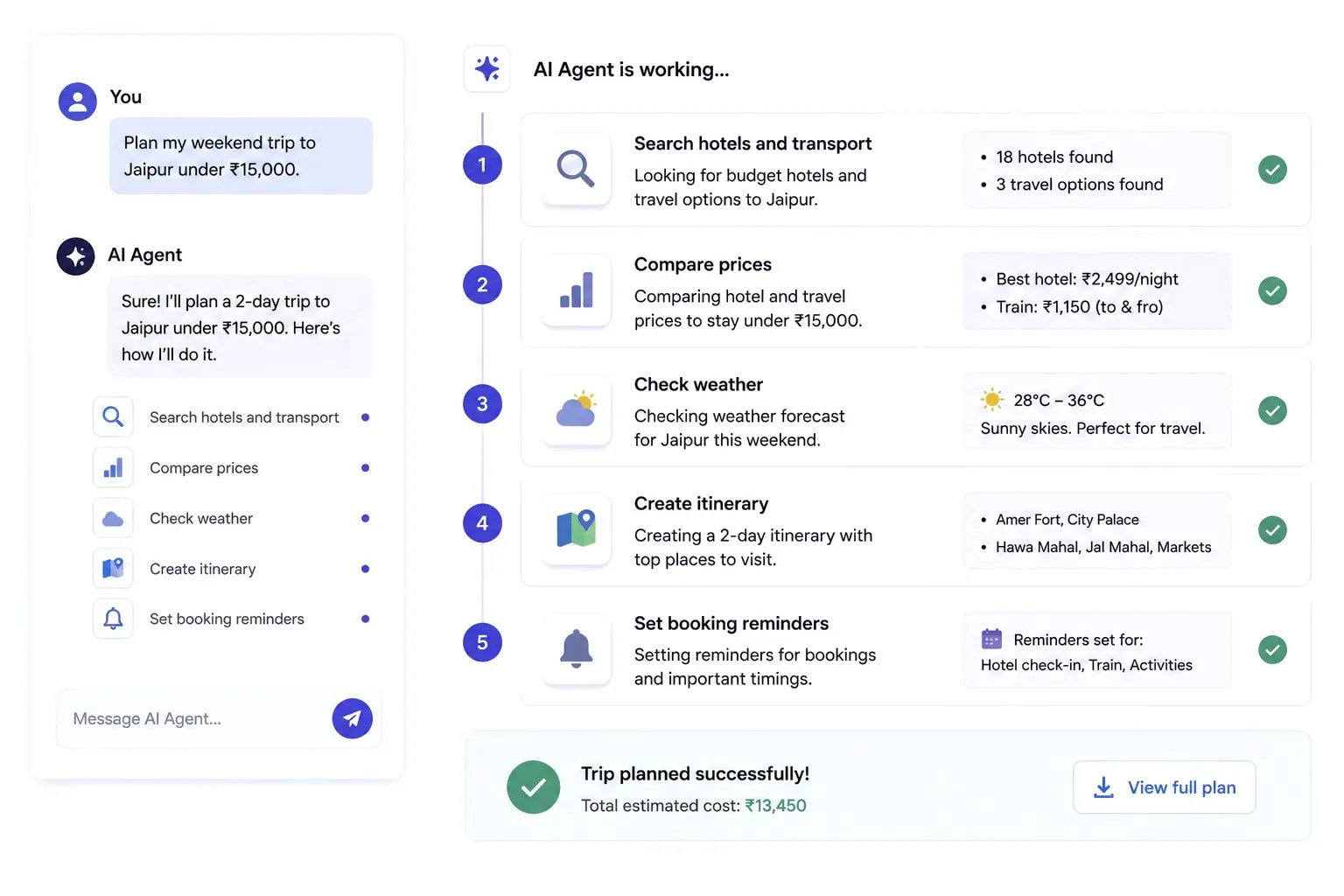
For example, imagine you tell an AI:
Plan a three-day trip to Jaipur within ₹20,000.
A chatbot might give you a suggested itinerary.
An AI agent could go much further. It could compare hotels, check train or flight options, calculate the total budget, organise the itinerary, save everything into a document, and even prepare a packing checklist, all as part of one request.
The difference isn’t just intelligence. It’s the ability to complete a workflow instead of stopping after one answer.
AI Agent vs Chatbot
Although both use large language models (LLMs), they work differently.
| Feature | Chatbot | AI Agent |
|---|---|---|
| Answers questions | ✅ | ✅ |
| Holds conversations | ✅ | ✅ |
| Performs multiple steps automatically | ❌ | ✅ |
| Uses external tools | Limited | Yes |
| Plans tasks | Rarely | Yes |
| Works towards a goal | Mostly no | Yes |
| Can make decisions during a task | Limited | Yes |
Think about customer support.
A chatbot can answer:
“What are your business hours?”
An AI agent could:
- Check your account
- Verify your identity
- Find your order
- Process a refund
- Send a confirmation email
- Update the company database
All during the same conversation.
How Do AI Agents Actually Work?
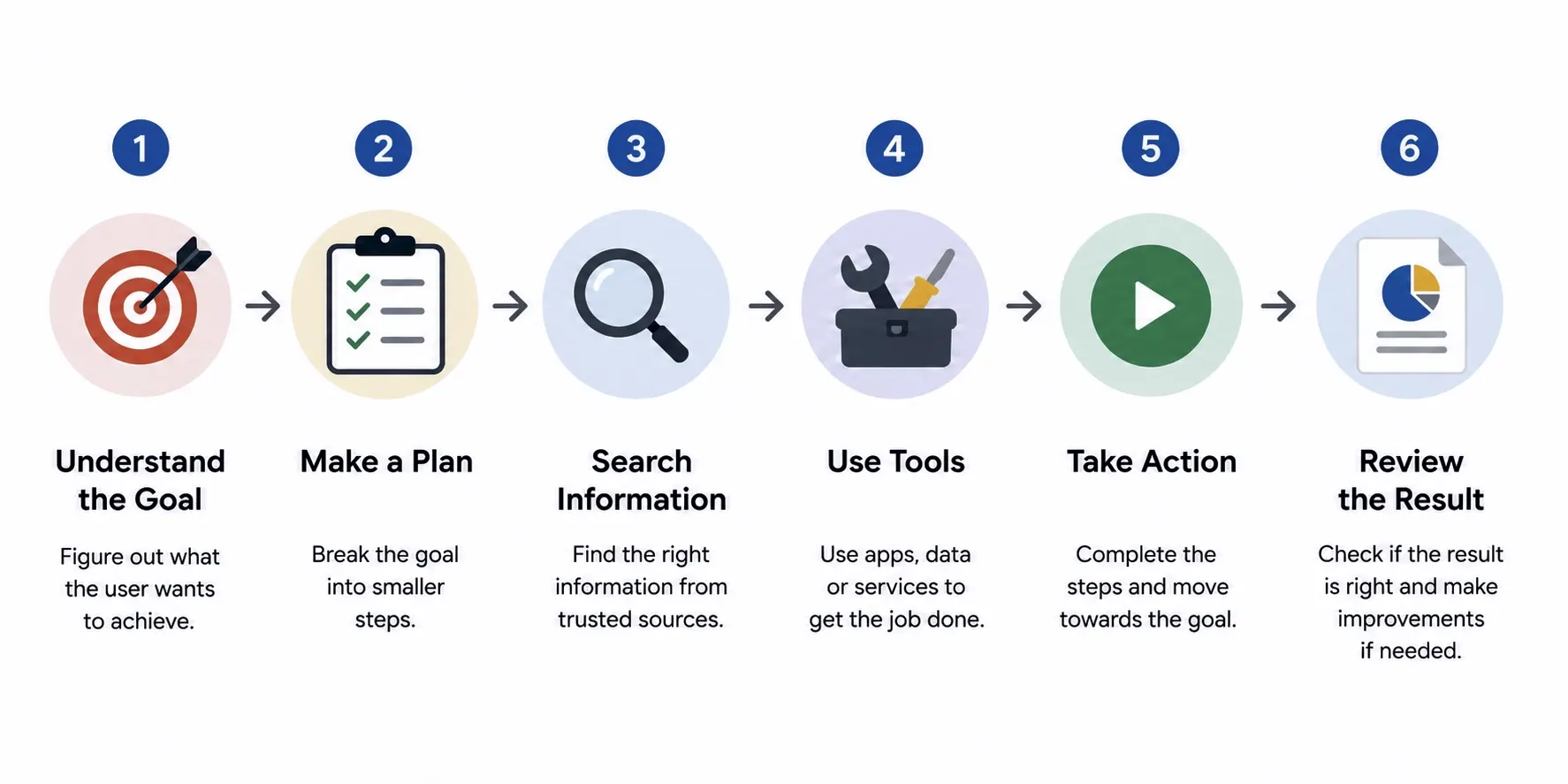
At first glance, an AI agent may look like a chatbot, but there is much more happening behind the scenes.
A typical AI agent follows a cycle like this:
1. Understand the Goal
It first figures out what you’re actually asking.
Instead of treating every sentence as an isolated prompt, it tries to understand the final objective.
For example:
“Create a presentation about electric vehicles.”
The goal isn’t simply writing text. It’s producing a finished presentation.
2. Make a Plan
Next, the AI breaks the work into smaller pieces.
It may decide to:
- Research electric vehicles
- Find recent statistics
- Create an outline
- Write slide content
- Add speaker notes
- Generate images if needed
This planning step is what separates many AI agents from normal chatbots.
3. Use Tools
Modern AI agents can connect to other software.
Depending on how they’re built, they may use:
- Web search
- Calendars
- Documents
- Spreadsheets
- Databases
- Coding tools
- Design software
Instead of pretending to know everything, they gather real information when required.
4. Review the Result
Many AI agents don’t stop after the first attempt.
They check whether the result makes sense.
If something is missing, they can improve it before presenting the final answer.
This is why people often describe AI agents as systems that can “think, act, and improve.”
A Simple Everyday Example
Imagine you’re organising a birthday party.
A chatbot can help answer questions like:
- What food should I order?
- Suggest decoration ideas.
- Write invitation messages.
An AI agent could do much more.
It could:
- Make a guest list
- Create a shopping checklist
- Compare decoration prices
- Draft invitation messages
- Add reminders to your calendar
- Calculate your budget
- Create a timeline for the event
You’re still giving the goal, but the AI handles much more of the work.
Where Are AI Agents Already Being Used?
AI agents are no longer just research projects. Many businesses are already using them in different ways.
Customer Support
Instead of answering only basic questions, AI agents can manage complete support requests from start to finish.
Software Development
Developers use AI agents to:
- Write code
- Fix bugs
- Test software
- Review code
- Explain complex functions
This saves time, especially for repetitive work.
Research
Instead of reading dozens of webpages yourself, an AI agent can collect information, organise it, compare sources, and prepare a summary.
Business Operations
Companies are using AI agents to automate tasks like:
- Processing invoices
- Scheduling meetings
- Managing documents
- Creating reports
- Updating databases
Personal Productivity
This is where many people will notice AI agents first.
Imagine asking:
“Organise my week.”
An AI agent could:
- Read your calendar
- Check pending tasks
- Suggest free time
- Prepare a schedule
- Set reminders
- Draft emails for meetings
Why Is Everyone Suddenly Talking About AI Agents?
The idea of AI agents isn’t new.
What’s changed is that today’s AI models have become much better at reasoning, following instructions, remembering context during tasks, and using external tools.
At the same time, companies are connecting AI with more apps and services.
Instead of AI working in isolation, it can now interact with calendars, cloud storage, web browsers, coding environments, and business software.
This makes AI far more useful than simply answering questions.
Many experts believe this shift could be as important as the move from search engines to chatbots.
Are AI Agents Perfect?
Not yet. They still have several limitations.
They Can Make Mistakes
AI agents can misunderstand instructions or choose the wrong action.
Human supervision is still important for important work.
They Depend on Good Data
If an AI agent receives incorrect information, its decisions may also be incorrect.
They May Need Permission
Many AI agents require access to emails, files, calendars, or business software.
This makes privacy and security extremely important.
Some Tasks Are Still Too Complex
Long-term planning, creative judgement, and critical business decisions still benefit from human experience.
AI agents are assistants, not replacements for people.
Will AI Agents Replace Chatbots?
Probably not.
Chatbots are still the fastest way to ask questions, get explanations, brainstorm ideas, or have conversations.
AI agents simply build on those abilities.
You can think of it like this:
- A chatbot gives you information.
- An AI agent helps get things done.
In the future, many AI products will likely combine both. You’ll chat naturally, and when needed, the AI will switch into “agent mode” to complete tasks on your behalf.
In Simple Words
AI agents represent one of the biggest changes in how people interact with AI.
Instead of acting like digital assistants that only answer questions, they can plan, use tools, make decisions, and complete multi-step tasks with much less guidance.
They’re still improving, and they’re not perfect. But it’s easy to see why so many companies are investing in them. As AI becomes better at working across apps and handling real-world tasks, AI agents could become a normal part of everyday life, from managing work to helping at home.
If chatbots introduced us to conversational AI, AI agents are showing what happens when AI starts taking action.