Universal USB-C Is a Lie
Your 120W charger can still charge a phone like it’s 2019.
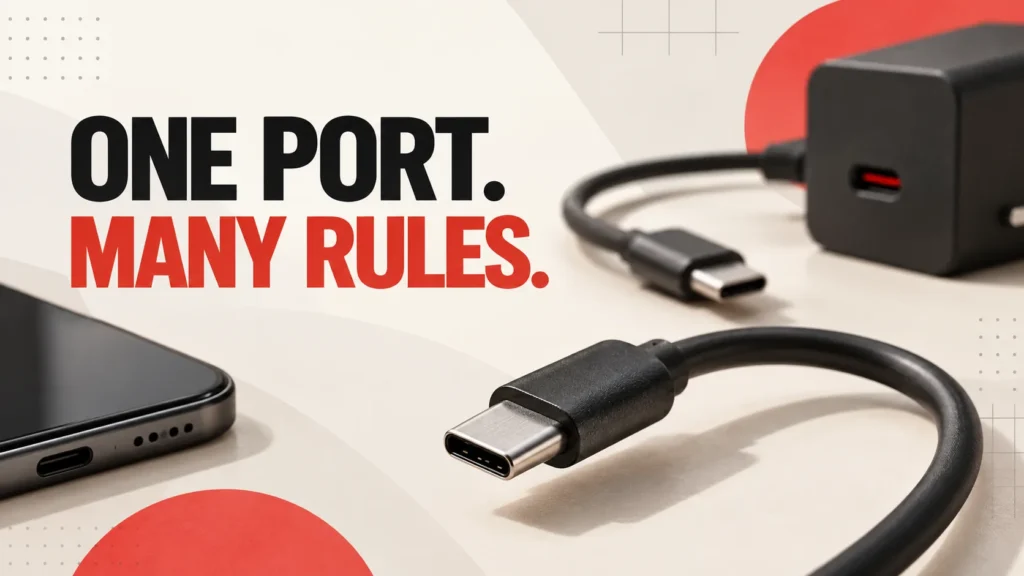
The plug is universal. The charging speed isn’t.
USB-C made the hole universal. It didn’t make charging universal.
What USB-C standardises
The shape of the port, the plug and the basic cable specification. Your cable fits without needing to guess which side goes up.
What it doesn’t promise
It doesn’t mean a 120W phone will pull 120W from every USB-C charger and every USB-C cable.
The New Race in Smartphones Is No Longer About Cameras
Phone makers are competing on much more than camera specs now.
We standardised the port. The charging rules stopped there.
BIS publishes the Type-C standard
India’s Bureau of Indian Standards published IS/IEC 62680-1-3:2022 for USB Type-C receptacles, plugs and cables.
Phones were expected to move to the common port
A later government-industry rollout was reported for smartphones and tablets. The exact implementation details are less clear than the connector standard itself.
The hole looks the same
The charger, phone and cable can still use different charging methods once you go beyond basic USB-C compatibility.
The brands selling the most phones here don’t all charge the same way.
vivo, Samsung and OPPO alone account for more than half of India’s smartphone shipments in this quarter. Add Xiaomi, Poco, realme, OnePlus and iQOO, and the market becomes a mix of charging systems.
A USB-C cable can look identical and still be the wrong cable for your phone.
cable information
120W on the charger doesn’t mean your phone gets 120W.
A charger can be capable of 120W without the phone ever drawing anything close to that. The phone decides how much power it can use, and the charger and cable have to support the charging method the phone expects.
That is why buying a bigger charger does not automatically make every phone charge faster. A high-wattage USB-C charger can still behave like an ordinary charger when the phone does not recognise its preferred fast-charging system.
POCO X8: A 10,000mAh Power Bank Disguised as a Phone
Bigger batteries are changing what we expect from a phone.
Same connector. Three very different fast-charge stories.
SuperVOOC wants the right cable too.
OnePlus phones can fall back to ordinary USB charging when the charger and cable aren’t the right match. OnePlus-branded SuperVOOC cables themselves can carry extra information and are rated for very high current on supported models.
67W and 120W are not just numbers on the brick.
Xiaomi explicitly recommends its higher-current cables for its faster charging systems. A normal USB-C cable can still charge the phone, but the phone may not reach the advertised peak.
FlashCharge is where the difference gets obvious.
In testing of the vivo X300 Pro, the original FlashCharge setup delivered around 80W in use. A universal USB-PD charger was much slower, and a PD charger without PPS fell much further behind.
A 25-minute phone can suddenly become an overnight phone.
Take a 5,000 mAh battery. At a nominal 3.85V, that’s roughly 19 Wh of stored energy. Real charging takes longer because energy is lost along the way and phones slow down as the battery fills.
PPS
Programmable Power Supply. The useful idea is simple: the phone can ask the charger for a more precise amount of power instead of choosing from a few fixed levels.
Choose from a few fixed steps.
The charger can adjust voltage and current more precisely while the battery fills.
RAM Shortage Is Making Phones and Laptops More Expensive
The memory inside your next device could cost more than you expect.
Read articleStop shopping by the words “USB-C cable”.
Shop for the charging system your phone actually uses.
Keep the original cable
The cable in the box is usually the least confusing option. Treat it as part of the charger rather than a disposable accessory.
Match the cable to the phone
For high-speed charging, check your phone maker’s cable requirement. A random cable can charge the phone perfectly well while still missing the speed you paid for.
For a third-party charger, check the actual features
Don’t stop at the biggest wattage number. Look for USB Power Delivery, PPS when your phone needs it, and a cable rated for the power you’re trying to use.
USB-C solved the annoying part. It didn’t solve the confusing part.
Your phone, charger and cable can all have USB-C connectors and still disagree about how quickly the battery should fill. That’s not a broken port. It’s the gap between a common connector and a common charging system.
Until the box tells you clearly what charging standard the phone uses, how much power it can take and what cable it needs, keep treating that original cable as part of the phone.
Where the numbers and technical claims came from
Indian USB Type-C connector, plug and cable standard, published January 2023.
Common charger rules covering USB Power Delivery above 15W and charging information.
India smartphone market shares and Q1 2026 market data.
Current support information for PPS, Super Fast Charging and cable requirements.
Official 6A cable and 67W/120W charging information.
SUPERVOOC cable requirements and official cable information.
Real-world comparison between original FlashCharge and third-party USB-PD charging.
5,000 mAh ≈ 19 Wh at 3.85V nominal, used only to show the rough effect of lower charging power.