Most people never think about image compression.
You take a photo.
Upload it.
Send it.
Post it.
Download it.
Everything just works. But honestly the modern internet would probably feel unusable without compression. Because the internet is constantly trying to make files smaller.
Every time you:
- send a WhatsApp image
- upload on Instagram
- watch YouTube
- open a website
- save a photo
compression is happening somewhere in the background. And most people only notice it when quality suddenly looks terrible.
Why Images Are So Large
Modern phones capture huge amounts of detail.
A normal smartphone photo today can easily be:
- 5 MB
- 10 MB
- even 20 MB or more
That is massive when millions of people are uploading images constantly every second.
Now imagine:
- Instagram storing billions of photos
- WhatsApp sending billions daily
- websites loading dozens of images at once
Without compression:
- apps would feel slower
- websites would load badly
- mobile data would disappear quickly
- storage would become expensive
- internet traffic would explode
Compression exists because raw files are simply too heavy for the modern internet.
What Is Image Compression
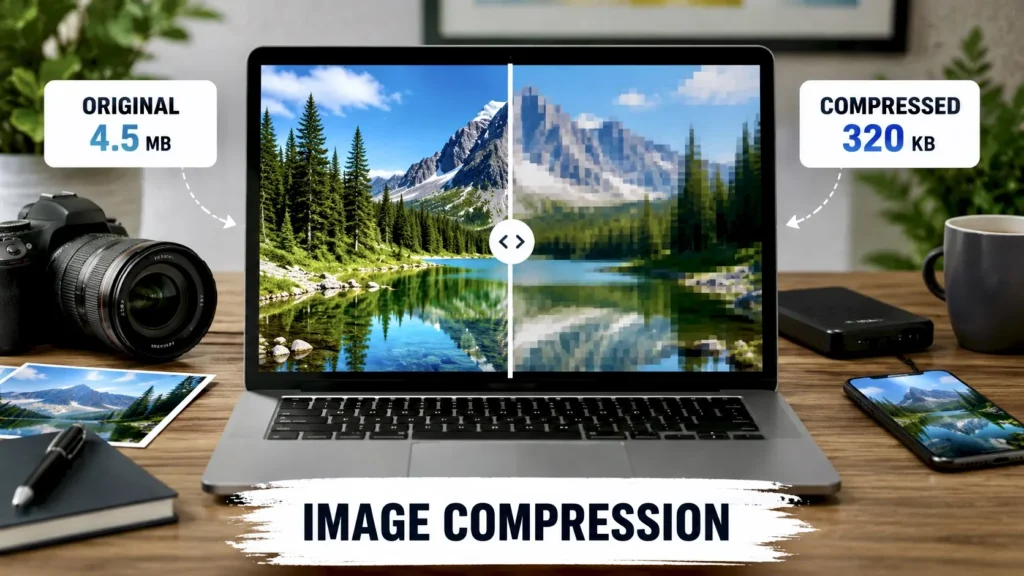
Image compression basically means making an image file smaller.
The goal is: reduce file size while keeping the image looking mostly the same.
That is the important part. Mostly the same.
Because compression is always a tradeoff between:
- quality
- file size
- speed
Smaller file usually means:
- faster upload
- faster download
- less storage
- lower internet usage
But too much compression starts damaging image quality. That is why blurry WhatsApp images exist.
How Does Image Compression Actually Work
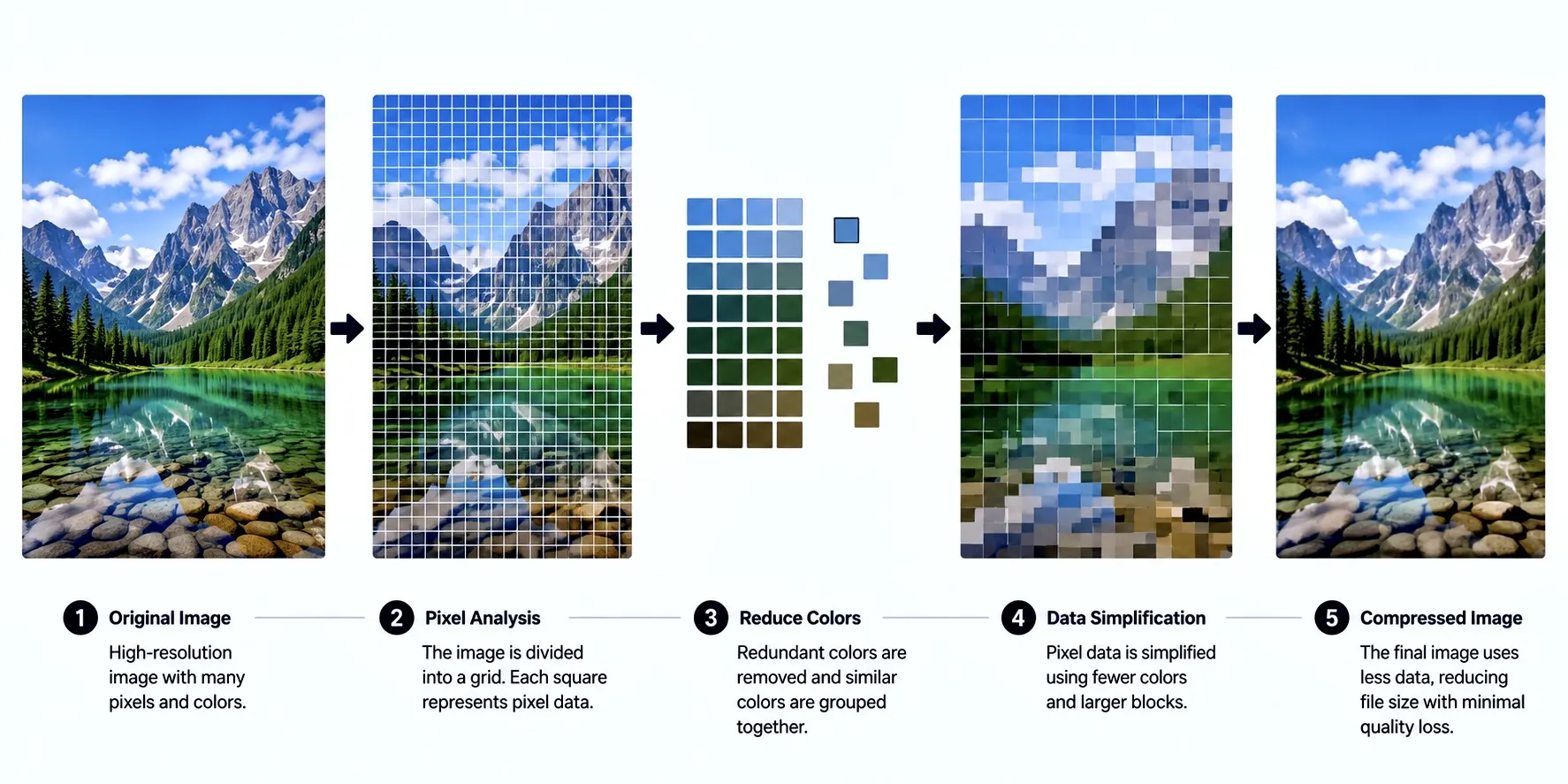
Think about a normal photo for a second. An image is basically made of millions of tiny colored dots called pixels. The more detail and color information the image stores, the larger the file becomes.
Compression works by reducing some of that information intelligently. For example, imagine a large blue sky in a photo.
Instead of storing:
blue pixel,
blue pixel,
blue pixel,
thousands of times separately,
The compression system notices: This area mostly looks the same.
So it simplifies the information. That instantly reduces file size.
Modern compression systems also:
- merge similar colors
- reduce tiny invisible details
- simplify textures
- remove information humans rarely notice quickly
That is why compressed images still look mostly normal at first glance. The system tries keeping the important visual parts while quietly removing less noticeable data in the background.
But when compression becomes too aggressive:
- details disappear
- edges become blurry
- textures look strange
- images feel soft
That is why heavily compressed photos sometimes look bad after uploading multiple times online.
Why WhatsApp Ruins Photo Quality
This is probably the most relatable example.
You take a sharp photo.
Send it on WhatsApp.
Suddenly it looks softer and less detailed.
That happens because WhatsApp compresses images heavily to:
- save bandwidth
- reduce storage
- speed up sending
- handle billions of daily uploads
Imagine if every user sent original 20 MB photos constantly. The system would become much heavier and slower. So apps compress files automatically before sending them.
Most people prefer: fast sending over perfect quality. Even if they complain later.
Compression Removes Information
This is the part many people do not realize. When apps compress images aggressively, they are often literally removing visual information.
Tiny details disappear.
Textures become softer.
Sharpness reduces.
The system tries removing parts humans are less likely to notice immediately. That is why compressed images can still look okay at first glance.
But if you zoom in, problems become obvious:
- blur
- smudging
- artifacts
- pixel blocks
- strange textures
You probably noticed this on:
- old memes
- forwarded images
- screenshots shared repeatedly
Every new compression cycle damages the image slightly more.
The Internet Depends On Compression More Than People Realize
Honestly compression is one of the hidden reasons the modern internet functions at this scale. Not just images.
Almost everything online gets compressed:
- videos
- audio
- websites
- apps
- games
- files
Because sending full raw data constantly would be incredibly inefficient. Imagine YouTube without video compression. Even short videos would become massive files.
Streaming would feel terrible for most users. Compression quietly makes modern digital life possible.
There Are Two Main Types Of Compression
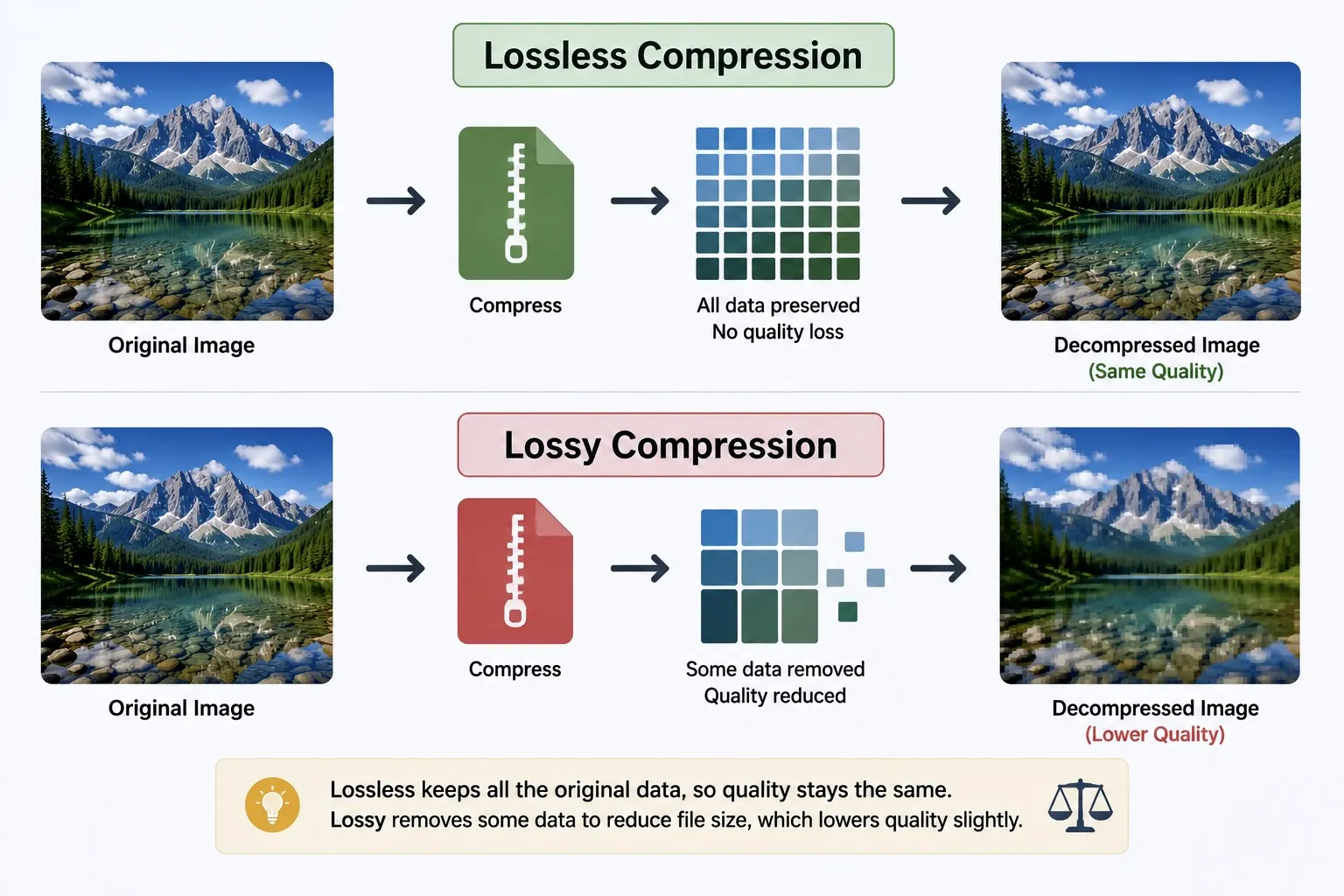
Most people never hear these terms but they are important.
Lossy Compression
This removes some data permanently to reduce file size aggressively.
That is what most social media apps use.
Smaller file.
Lower quality.
JPEG images usually use lossy compression.
This is why photos become softer after uploads.
Lossless Compression
This reduces file size without permanently removing important image data.
Quality stays almost identical.
PNG files often use lossless compression.
But the file sizes stay larger compared to heavily compressed JPEGs.
That is why websites choose different formats for different situations.
Why Websites Compress Images So Much
Speed. Honestly, modern internet users are impatient now.
If a website loads slowly, people leave quickly. Large images are one of the biggest reasons websites become heavy. Without compression, apps would feel slower and internet traffic would explode.
So websites compress images aggressively to:
- load faster
- reduce bandwidth costs
- improve mobile performance
- keep users on the site
Google itself pushes websites to optimize image sizes because speed affects search rankings too.
That is why many websites quietly reduce image quality slightly behind the scenes. Most users never notice.
Social Media Platforms Care More About Speed Than Quality
This is another interesting thing.
Platforms like:
- X
- Snapchat
usually prioritize smooth experience over perfect media quality.
Because platforms care about:
- loading speed
- scrolling smoothness
- server costs
- storage efficiency
The average user scrolling quickly on a phone screen may not even notice slight quality reduction. So apps compress aggressively because the performance benefits are huge at internet scale.
Compression Also Saves Mobile Data
This matters a lot globally.
Not everyone has:
- unlimited internet
- fast WiFi
- expensive devices
Compressed images use less data.
That means:
- faster loading
- lower data usage
- better experience on slower networks
Without compression, many modern apps would feel frustrating in regions with slower internet connections. Compression quietly makes the internet more accessible.
AI Is Changing Compression Too
This part is interesting.
New AI systems are now helping improve compression methods. Most people never see the hidden systems running behind the modern internet.
Some modern tools can:
- predict missing details
- rebuild textures
- sharpen compressed images
- upscale low quality photos
So instead of only shrinking files, systems now also try making compressed media look better artificially. That is why some photos today look surprisingly sharp even at smaller sizes.
AI is slowly becoming part of how digital media gets optimized online.
Compression Is Basically Controlled Sacrifice
At its core, image compression is about deciding: what information can be sacrificed without ruining the experience.
That is really what is happening.
The system constantly asks: Can humans notice this detail disappearing?
If the answer is probably not, the file becomes smaller. And honestly humans adapted to this without realizing it.
Most people now consume compressed media constantly every single day.
Photos.
Videos.
Music.
Streaming.
Very little of what we see online is truly original full quality data anymore.
The Internet You See Is Not The Original Version
This is probably the strangest realization behind compression.
The internet is full of optimized versions of reality.
Compressed photos.
Compressed videos.
Compressed audio.
Compressed websites.
Everything is being reduced, resized, optimized, processed, and simplified constantly so it can move across the internet faster. And honestly most users never notice because compression became normal.
We are used to seeing the internet through optimized versions instead of original files. That is why a raw professional camera photo can sometimes look shockingly detailed compared to a normal uploaded social media image.
One is close to the original quality. The other passed through layers of internet optimization systems before reaching your screen.
Image Compression Exists Because The Internet Needs Speed
At the center of everything is one simple reality. The internet moves enormous amounts of data every second.
Without compression:
- apps would slow down
- websites would become heavier
- streaming would struggle
- storage costs would explode
Image compression quietly keeps the modern internet practical. Most people only notice it when quality drops badly.
But honestly it is one of the invisible systems making digital life work every single day.