A subscription used to feel like something you had for a newspaper or a magazine. Now it can be almost anything. Music, movies, software, cloud storage, fitness apps, learning platforms and even some car features can all ask for a monthly payment. The strange part is not that subscriptions exist. It is how normal they have become.
You open an app and see a premium plan. You try a new tool and get a free trial. You store your photos somewhere and discover that there is a monthly storage limit. You want one extra feature and suddenly there is another plan waiting for you.
At some point, the question becomes pretty simple: why can’t I just buy the thing once and keep using it?
We used to buy things
There was a time when buying something usually meant the transaction ended there.
You bought a DVD and the DVD was yours. You bought a piece of software and, depending on the product, you could keep using that version for years. You bought a song and you did not need to ask the seller every month whether you were still allowed to listen to it.
That model was easy to understand. You paid once, and in return you got the product. The internet changed that relationship.
Now many digital products are built around ongoing access. You are not necessarily paying for a thing that sits in your hands. You are paying to keep using a service that lives somewhere else.
Pay for the product and keep using it.
Keep paying to keep using the service.
That sounds like a small business decision, but it changes something much bigger. It changes what “buying” means.
Why companies like subscriptions
The biggest reason is not mysterious. One-time sales are unpredictable. A customer buys something today, and the company then has to find another customer tomorrow. Some months can be good. Some can be quiet.
A subscription is different. If a company has a large number of paying users who continue renewing, it can expect money to come in again next month. The amount is easier to plan around.
Imagine 10,000 people buying something for ₹500 once. The company gets ₹50 lakh, and the sale is finished. Now imagine those same 10,000 people paying ₹200 every month. That is ₹20 lakh coming in every month as long as enough people continue paying.
₹50 lakh once
₹20 lakh every month
That does not automatically mean subscriptions are bad. It simply explains why companies moved toward them so heavily. The business gets a more regular source of income. The customer gets ongoing access. On paper, both sides have something to gain.
The problem starts when the monthly payment becomes easier to accept than the total amount you are actually paying over time.
The small payment trick
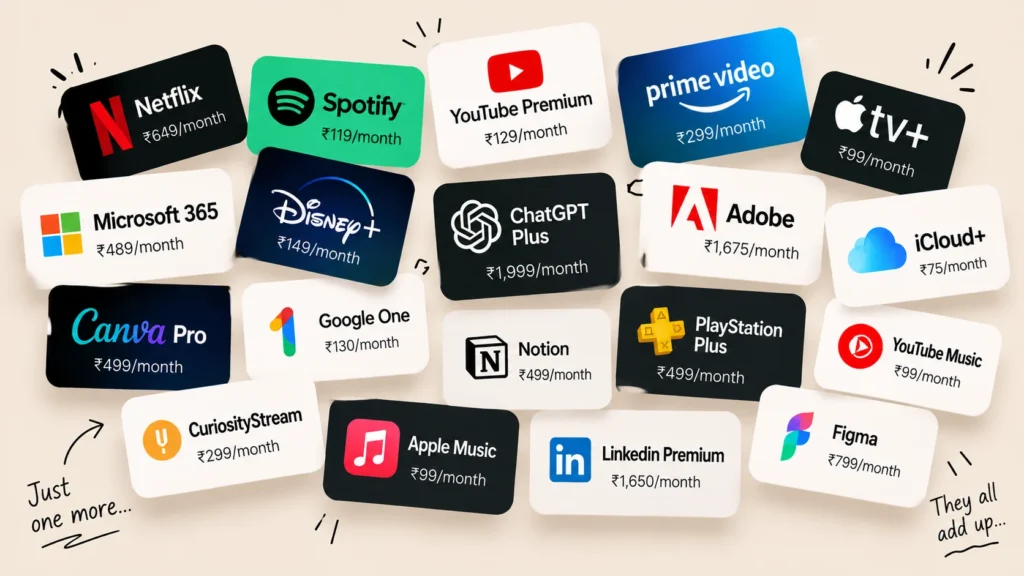
This is where subscriptions become strangely effective. ₹99 does not sound like much. Neither does ₹199. Even ₹499 can feel manageable when you look at it on its own. The problem is that you rarely have just one subscription.
You might have one for music, one for video, one for cloud storage, one for software and one for something you tried for a month and forgot about.
Each payment looked small when you signed up. Together, they are not small anymore.
That is the psychological difference between paying once and paying regularly. A large payment forces you to notice it. Small automatic payments are easier to forget.
And when the payment happens automatically, you may not even make a fresh decision every month. You made the decision once, and the system keeps repeating it.
This is one reason it is worth occasionally checking the services you are actually using. A subscription you forgot about can become one of those tiny expenses that quietly survives for months.
You are also paying for convenience
There is another reason people accept this model so easily. Subscriptions are convenient.
You do not need to buy individual songs. You do not need to keep a shelf full of DVDs. You do not need to install software from a disc and keep the same version forever. You log in and use the service. That convenience is real.
The problem is that convenience can make the payment almost invisible.
Think about streaming. You might pay every month for access to thousands or millions of songs and shows, but you may keep returning to the same few favourites.
You are not really paying for each song you listen to. You are paying for the whole system being available whenever you want it. That can be a good deal when you use it constantly. It can feel very different when you barely use it.
It is “Am I using it enough to make the monthly payment worth keeping?”
That is an important difference because a cheap subscription can still be expensive if you keep paying for it without using it.
Products are changing too
Subscriptions are also easier to justify when the product keeps changing.
Software is a good example. A modern app is rarely finished in the way an old physical product was finished. New features arrive. Bugs are fixed. Security problems are patched. The service changes over time.
That gives companies a reasonable argument for recurring payment. You are not only buying what exists today. You are paying for continued development and continued access. That can make sense.
But it also creates a strange relationship with the product. You are no longer buying a finished object and deciding when to replace it. You are staying inside a service that the company controls and keeps changing.
The old idea was:
Pay once → use it
The new idea is closer to:
Pay regularly → keep using it
Neither model is automatically better. They simply give the customer a different kind of relationship with the product.
The part that bothers people
The real discomfort starts when you realise how many things have moved from ownership to access.
A file stored in the cloud is accessible because the service is still running and your account is still active.
A streaming library exists as long as the service gives you access to it. Software may depend on an active plan. The important word here is access.
You can have years of photos, playlists, files, settings and history inside a service without actually owning the system that holds them.
That does not mean you own nothing anymore. Physical products still exist, and plenty of software and services still offer one-time purchases in some form.
But the direction is obvious in digital products. More of what we use is becoming a service rather than a thing we simply buy.
And it keeps spreading
Once companies see that people are comfortable paying regularly for one type of service, the same idea can move into another category.
First it was magazines. Then software. Then music and video. Then cloud storage. Then fitness apps and learning platforms.
Now even physical products can sometimes have features or services tied to recurring payments.
The interesting part is not that companies found a new way to charge us. The interesting part is that we slowly got used to it.
The first subscription feels like a decision. The fifth one barely feels like a decision at all.
That is why the subscription model works so well. It does not always arrive as a large expense. It arrives as a collection of small choices that become normal. The same thing happens on platforms where the service keeps learning what you like and keeps giving you reasons to stay. Instagram is a good example of that.
Are subscriptions actually bad?
Not really. That answer is too simple.
If you use a service every week, it keeps improving, and the monthly price feels reasonable for what you get, a subscription can make perfect sense.
The problem is when the payment continues simply because cancelling feels like more effort than keeping it. That is when you stop paying for value and start paying out of habit. And this is where the whole model becomes worth thinking about.
A subscription asks you to make one decision once, but the payment can continue for a very long time. That is very different from walking into a shop, paying for something and leaving.
The old model ended when you bought the product. The subscription model keeps the relationship going.
Maybe that is the real reason everything feels subscription-based now. Companies did not just change the way they charge. They changed the relationship between us and the things we use.
We moved from buying things to keeping access to them. And once you start noticing that shift, every “Start Free Trial” and “Subscribe Now” button looks a little different.