The era of buying a smartphone just for its camera is officially dead. The real race has moved entirely underneath the glass into battery chemistry, thermals, and raw packaging density.
For years the easiest way to talk about a new smartphone was to talk about its cameras. Bigger sensors, better zoom, and more megapixels. Every flagship had a new camera story and every year the question was basically the same. Which phone takes better pictures?
That race is over. Smartphone sensors hit a physical wall. Unless you want a phone that is two centimetre’s thick the glass cannot get any bigger. The software tricks have peaked too. Every modern phone already takes great low light shots and sharp portraits. Blind camera tests prove most consumers cannot even tell the difference between a 1.5 Lakh iPhone and a 50K Android anymore.
If cameras are a solved problem what actually makes a next generation phone better? Phone makers are starting to compete over things you usually cannot see.
The Silicon Carbon Battery Flip
Take batteries. For years a larger battery usually meant accepting a thicker phone. Lithium ion batteries are basically dead weight. They simply cannot hold enough energy without expanding the chassis.
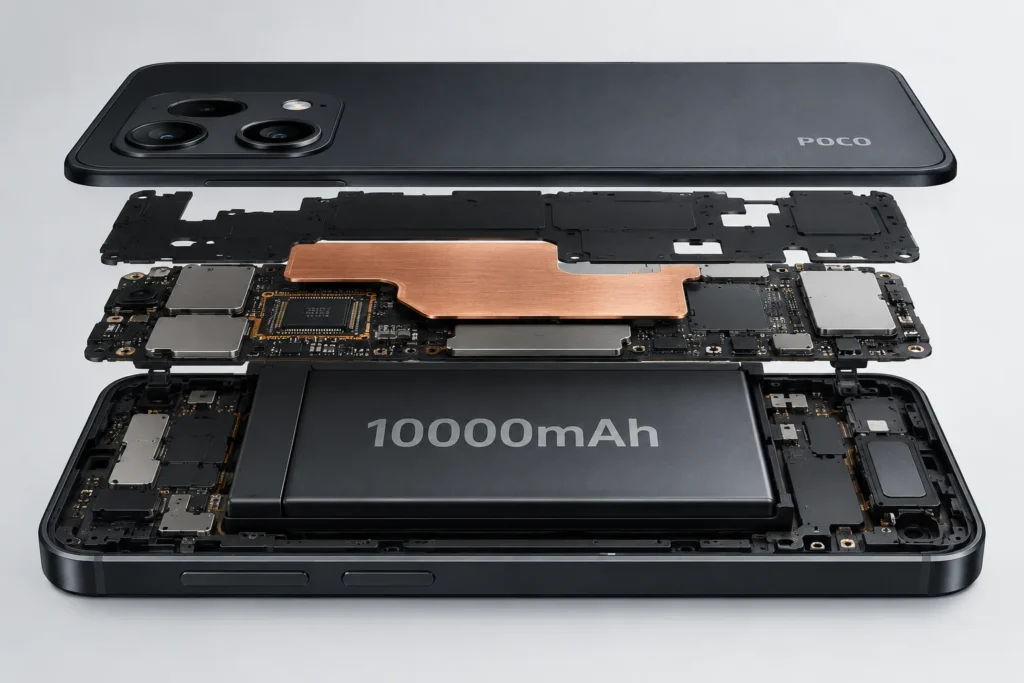
That relationship changed because Chinese manufacturers completely flipped the script using silicon carbon anodes. Silicon is far more efficient at storing energy and is capable of holding 15 lithium atoms for every 4 silicon atoms. While standard lithium ion batteries top out at a theoretical density of roughly 387 Wh/kg silicon carbon batteries can reach 600 Wh/kg. Brands like Xiaomi, Honor, POCO, Vivo, and OnePlus are rapidly embracing this technology. They are shipping phones with massive 6000mAh to 8300mAh batteries while keeping the devices incredibly thin.
Meanwhile Apple and Samsung are playing a massive game of catch up. They remain largely stuck in the 5000mAh range. A larger battery determines how much freedom engineers have when designing the rest of the device. It supports brighter displays and heavier processing tasks without turning the phone into a brick.
The Foldable Flex: Slicing Physics in Half
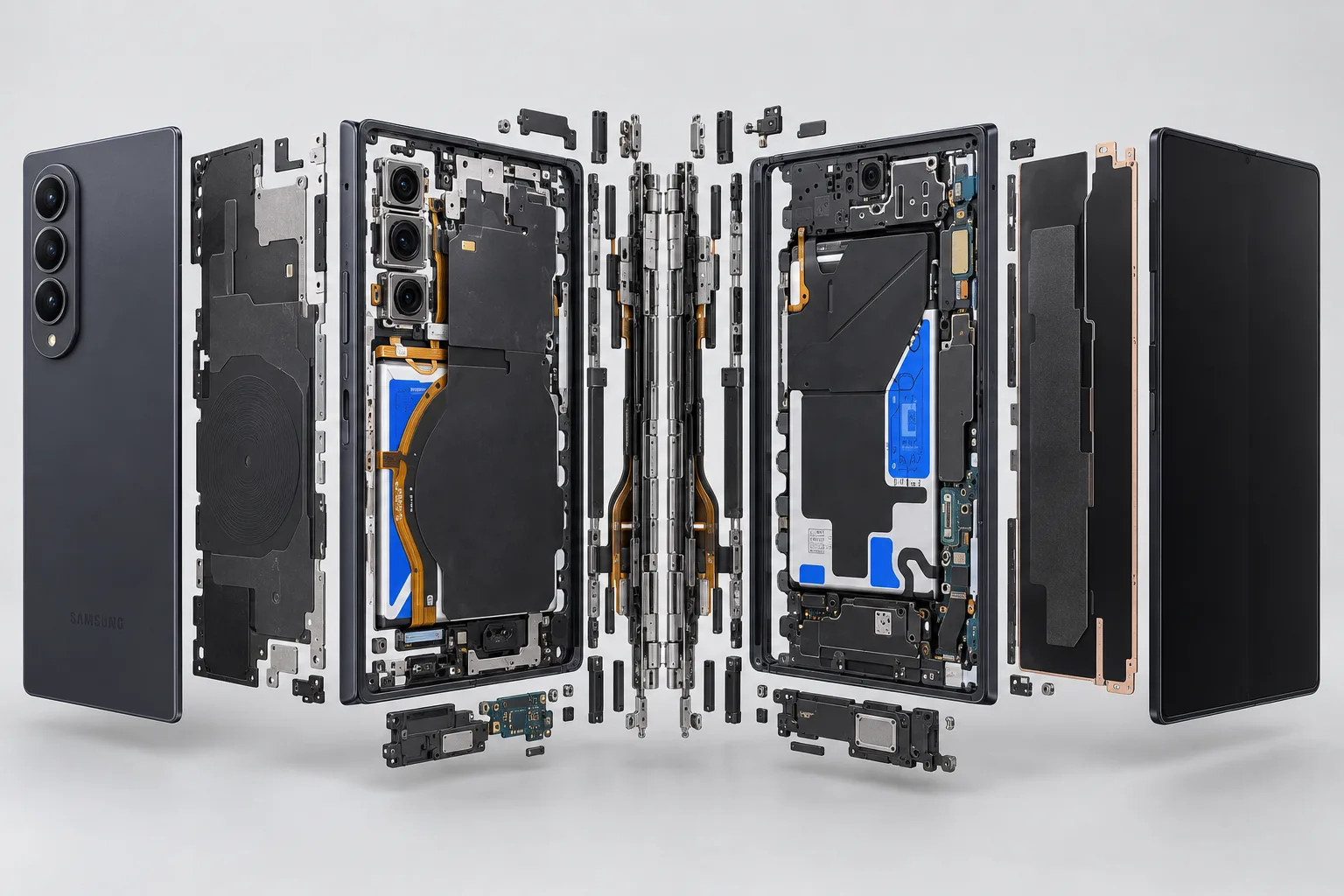
If packing heat dissipation and battery density into a regular slab is hard, foldables make it an absolute nightmare.
In a standard smartphone engineers have a single solid volume to work with. If a component runs hot or needs more room you shift things around inside the same rectangular box.
Foldables destroy that luxury. You are cutting the device in half and giving the engineers barely 4mm to 5mm of thickness per side when opened.
Every fundamental rule of phone design breaks down here.
- You cannot fold a battery: Lithium and silicon cells do not bend. Engineers have to split the battery into two separate cells on either side of the chassis. They have to balance the weight down to the gram so the phone does not feel lopsided when you type with two hands.
- The hinge steals the best real estate: In a regular phone the center spine is where the motherboard and cooling channels sit. In a foldable a complex mechanical titanium hinge takes up that entire corridor.
- Split motherboards and flexing circuits: Because the center is occupied by moving gears the motherboard has to be sliced in two. Every signal, display data stream, and power line has to pass through ultra thin ribbon cables running through the hinge. Those cables have to survive hundreds of thousands of folding cycles in extreme humidity without snapping.
- Thermal isolation: A standard vapor chamber cannot bend across a mechanical joint. Engineers have to design two separate cooling ecosystems and figure out how to transfer heat between both halves so one side does not burn your palm while the other stays cool.
This is why foldables are the ultimate benchmark for hardware engineering today. It is not about the novelty of a bendable screen anymore. The gimmick phase is over.
A modern foldable is a brutal test of packaging density. If a brand can fit a desktop tier processor, dual batteries, proper cooling, and a durable hinge into a chassis that still closes flat in your pocket, they have solved mechanical problems that camera software never had to deal with.
The Thermodynamic Reality Check
And then there is the real problem. Heat.
Why is heat suddenly a massive issue again? It is because of on device AI. Running complex AI models locally and pushing 3000 nit screens burns an insane amount of sustained power. Modern flagship chips can produce a lot of performance but peak benchmark scores are completely useless now. If a phone cannot cool itself it will thermal throttle in five minutes and force that beautiful bright screen to dim down to protect the battery.
This is why cooling is becoming the most important part of phone design. Vapor chambers are the new battleground. A vapor chamber is a thin hollow chamber typically made of either copper or stainless steel with a small amount of liquid inside. When the liquid heats up it becomes a gas which expands and disperses the heat throughout the phone. The real flex for a 2026 flagship is not the processor speed. It is how much cooling the engineers managed to cram inside to keep the chip running at peak performance during a hot Indian summer.
Even Apple is bragging about this. The new iPhone 18 Pro uses a redesigned vapor chamber with triple the total surface area of previous models to improve sustained performance by 40 percent. You cannot advertise a vapor chamber like a camera lens but you notice the result when your phone does not melt while running an AI task.
The Form Factor Flex of Smartphone
Foldable phones make this engineering problem even harder. A normal smartphone already has very little room inside. A foldable has to accommodate hinges, flexible displays, and dual batteries in half the space. The iPhone Duo uses a custom vapor chamber as part of its thermal management system just to survive running a 7.6 inch internal display while staying 5.2mm thin.
When every glass slab takes identical photos the only way a brand can justify charging over 1.5 Lakh is through extreme physical engineering. The question is no longer who can put the best camera in a phone. It is who can fit the most capability into the same physical space.
Packaging density is the new ultimate luxury. Every component competes for the same limited volume. You are paying for the fact that engineers fit a desktop tier processor, massive cooling chambers, and next generation batteries into a sliver of titanium.
Stop watching generic YouTube camera comparisons. The only specs that matter right now are battery chemistry and how well the phone handles heat. The next great smartphone is not the one with the biggest lens on the back. It is the one where the engineers managed to make everything work together underneath the glass.