We already have ChatGPT, Claude and Gemini. They can write, explain, reason, search, code and do a lot of other things. So when another AI model suddenly starts getting attention, a reasonable question is: what is it actually bringing to the table?
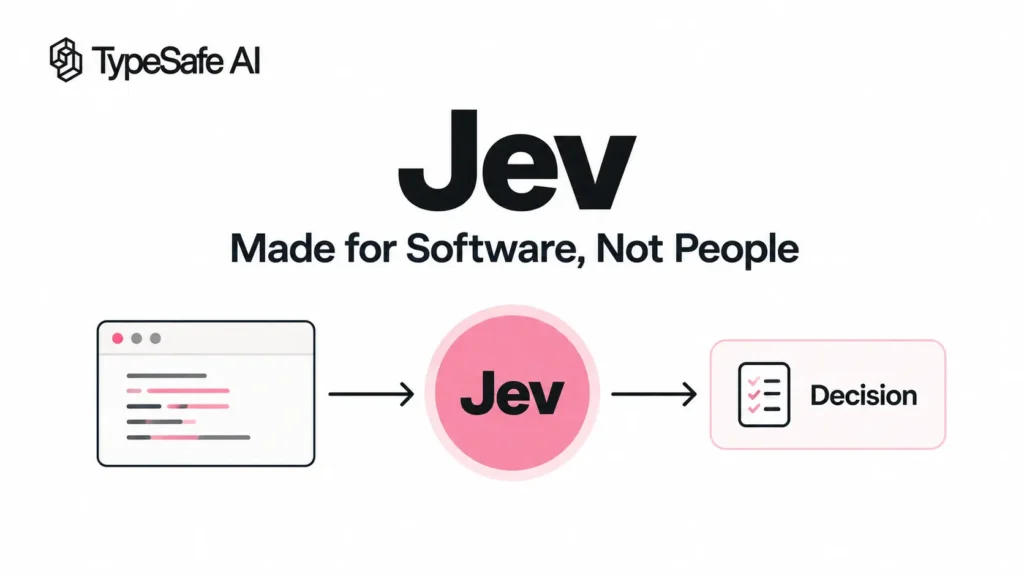
Jev is not another chatbot. You do not open Jev, type a question and wait for a long answer. It is built for software, where the useful result is often not a paragraph but a simple decision that a program can use.
So what does Jev actually do?
Think about a customer support system.
A customer writes, “I’ve been waiting 12 days for my refund.”
The company’s software wants to know where that message should go. It could ask Jev a simple question:
It looks at the information and returns a structured answer. For a simple example, it might say that Billing is the most likely choice, along with a probability showing how confident it is.
The important part is what happens next. Jev does not take control of the company’s system and decide what the company should do. It answers the question that the software asked. The company’s own code decides what happens after that answer.
That distinction is important because Jev is not an autonomous business manager. It is a decision-making component that software can use.
TypeSafe, the company behind Jev, says the model is designed around three basic kinds of questions. A program can ask for a yes-or-no judgment, choose one option from a defined list, or assign a score to something. TypeSafe
Instead of asking an AI to write something, the software can ask it a very specific question and get back an answer in a form the software already understands.
Is Jev an app for normal users?
Not really. It is provided through an API. In simple terms, an API lets one piece of software send information to another service and receive a result without a person sitting in the middle typing questions and copying answers.
So the customer might never see Jev at all.
The process could look something like this: a customer sends a message to a company’s website, the company’s software sends that message to Jev with a question, It returns a result, and the company’s software uses that result to decide what happens next.
The customer simply sees the final result.
That makes Jev mainly a tool for developers and businesses building software, rather than a consumer AI product. an independent Jev API guide describes the process as sending information and questions to the Jev API, reading the answer in code, and then deciding separately whether the application should act on it.
Why would software need this?
Software has always been good at making fixed decisions.
That works perfectly when the rule is clear. The problem comes when the decision depends on things that are difficult to describe with ordinary rules.
Take customer support again. A company might want to know whether a message sounds urgent. It could write dozens of rules based on certain words, but people do not always describe problems in the same way.
Jev can be given the message and asked to rate its urgency.
The same approach can be used to sort incoming requests, decide which process should handle something, check whether an AI-generated answer should be trusted, or determine whether a workflow should continue or stop. TypeSafe and Vercel describe these kinds of uses as classifying, routing, scoring, checking results and choosing what should happen next.
This is where the idea starts becoming more useful than it first appears.
Think of Jev as an AI-powered rule
Imagine ordinary software making a decision like this:
If the message contains X, do Y.
That is simple, but it can become messy when real-world situations do not fit neatly into fixed rules.
With Jev, the software can ask something closer to:
Does this message look serious enough to send to a human?
The software still controls the workflow. Jev simply supplies the judgment that the fixed rule could not easily provide.
The idea is to let AI sit inside normal software logic as a flexible decision rule, instead of making the software deal with a long answer written for a person. TypeSafe
How is this different from ChatGPT or Claude?
This part is easy to misunderstand.
It is not that ChatGPT, Claude or Gemini cannot make decisions. They can. They can also be asked to return structured data instead of normal prose.
The difference is what the model is built around.
A general language model is fundamentally designed to generate language. Even when you ask it for structured data, it is still producing an output that the application has to handle carefully.
Jev is built around the decision itself. The possible answers are defined in advance, and the model returns those answers directly along with probabilities and confidence information. TypeSafe
That makes a difference when a program needs an answer it can immediately use.
Suppose your software needs one of three values:
- Billing
- Technical Support
- Sales
It does not need an explanation. It needs one of those values. Jev is designed for that kind of job.
Where does Jev fit into an AI agent?
This is probably the easiest way to understand why a company would want Jev.
These decisions do not always need a full conversational answer. They need reliable signals that the software can use. That is where Jev can sit alongside the main language model.
The language model handles the conversation and broader understanding. Jev handles small, specific judgments around the workflow. The software then uses those results to determine what happens next.
Why not just use a normal AI model for all of this?
You could. The question is whether that is the most practical way to build the system.
A general AI model is doing a much broader job than simply answering a small decision question. If a program only needs a classification, a score or a yes-or-no judgment, generating a whole response can be unnecessary.
Jev is built specifically around these smaller decisions. TypeSafe says this lets it process multiple questions in parallel and return structured results without going through the usual process of generating a long text response and then parsing that response in software. TypeSafe
Speed and cost are also part of the pitch.
TypeSafe currently publishes Jev at $0.042 per million input tokens and reports response times of roughly 70 to 500 milliseconds. On its own workflow evaluations, the company reports much larger speed and cost advantages against language models. Those figures come from TypeSafe’s own tests and should be treated as company-reported results rather than independent benchmarks. TypeSafe
The basic idea is simple: when software has to make a huge number of small AI-assisted decisions, even a small saving in time and cost can matter.
They are mainly built to communicate with people. You ask something, and they generate an answer that a person can read and understand.
Jev is built for software. A program gives it information and asks a focused question, and Jev returns a result that the program can use.
What Jev does not do
Jev is not a replacement for ChatGPT, Claude or Gemini.
It is not designed to write articles, hold conversations or produce long explanations. It is not a search engine either. And it does not magically know what a business should do.
A developer has to decide what question to ask and what the possible answers mean. The application then decides what to do with Jev’s result.
This is also why confidence matters. If Jev is unsure, the software can choose not to act automatically and instead send the case to a person or another system for review. an independent Jev API guide specifically gives this kind of separation between getting a result and deciding whether to take an action.
The model provides a judgment. The surrounding software remains in charge.
Why is Jev suddenly getting attention?
TypeSafe released Jev publicly in early access on September 15, 2026. A few days later, Vercel reported that Jev had become the fastest-adopted model launch in the history of its AI Gateway. According to Vercel, nearly 13% of its paid teams were using Jev within its first 24 hours. That is a Vercel platform measurement, so it should not be treated as a measure of the entire AI market. TypeSafe Vercel
The bigger reason for the attention is not that Jev is another model competing to write better answers.
The interesting part is where AI is being used.
AI is moving further into ordinary software. It is being used to sort requests, check information, route work, choose tools and make decisions inside automated workflows. Those systems often need many small judgments rather than one long conversation.
Jev is built specifically for that layer.
That is why it is worth paying attention to, even if you never use Jev yourself.
Forget the complicated terminology for a moment.
People
ChatGPT, Claude and similar models are built mainly for communicating with people.
talks with youSoftware
Jev is built for communicating with software and giving it a focused judgment.
software talks to itJev is not really an AI you talk to.
It is an AI that software talks to.