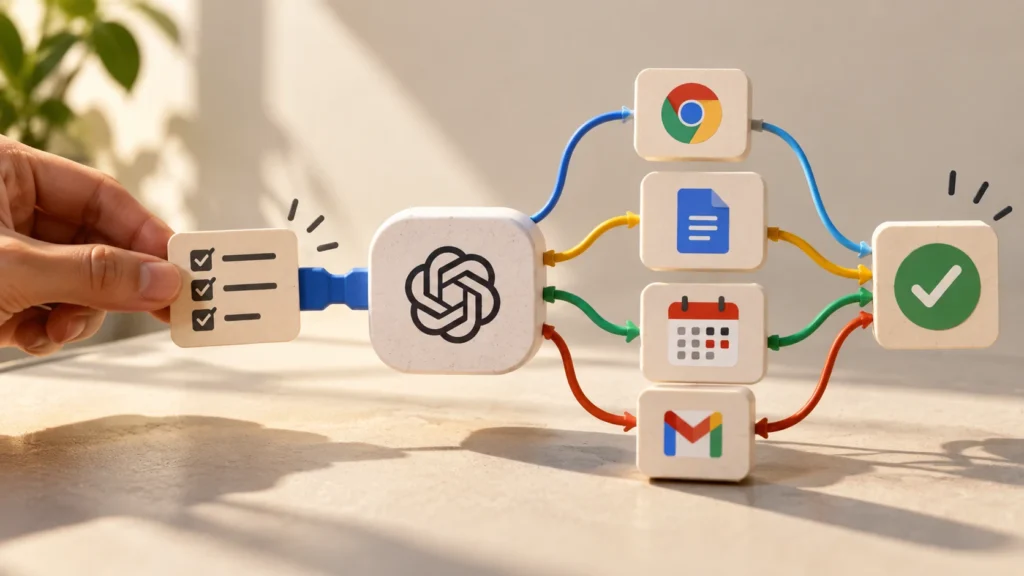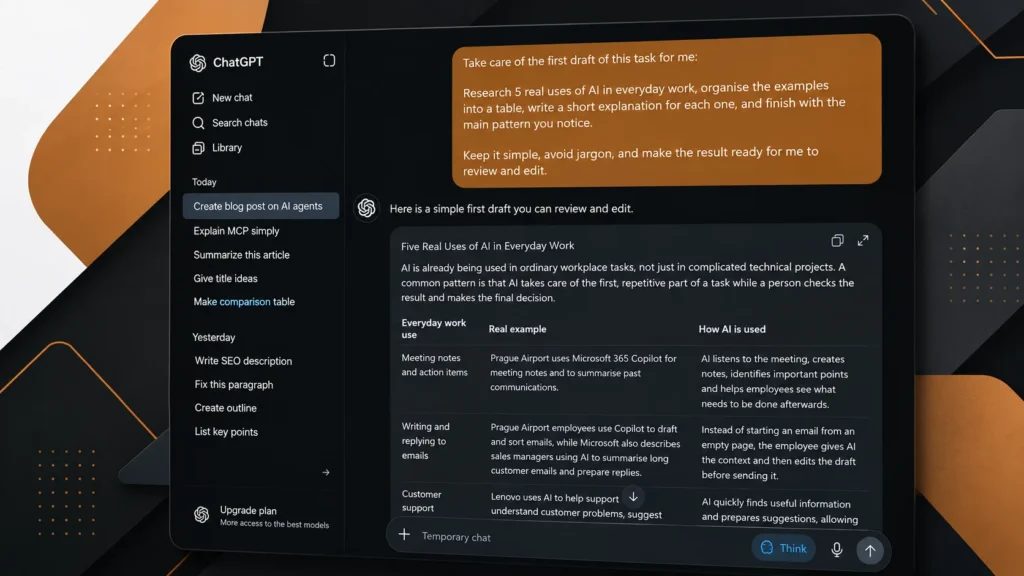
For a long time, using software meant doing the work yourself. You opened an application, found the right option, typed everything in, moved things around, checked the result and then moved to the next step. Even when software made the work faster, you were still the one doing most of it.
AI is slowly changing that relationship.
The change is easy to miss because nothing dramatic happened on a particular day. There wasn’t a morning when computers suddenly started doing our jobs. Instead, the way we interact with them has quietly changed.
Earlier, you would tell a computer exactly what to do. Now you can describe what you want and let the system figure out some of the steps itself. That sounds like a small difference, but it changes what your role looks like.
You might ask AI to write something, organise information, compare options, create a plan or work through a task. You are still involved, but you are not necessarily sitting inside every step of the process.
You give it direction, look at what comes back, fix what is wrong and move on. That is a different way of working.
From doing the work to directing the work
Most of us were taught to think about productivity in a very simple way: if you want something done, you do it.
That made sense when the main tools available to us were tools that required direct control. A spreadsheet could calculate for you, but you still had to put the data in. Photoshop could help you edit an image, but you still had to perform the edits. A search engine could find information, but you still had to go through the results yourself.
AI can sit somewhere closer to the middle. You can give it an objective rather than a list of tiny instructions. That means the valuable skill gradually starts moving away from pure execution.
It becomes more important to know what should be done, explain it clearly, notice when the result is wrong and decide what needs to change.
You are still doing the work. You are just doing less of the mechanical part of it. This is where the idea of “assign, don’t do” comes from.
The new loop is simple
Think about the way you might work with another person.
You give them a task. They do it. You check the result. Maybe something is wrong, so you ask them to change it. They make the correction and you continue.
AI is beginning to fit into that same loop. Assign. Check. Adjust. Then assign the next thing.
Assign
Give AI the task and explain what you want.
Check
Look at what AI produced and see if it makes sense.
Adjust
Fix what is wrong, improve what is weak, and continue.
The important part is that AI does not have to be perfect for this to be useful. In fact, it can make obvious mistakes and still save you a lot of time. You are no longer spending ten minutes doing something manually just because you do not trust the machine to do it perfectly.
You can let it handle the first version and spend your time checking whether that version is actually good. That changes the economics of your time. This is where AI starts moving beyond simply giving you an answer and starts doing actual work.
If a task used to take an hour and AI can produce a useful first attempt in ten minutes, your job is no longer simply to finish the task. Your job becomes knowing whether those ten minutes produced something worth keeping. And that is a different skill.
Why this can feel uncomfortable
There is a strange psychological part to this shift. When you do everything yourself, you can see your effort. You know where the time went. You wrote the paragraph, fixed the spreadsheet, searched for the information and arranged everything.
When AI handles some of those steps, the work can feel less like yours. You may even feel that you are not doing enough. But effort and involvement are not the same thing.
A person managing a process does not need to personally perform every action inside that process. Their value can come from deciding what should happen, spotting problems early and keeping everything moving in the right direction.
AI is pushing more people towards that kind of role. The difficult part is knowing where to stop trusting it.
Do the work
Handle the task yourself.
Work through every step.
Spend time on execution.
Direct the work
Tell AI what needs to be done.
Check what comes back.
Spend more time on decisions.
The real skill is judgment
The easiest mistake is to think that this new way of working is about writing better prompts. It is partly about that, but not really.
A perfectly written instruction is useless if you cannot recognise a bad result.
The more AI handles, the more important your judgment becomes. You need to know what a good answer looks like. You need to notice when something sounds convincing but is actually wrong. You need to decide which parts deserve another check and which parts are good enough to move forward.
So the useful loop becomes:
Give AI the job.
Look at what it did.
Correct it.
Move on.
AI can do the work. You still decide what is good.
The more AI handles, the more important it becomes to know what to trust, what to change, and when the result is ready to use.
The person who understands that loop can often get more done than someone who insists on manually handling every step. Not because they are working harder, but because they are spending their attention differently.
This is bigger than chatbots
This is also why the conversation around AI is slowly moving beyond simple chatbots.
A chatbot answering a question is useful, but the bigger shift happens when AI starts handling a sequence of tasks. Instead of asking one question and getting one answer, you give the system a goal and it works through parts of the process.
That is where ideas like AI agents become important. The interface may still look like a chat box, but the relationship is different. You are no longer just asking for information. You are assigning work.
AI Answers
You ask a question and get a response.
AI Does
You give it a task and let it handle parts of the work.
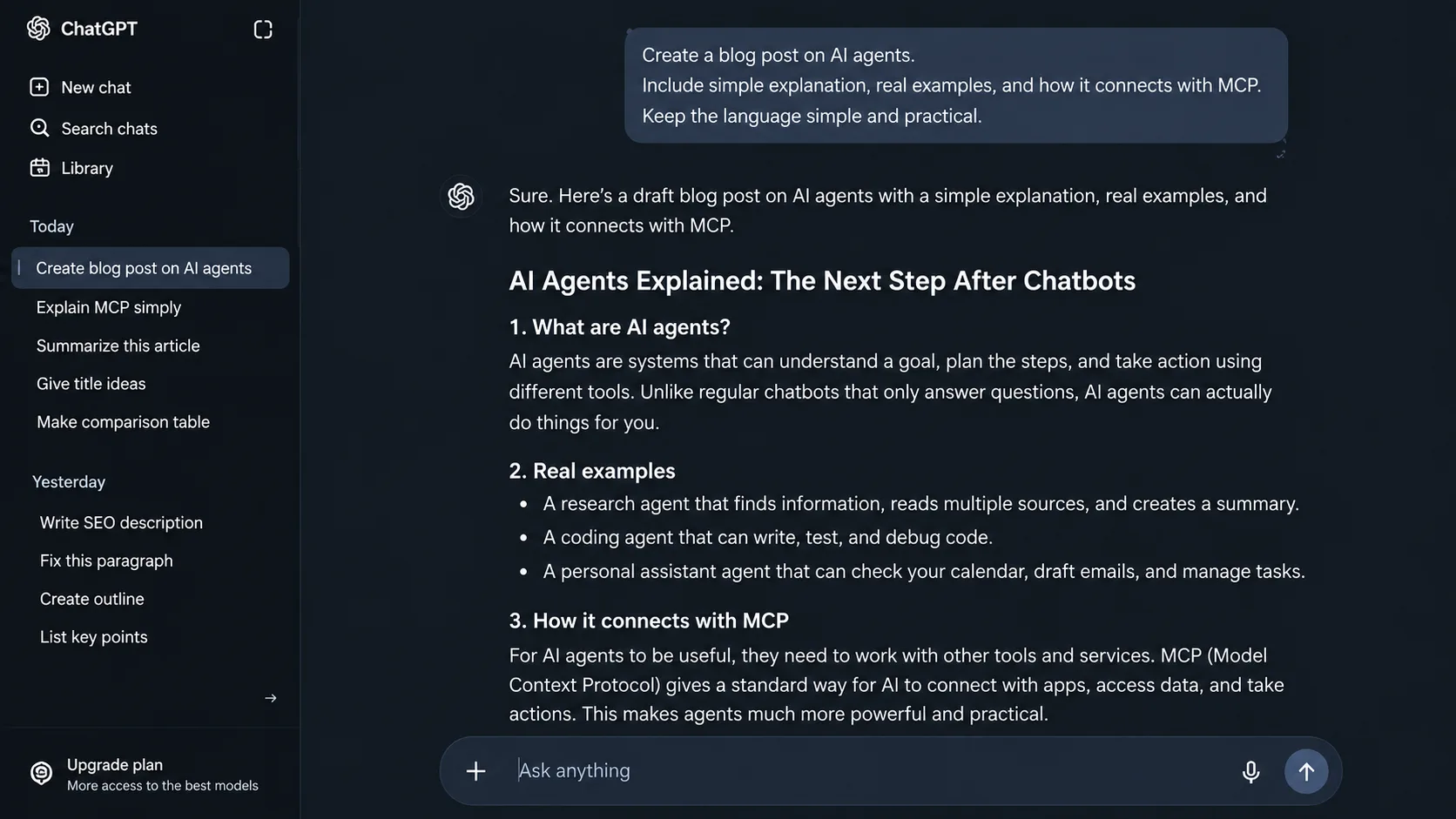
And once that becomes normal, software starts feeling less like a collection of buttons and more like something you can delegate to. For that to work properly, AI needs a way to connect with other tools and services. That is where MCP comes in.
That is a much bigger change than simply having a smarter search box.
We are probably not leaving humans out of the loop
There is a tendency to describe every AI change as either “AI will replace everyone” or “AI is just another tool.” Reality is sitting somewhere in between.
People are still making the decisions. Someone still has to define the goal, decide what matters, check the result and take responsibility for the outcome.
What is changing is how much of the execution sits between those decisions.
That may eventually change how many jobs are organised. A person who once spent most of the day producing things manually may spend more of that day reviewing, coordinating and directing systems that produce them.
Ask
Know what you want and explain it clearly.
Trust
Know what is safe to accept and what needs checking.
Change
Know when the result needs another round of work.
The job title might not change immediately. The work inside the job might. And that is probably the part worth paying attention to.
We are entering a period where knowing how to do something manually may still matter, but knowing how to get a system to do the first 80 percent of it could matter just as much.
The people who understand that early will not necessarily become experts in AI. They may simply become comfortable with a different way of working. You don’t need to understand every AI tool either. What matters is knowing which AI to use for which job.
Give the system a direction. Let it work. Check what came back. Fix what matters. Then do it again. The future of work may not be about doing everything yourself.
It may be about knowing what should never be done manually in the first place.