APIs have been connecting software for years.
Your weather app can ask a weather service for today’s temperature. A payment app can communicate with a bank. A website can pull data from another service. Developers don’t need to know how those systems work internally. They just use the interface the service provides.
So when MCP started getting attention as a way for AI applications to connect to tools and data, there was a pretty obvious question.
Why? What was wrong with APIs?
That sounds like a small difference, but it becomes much more interesting once you look at how AI actually uses software.
APIs Already Solve the Basic Problem
An API is basically an interface between software systems. It gives one piece of software a defined way to interact with another without needing to know everything happening behind the scenes.
Imagine you are building an application and want to get weather information.
The basic flow could look like this:
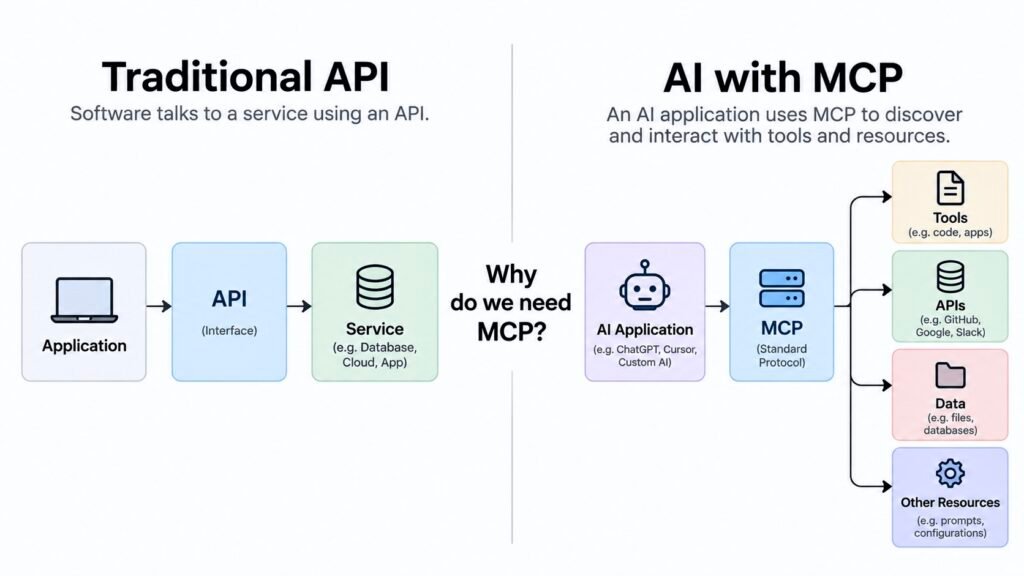
Your application → Weather API → Weather service → Response
Your application asks for the weather, the service processes the request, and the answer comes back. Nothing is wrong with this.
In fact, APIs are one of the reasons modern software can be built by combining hundreds of different services instead of rebuilding everything from scratch.
get_weather(city).Your application knows what that function does, what information it needs, and what kind of response it should expect.That’s enough.The application doesn’t need to understand the weather company’s entire backend.And this is where the MCP question becomes interesting. Because an AI application can also call an API. So why introduce another protocol?
The Problem Appears When the AI Has Many Things to Use
Let’s say we are building an AI assistant. We want it to work with Gmail, GitHub, Google Calendar, Slack, a database, some local files and maybe a company’s internal software.
Technically, we can connect these things using APIs.
We could build:
AI application → Gmail API
AI application → GitHub API
AI application → Calendar API
AI application → Slack API
AI application → Database API
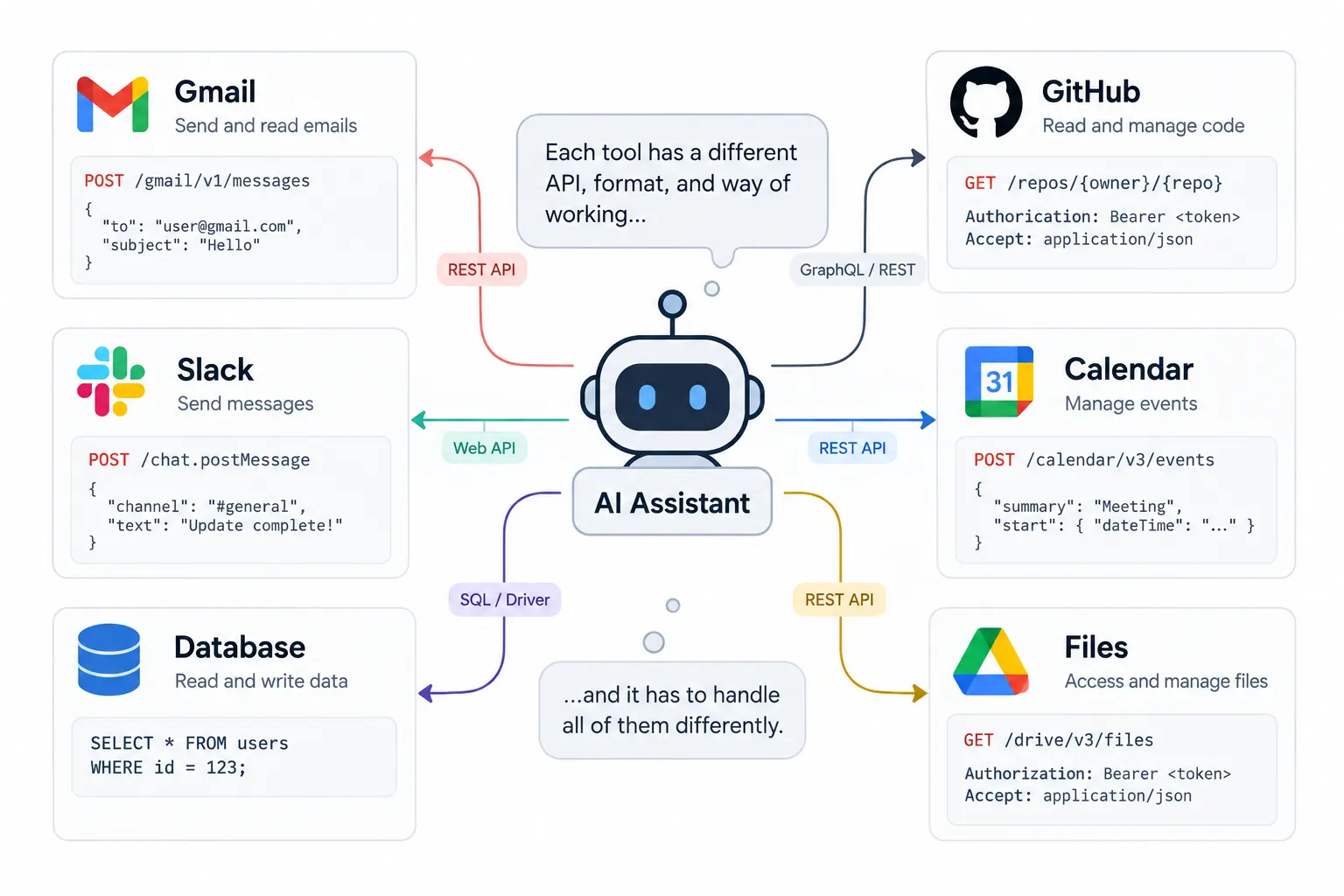
There is nothing technically impossible about this. The problem is what happens to the AI application itself.
Every service has its own interface, authentication method, documentation, request format, response format, permissions and quirks. The application has to understand each one.
The more tools you add, the more individual integrations you end up managing. That is still an API problem in the normal sense. But there is another problem sitting on top of it.
The AI has to figure out how to use all those capabilities. And that is where things change.
Software Usually Knows What It Wants
A normal application generally doesn’t sit there wondering what it should do. A developer has already written the logic.
If the application needs a user’s calendar, the developer tells it which calendar endpoint to call and what parameters to send.
If it needs GitHub data, the application knows which API operation to use. The path is already decided.
An AI agent is different. You can give it a goal instead of a fixed sequence of instructions.
Check my calendar tomorrow, find a suitable time for a meeting, look at the latest project issue on GitHub, and send the client a message.
Now the AI has to work out what capabilities it needs.
It may need a calendar tool. It may need a GitHub tool. It may need a messaging tool. It may need information from a particular file. And it has to decide how those capabilities fit together.
The problem is no longer simply: Can software communicate with this service?
It becomes: How does an AI application discover what it can use, understand those capabilities, and actually invoke them?
That is a different problem.
Imagine Building This Without a Common Standard
Suppose you make your own AI assistant. You connect GitHub first. Then Slack. Then Google Drive. Then your company’s CRM.
Every connection works, but your AI application now has to deal with four different integration systems.
The GitHub integration exposes things one way. The CRM exposes them another way. The Slack integration has its own conventions.
Your database works differently again. The AI itself doesn’t really need four completely unrelated ways of interacting with tools.
It needs a consistent way of being told:
Here are the things you can use.
Here is what each thing does.
Here is what information it needs.
Here is the result you can expect.
This is where MCP starts to make sense.
So What Is MCP Actually Doing?
The Model Context Protocol uses a client-host-server architecture. MCP servers can expose capabilities such as tools, resources and prompts, while the host application manages the clients and their connections.
You don’t need to memorize that architecture. The useful part is the idea behind it.
An MCP server can act as a standardized doorway to some capability. That capability might involve a database. It might involve files. It might involve GitHub. It might involve calling an existing web API.
The MCP server exposes those capabilities in a way an MCP-compatible AI application can understand.
So instead of thinking:
AI → completely different integration for every service
you can think more like:
AI application → MCP → tools and resources
The service underneath can still be doing whatever it was doing before. This is why MCP isn’t really an API replacement.
An MCP server can actually call APIs behind the scenes. The API is still useful. MCP is solving a different layer of the problem.
This Is Where Tools Become Important
One of the main things an MCP server can expose is a tool.
The MCP specification describes tools as functions that can be invoked by language models. Those tools can query databases, call APIs, perform computations or interact with other external systems.
Imagine a server exposing:
search_invoices
get_invoice
check_payment_status
Now imagine you ask: “Did Acme pay their latest invoice?”
The AI could discover that these tools are available and decide which ones it needs. Maybe it searches the invoices first. Then it finds the latest one. Then it checks the payment status.
The important part is not that an API couldn’t do this. Of course it could.
The important part is that MCP gives the AI application a standardized mechanism for exposing and invoking these capabilities.
That matters much more when an AI has dozens or hundreds of possible tools.
MCP Is Also About More Than Tools
Tools get most of the attention because they are the part that lets AI actually take action. But MCP also defines other primitives.
Servers can expose resources, which can provide contextual data such as files, database schemas or application-specific information. MCP also supports prompts, which are structured prompt templates that can be discovered and used by clients.
So the idea isn’t simply: “Here is an API endpoint.”
It can be closer to: “Here are the capabilities and information this system can provide to an AI application.”
That distinction becomes increasingly useful as AI moves from simply generating text toward actually working with external systems.
MCP vs API
| API | MCP | |
|---|---|---|
| Main purpose | Lets software interact with a service or system | Standardizes how AI applications interact with tools and resources |
| Focus | Application-to-service communication | AI-to-tool and AI-to-context interaction |
| Defines | Interfaces, requests, responses and operations | Tools, resources, prompts, capabilities and protocol interactions |
| Can use APIs? | Yes | Yes. An MCP tool can call an API underneath |
| Replaces the other? | No | No |
The easiest mistake here is to look at the table and conclude that MCP is just a better API. It isn’t.
A better way to look at it is this:
An API gives software a way to communicate with something.
MCP gives an AI application a standardized way to work with capabilities exposed to it.
Those things can overlap, but they are not the same job.
Why This Matters More for AI Than It Did Before
Traditional software has usually been built around fixed integrations. A developer decides that the application needs a particular service, writes the integration, tests it and ships it.
AI agents introduce a different model. The user can give the AI a goal, and the AI can choose from a collection of available capabilities to accomplish it. That means the number of possible tools matters.
One integration isn’t especially interesting. Ten integrations are manageable. Hundreds of tools become a very different engineering problem.
The more systems an AI can interact with, the more useful a common protocol becomes. That’s probably the most important reason MCP exists. Not because APIs suddenly became inadequate. Because AI is becoming a different kind of software client.
But MCP Doesn’t Magically Fix Everything
This is worth saying because it is easy to get carried away with the idea. A standard protocol doesn’t automatically make every tool safe, accurate or well designed.
If an MCP tool has too much permission, that’s still a problem.
If the underlying API is badly designed, MCP doesn’t magically repair it.
If the AI misunderstands what a tool does, the protocol doesn’t make the model smarter.
And security still matters a lot.
The MCP specification itself treats tool use, data access and user consent as important security concerns, and its documentation recommends that applications maintain clear user control over tool invocations and data exposure.
That is actually one of the more interesting things about MCP.
Making it easier for an AI to use software also makes questions about permissions and trust more important.
So, Is MCP Replacing APIs?
No. And this is probably where the whole “MCP vs API” discussion becomes misleading.
You can still have:
Application → API → Service
With an AI system, you might instead have something like:
AI application → MCP server → API → Service
The MCP server could expose a tool to the AI, while that tool uses an existing API underneath. Or the MCP server could interact with something else entirely, such as local files or a database. So there isn’t necessarily a battle happening between MCP and APIs. They can sit at different layers.
Our Take
The interesting thing about MCP is not that it fixes some huge flaw in APIs. APIs have been doing their job for a long time. The interesting thing is that AI is changing what we expect software to do.
A normal application usually knows exactly which service it wants and what operation it needs to perform.
An AI agent can be given a goal and a collection of possible tools. It may need to discover those tools, understand what they can do, choose between them and combine their results. That is a different integration problem.
MCP makes more sense once you look at it from that angle. It’s less about replacing APIs and more about creating a common layer for AI applications that need to work with lots of different capabilities.
And maybe that is the better question to ask whenever another AI protocol shows up. Not “Didn’t we already have something for this?”
But: “What has changed about the software using it?”
Because sometimes the old technology still works perfectly. The thing that changed is the user on the other side.