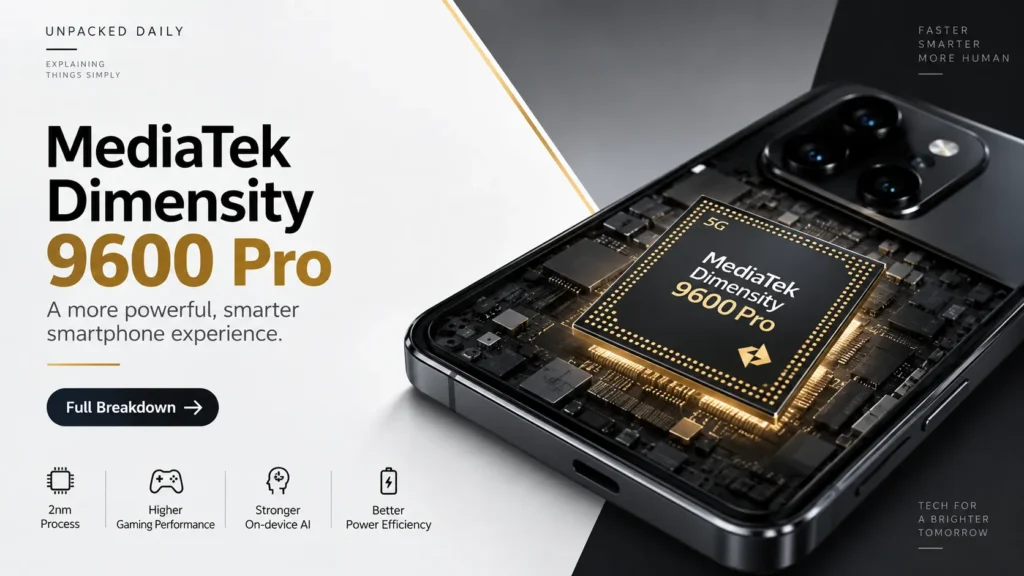
MediaTek’s Dimensity 9600 Pro is getting a lot of attention because the specifications look almost ridiculous on paper. A 2nm process, CPU cores reaching 4.55GHz, an all-big-core design, LPDDR6 memory and a new GPU are enough to make any hardware enthusiast curious.
But specifications alone don’t tell you what a chip will actually feel like in a phone.
The interesting question is not simply how fast the Dimensity 9600 Pro can be. It is what MediaTek changed to get there, how much of that performance can be sustained during gaming, and what the new architecture means for everyday use.
The chip also creates some confusion because MediaTek has introduced the Dimensity 9600M alongside it. Despite the similar name, the two chips are not simply different performance versions of the same design. The underlying hardware is quite different.
What is the Dimensity 9600 Pro?
The Dimensity 9600 Pro is MediaTek’s new flagship smartphone processor, built around a 2nm manufacturing process. According to the material we’re working from, it is the first smartphone processor in this generation to use TSMC’s 2nm node.
But the manufacturing process is only one part of the story.
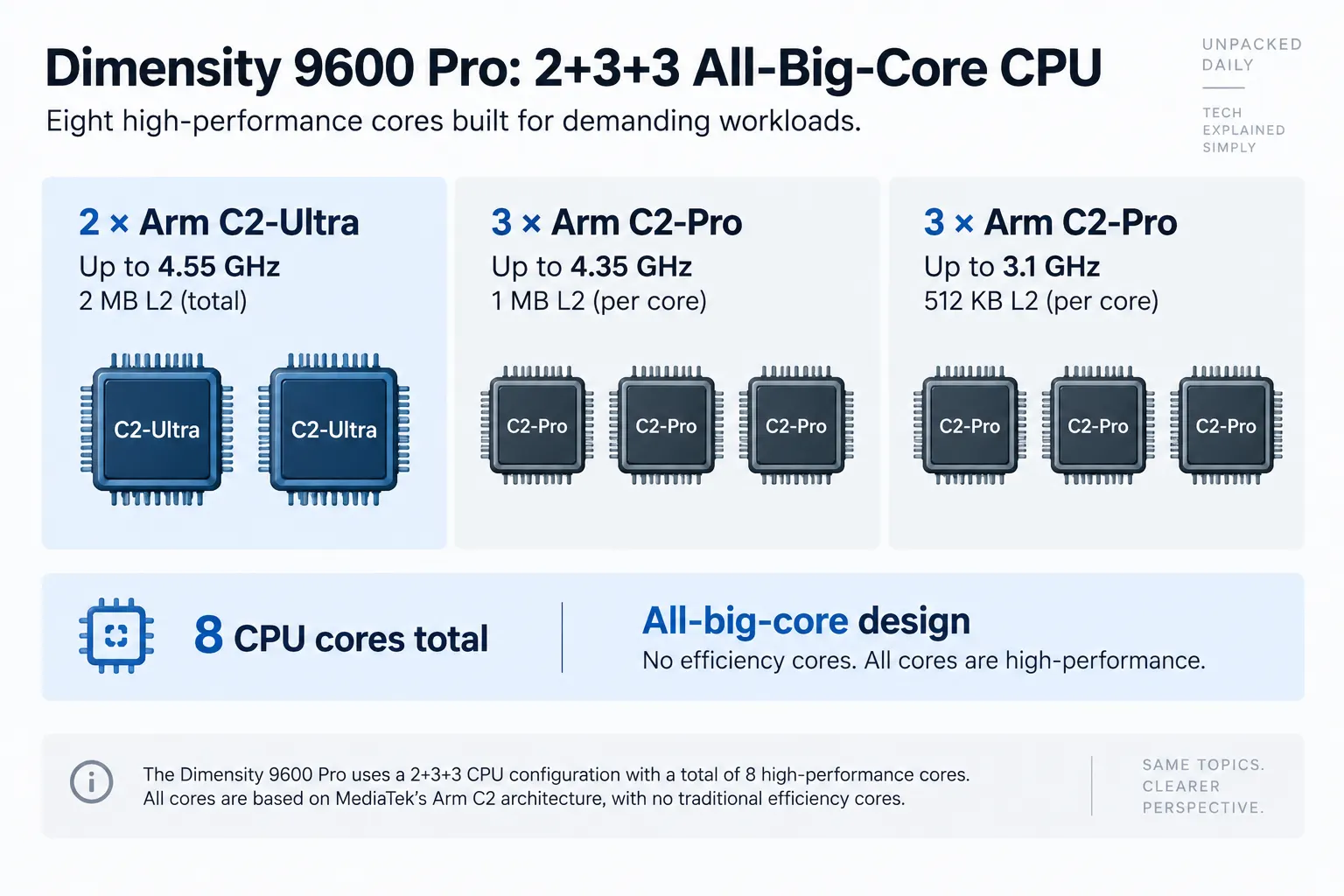
The 9600 Pro also moves away from the traditional arrangement of powerful performance cores mixed with smaller efficiency cores. Instead, it uses an all-big-core CPU design.
That means every CPU core is designed to handle serious workloads.
The configuration is 2+3+3, with two C2-Ultra cores running at up to 4.55GHz and six C2-Pro cores running at lower frequencies. That is a fairly aggressive approach for a smartphone chip.
Why does 2nm matter?
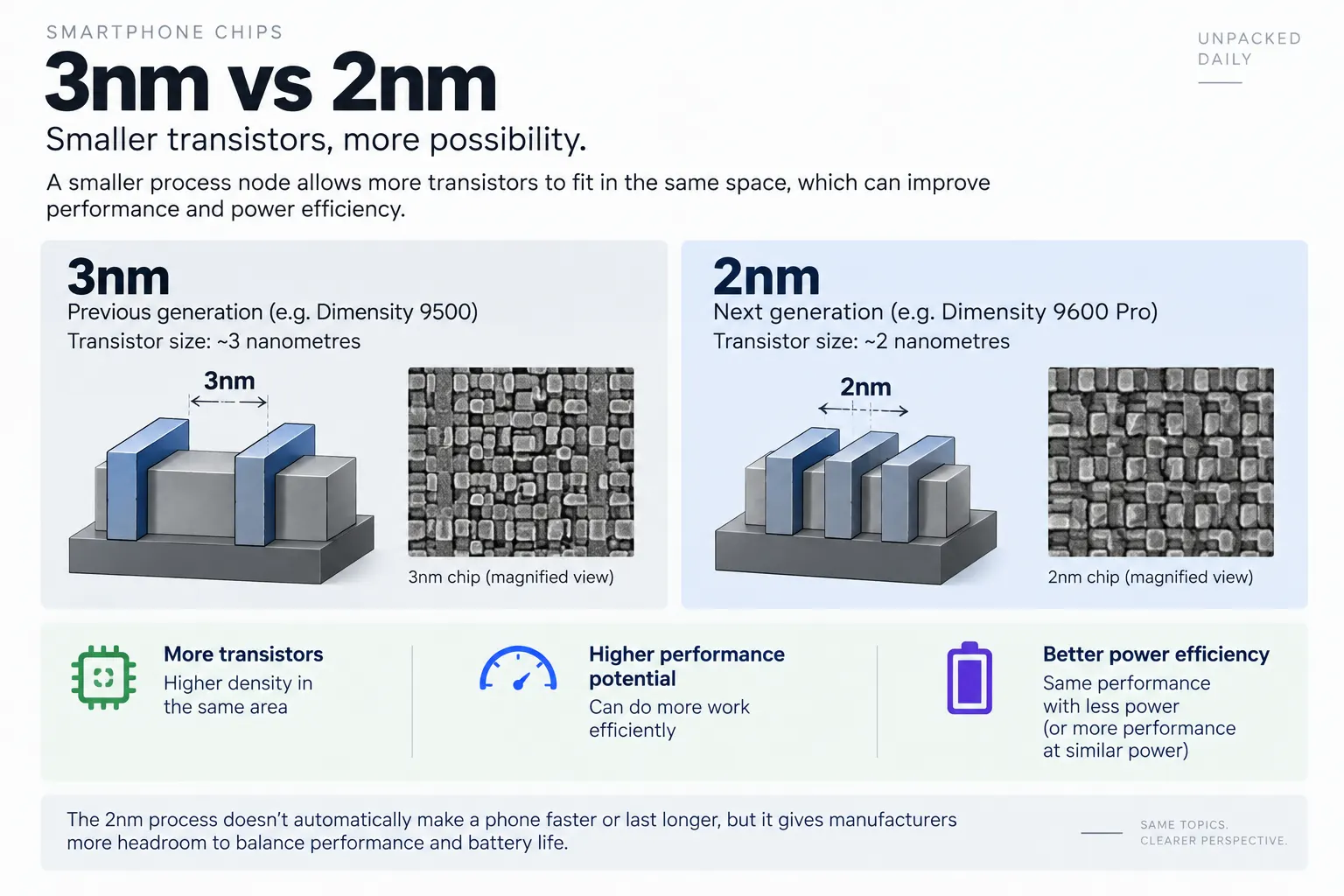
“2nm” sounds like a specification designed mainly for a comparison chart, but the manufacturing process has a real effect on how a processor behaves.
Moving to a smaller process allows manufacturers to fit more transistors into a given area. More importantly, newer process technology can improve the relationship between performance and power consumption.
The idea is simple: if a chip can do the same amount of work using less power, the phone can potentially stay cooler and use less battery. If the manufacturer instead uses that efficiency to push performance higher, the same efficiency can be used to make the chip faster.
That is why a smaller process does not automatically mean a phone will have dramatically better battery life. Manufacturers have to decide how aggressively they want to use the extra efficiency.
The source material also points to roughly 23 percent lower power consumption compared with the previous 3nm generation, although actual phone-level results will depend heavily on implementation and workload.
And this is where things become more interesting.
The all-big-core CPU is the real change
Most smartphone processors have traditionally used different types of CPU cores for different jobs.
A small core can handle background tasks without wasting much power, while larger cores wake up when you need more performance.
The Dimensity 9600 Pro takes a different route.
It uses two high-frequency C2-Ultra cores alongside six C2-Pro cores. There are no traditional efficiency cores in the configuration described in the source material.
This gives the processor a lot of available CPU performance, but it also creates an obvious question.
What happens when all those powerful cores are working hard for a long time?
A processor can run at very high speeds for short bursts. Keeping those speeds over a 30-minute gaming session is a completely different problem.
That is why early benchmark numbers should always be treated differently from sustained performance.
How powerful is the Dimensity 9600 Pro?
On paper, it is clearly designed for flagship-level workloads.
The two C2-Ultra cores can reach 4.55GHz, while the six C2-Pro cores provide additional high-performance CPU capacity. The chip is also paired with next-generation LPDDR6 memory, which is important because modern processors increasingly depend on moving large amounts of data quickly rather than simply increasing CPU clock speed.
This matters even more for AI workloads.
Modern phones are doing more processing locally. Image processing, voice features, generative AI and other on-device workloads all require the processor to move large amounts of information between the CPU, GPU, memory and AI hardware.
So a faster CPU is only part of the equation. The memory system matters too.
LPDDR6 could be more important than it sounds
The Dimensity 9600 Pro is described in the source material as the first mobile chip to support LPDDR6.
That might not sound as exciting as a 4.55GHz CPU, but memory bandwidth can become a major limitation as chips become more powerful.
Imagine having a very fast processor but not being able to feed it data quickly enough. The CPU and GPU can end up waiting for information instead of continuously working.
LPDDR6 is intended to provide the bandwidth needed by these newer workloads, including large AI models running directly on the phone.
In other words, MediaTek is not upgrading only the processor cores. It is upgrading the entire path through which data moves.
Is the Dimensity 9600 Pro good for gaming?
This is probably the question most people will ask.
The 9600 Pro uses a new 12-core Mali G2 Ultra NX GPU with hardware-accelerated ray tracing. The source material also cites early engineering tests in which demanding games such as Genshin Impact and Wuthering Waves maintained 60 FPS for 30 minutes, while Hitman Absolution reached 120 FPS.
Those numbers sound impressive, but they need some context.
A phone’s gaming performance is not determined by the processor alone.
The cooling system matters. So does the screen resolution, game optimisation, graphics settings, software scheduling and the amount of heat the manufacturer is willing to tolerate.
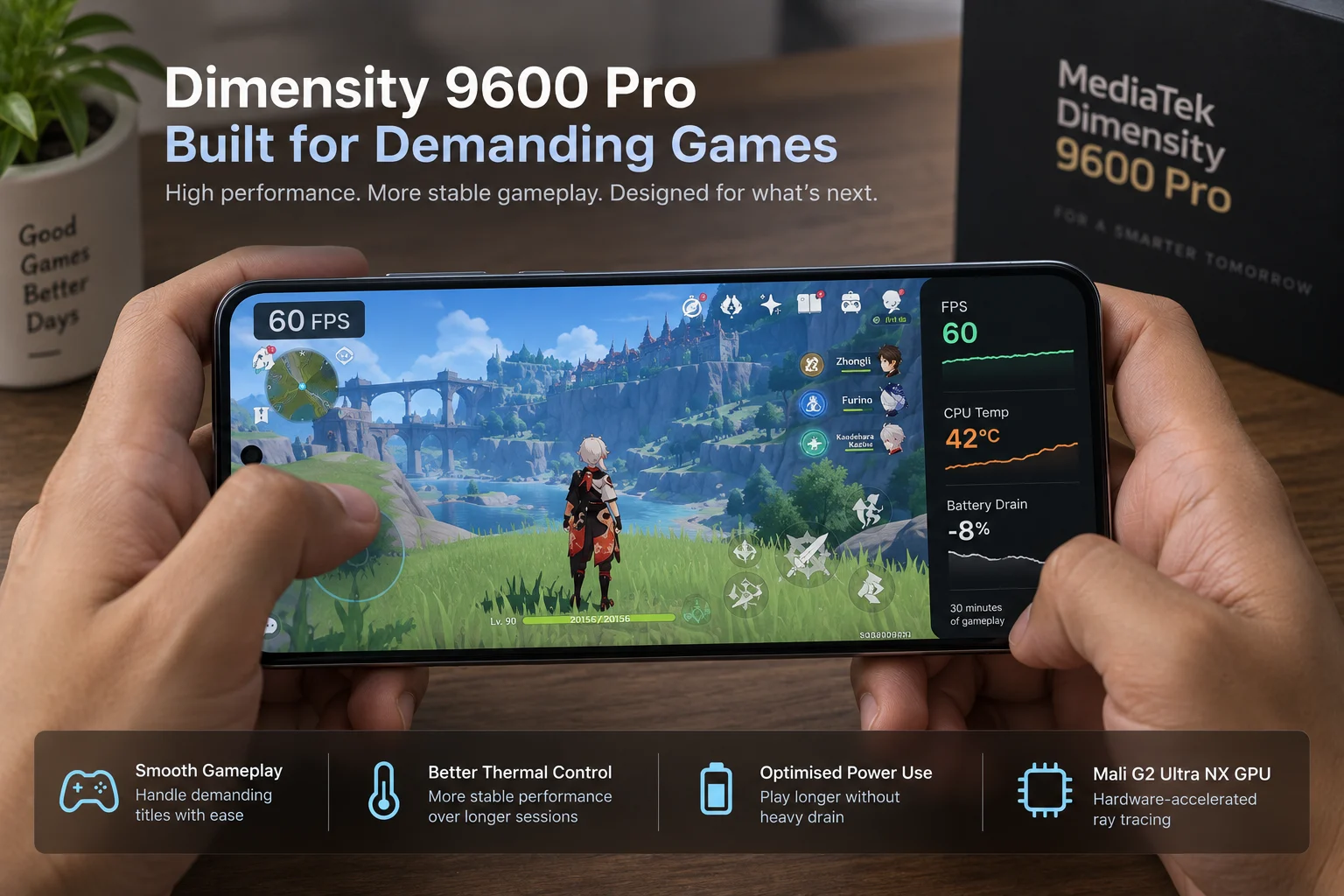
A chip can produce extremely high peak performance and still lose some of that performance after several minutes of sustained load.
That is why retail-phone thermal testing will be more interesting than early laboratory benchmark screenshots.
What about AI?
AI is another major part of the Dimensity 9600 Pro’s design.
The move toward on-device AI means smartphones increasingly need hardware capable of processing models locally rather than sending every task to the cloud. That creates a different type of performance requirement.
The processor needs high CPU performance, strong GPU performance, fast memory and dedicated AI hardware working together.
The 9600 Pro’s combination of the new CPU architecture and LPDDR6 memory is therefore significant for AI workloads, not just gaming.
It is also a good example of why looking only at CPU benchmark scores can be misleading. A modern flagship chip is becoming less about one component and more about how several components work together.
Dimensity 9600 Pro vs Dimensity 9600M
This is probably the most confusing part of the launch.
The names make the two chips sound closely related, but according to the material in our draft, the underlying hardware is considerably different.
The Dimensity 9600 Pro uses a 2nm process, Arm C2 CPU cores and LPDDR6 memory.
The Dimensity 9600M uses a 3nm process, older Arm C1 cores and LPDDR5X memory. The source material describes it as essentially a repackaged Dimensity 9500 with newer software features layered on top.
Here’s the simple comparison:
| Feature | Dimensity 9600 Pro | Dimensity 9600M |
|---|---|---|
| Process | 2nm | 3nm |
| CPU architecture | Arm C2 | Arm C1 |
| CPU layout | 2 Ultra + 6 Pro | 1 Ultra + 3 Premium + 4 Pro |
| Memory | LPDDR6 | LPDDR5X |
| GPU | Mali G2 Ultra NX | Mali-G1 Ultra |
The difference is therefore more than clock speed.
The 9600 Pro represents a newer hardware platform, while the 9600M sits closer to the previous generation underneath the newer branding.
So what will actually matter when phones arrive?
This is where the Dimensity 9600 Pro becomes genuinely interesting.
The specifications already tell us that MediaTek is chasing higher performance and greater memory bandwidth. What they cannot tell us by themselves is how manufacturers will implement the chip.
A thick phone with a large cooling system can behave very differently from a thin phone using the same processor.
The same chip can also deliver different battery life depending on the screen, software, thermal limits and power tuning chosen by the manufacturer.
So when the first commercial phones arrive, three things will be worth watching closely: sustained gaming performance, temperatures and battery consumption.
Those tests will tell us much more than a single benchmark score.
The bigger picture
The Dimensity 9600 Pro is interesting because it represents a broader change happening in smartphone processors.
The industry is no longer simply chasing higher CPU clock speeds.
Processors are becoming systems of their own, combining powerful CPU cores, increasingly capable GPUs, dedicated AI hardware and faster memory into a single package.
The 9600 Pro’s 2nm process, all-big-core CPU design and LPDDR6 support are all pieces of that transition.
And there is another reason this chip matters.
The most interesting question is not whether a phone can produce an enormous benchmark number for five minutes. It is whether that performance can be maintained without excessive heat or battery drain.
That’s something we won’t know from specifications alone.
Final thoughts
The Dimensity 9600 Pro brings several major changes at once: a 2nm process, an all-big-core CPU design, LPDDR6 memory and a new GPU architecture.
That makes it much more than a simple clock-speed upgrade.
For gamers, the GPU and sustained thermals will matter most. For AI workloads, the combination of processing power and memory bandwidth could be more important than raw CPU speed. And for everyday users, the biggest question will eventually be whether the efficiency improvements translate into better battery life or are simply spent pushing performance even higher.
Either way, this is a chip worth watching closely as the first retail phones arrive. The specifications are impressive.
Now we need to see what happens when they meet real-world heat.