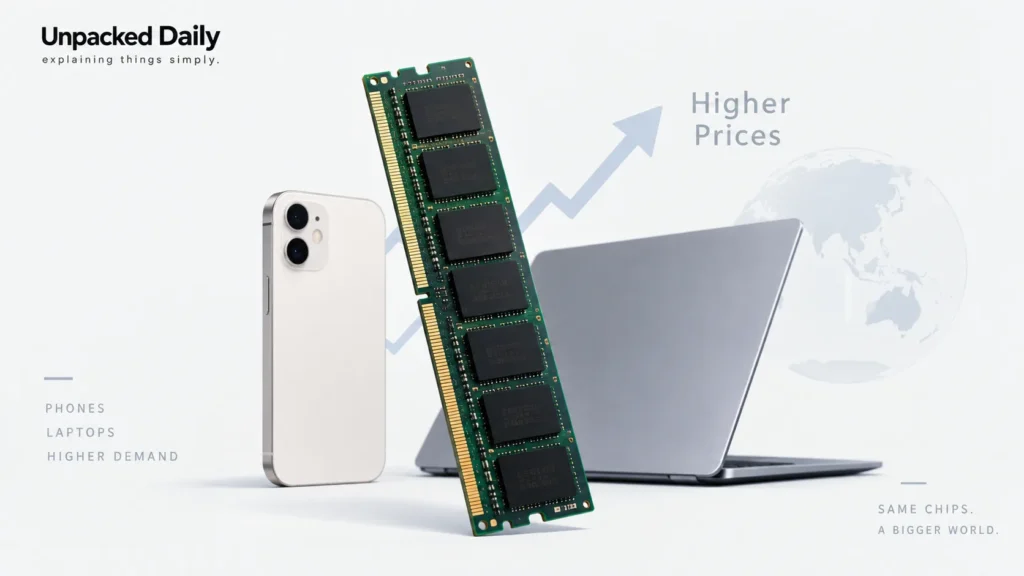
The ongoing RAM shortage is no longer just a semiconductor industry problem. AI data centres are consuming huge amounts of memory, putting pressure on DRAM and other memory supplies and pushing up costs for phones, laptops and PCs. This article explains how that shortage moves through the supply chain and eventually reaches the device you buy.
Apple used to sell a Mac mini for $599. In May, it discontinued that base model, leaving the $799 version as the cheapest option. Then, in June, Apple raised prices across its Mac and iPad range. By the end of July, Tim Cook was describing memory pricing as a “100-year flood.” Then came the iPhone 18 Pro. It starts at $1,199 and has 12 GB of RAM, the same amount as the 17 Pro. So the phone got more expensive. The RAM didn’t.
Apple is not the important part of this story. The interesting part is how a shortage that starts inside AI data centres eventually reaches something as ordinary as the price of a phone or laptop.
Memory is not one thing
When we say “memory”, we usually mean RAM. But there are several different types. RAM is the working memory of a device. It is fast and temporary. Most of it is DRAM. NAND is flash storage, the stuff behind the 256 GB or 1 TB number on your phone or SSD. VRAM is memory attached to a graphics processor.
Then there is HBM, or high-bandwidth memory. HBM is still DRAM, but it is built differently. Several memory dies are stacked together and connected using thousands of tiny vertical connections. The stack sits very close to the processor.
Why does AI need this?
AI accelerators spend a huge amount of time moving data between memory and the processor. The mathematical calculations are fast, but feeding the processor enough data can become the bottleneck. HBM solves part of that problem by offering enormous memory bandwidth.
Nvidia’s Rubin GPU can use up to 288 GB of HBM4 and up to 22 TB/s of peak bandwidth per GPU. That is an absurd amount of memory bandwidth compared with an ordinary phone or PC. And this is where the consumer story begins.
Nobody is pulling RAM out of your laptop
AI companies are not buying the exact RAM that was supposed to go into your laptop. They are competing for the manufacturing capacity that makes memory.
A DRAM factory produces a limited number of wafers, and those wafers can eventually become HBM, server memory, phone memory or PC memory. Manufacturers decide where that capacity goes. HBM is particularly demanding. Micron has said HBM3E needs about three times the wafer supply of DDR5 for the same number of bits, and HBM4 will require even more.
TrendForce estimates HBM could account for about 22% of the big three memory makers’ DRAM wafer input by the end of 2026 while producing only around 9% of the bits.
AI servers also consume huge amounts of ordinary server DRAM and enterprise SSDs. Memory companies are therefore prioritising the products needed for data centres, where demand is enormous. Micron even decided to exit its Crucial consumer business, citing the surge in AI data centre demand and a desire to focus supply on larger strategic customers.
The important distinction:
No, Nvidia did not take the RAM out of your next laptop. It is more complicated than that. AI is changing what the memory industry chooses to make.
From a data centre to a price tag
Follow the chain. A cloud company builds more AI capacity and commits to large memory purchases. Memory manufacturers have limited wafers and limited inventory, so they prioritise customers that have secured supply in advance. That leaves less capacity for everyone else.
Conventional DRAM for phones and PCs then becomes harder to obtain. Prices rise. IDC says DRAM and NAND costs are now up more than 300% year on year.
And once the memory itself becomes more expensive, the device manufacturer has a problem. It can raise prices, accept lower margins, reduce specifications, or simply stop selling some configurations. We are already seeing versions of all four.
IDC previously estimated memory made up around 15 to 20% of the cost of a mid-range smartphone. TrendForce has estimated that share has risen to around 30 to 40%. That is a major change in the cost of something that used to look like a fairly ordinary component.
It also explains something that might otherwise seem strange. If a new phone costs more but still comes with the same amount of RAM, the manufacturer may not be giving you less for no reason. It may simply be paying much more for the same memory.
Why can’t they just make more?
This sounds like an easy problem until you look at how memory is manufactured. Building a semiconductor fab takes years and billions of dollars. Even after the building exists, it still needs equipment, calibration, testing and time to reach useful production levels.
HBM also needs advanced packaging and customer approval. So when demand suddenly jumps, supply cannot instantly catch up. That is why memory shortages can last much longer than a normal product shortage.
At the same time, memory companies have another problem. The industry has a long history of boom-and-bust cycles. Build too much capacity and prices can collapse. Build too little and customers fight over what is available. Nobody wants to spend billions creating excess memory capacity just before AI spending slows down.
The catch:
The industry has to balance two very different risks: not making enough memory today, and making too much tomorrow.
How phone and laptop makers are reacting
The first response is obvious: raise prices. Apple has raised prices on Macs and iPads and then on the iPhone. Other companies including Microsoft, Samsung, Sony, Dell, HP and Lenovo have also raised prices on affected products.
The second response is quieter: give you less. IDC expected most 2026 flagship smartphones to stay at 12 GB rather than move to 16 GB. The iPhone 18 Pro did exactly that.
Sometimes the cheaper version does not get worse. It disappears. That happened with the $599 Mac mini.
Smaller phone and PC manufacturers have even less room to absorb higher component costs because they have less purchasing power and fewer long-term supply agreements.
The third strategy is buying early. Large companies can secure memory months or years ahead. IDC says Apple and Samsung can lock in supply 12 to 24 months in advance. Samsung also has the advantage of producing memory itself.
This creates another divide in the market. The companies with money and scale can protect themselves better. Smaller manufacturers have fewer options.
What comes next
The immediate impact is already visible. Phone, PC and tablet prices are going up, cheaper product tiers are becoming harder to maintain, and shipment forecasts are falling.
IDC expects global smartphone shipments to decline 16.7% in 2026 while the average selling price rises to $581. It also expects PC shipments to fall 11.3% this year.
The future is less certain. IDC expects the PC memory shortage to continue well into 2027, with some easing from 2028. TrendForce expects server DRAM prices to keep rising through the second half of 2027, although more slowly. But there is another possibility. If AI spending slows while new memory capacity arrives, the market could eventually swing from shortage to oversupply.
That is the strange part of the memory business. The same industry that is struggling to make enough chips today can end up making too many tomorrow.
What seems clear is that the old assumption of getting more RAM and storage for roughly the same money every few years is no longer something we should take for granted.
Look beyond the number:
Next time you see “12 GB RAM” on a phone or “32 GB RAM” on a laptop, remember that number is connected to a much larger system. That memory came from a wafer, and the same industry is producing the HBM used by AI accelerators. Somewhere along that chain, manufacturers have to decide who gets the limited supply.
For years, consumers benefited because memory supply could keep expanding fast enough to keep prices under control. Now the people building AI data centres are at the front of the queue.
And you do not have to use AI to feel the cost of the AI boom. You may feel it when your next phone costs more without getting more RAM. You may feel it when a cheaper laptop configuration disappears, or when the upgrade that used to be normal becomes an expensive option.
The AI boom is happening in data centres. The bill, however, can eventually reach your desk.
Sources
Market research and industry data
- TrendForce: 1Q26 DRAM industry revenue and supplier shares
- TrendForce: 1Q26 memory price outlook revision
- TrendForce: memory makers prioritize server applications
- TrendForce: server DRAM contract prices and long-term agreements
- TrendForce: DRAM price trends
- TrendForce: DRAM market bulletin, Sep. 2, 2026
- IDC: smartphone shipments forecast, Aug. 26, 2026
- IDC: global memory shortage and the smartphone and PC markets
- IDC: PC market outlook
Chips and memory makers
- Nvidia: Rubin GPU architecture
- Micron: exit from the Crucial consumer business
- Korea Times: SK Group chairman on the shortage lasting through 2030
- TrendForce: SK hynix DRAM capacity plans
Device makers