
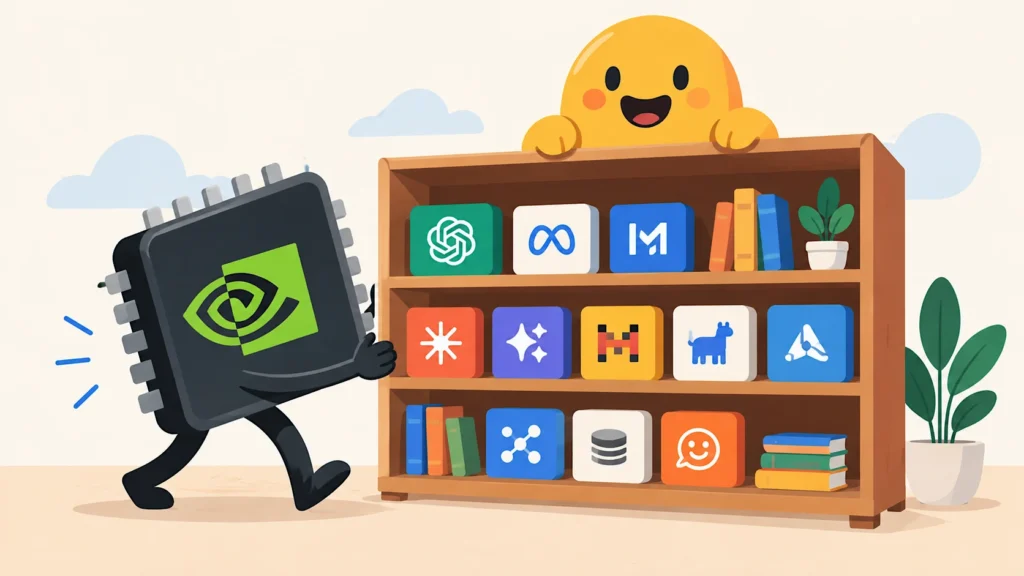
Nvidia has agreed to buy Hugging Face for about $12.93 billion.
The deal is not finished yet. It still needs regulatory approval and is expected to close in the first half of 2027. So nothing has actually changed hands.
But this is one of those deals worth understanding before it is finished, because Hugging Face sits in a very important part of the AI world. It is one of the main places where developers find, share, test and use open AI models.
What exactly is Hugging Face?
If you have never used it, Hugging Face can sound like just another AI company.
It is actually more useful to think of it as a giant public shelf for AI.
Instead of books, it holds AI models, datasets and tools that developers can find, test and use.
Developers can publish AI models there. Other people can find them, download them, test them and build things with them, depending on the model’s licence.
So instead of building an AI model completely from scratch, a developer can go to Hugging Face, find something that already does most of what they need and build on top of it.
That is a big reason the platform became so important.
We recently looked at the different AI models people are using in 2026, from ChatGPT and Claude to Gemini and others. Hugging Face is the kind of place where many of the less famous models live, get tested and get shared.
You do not normally hear about Hugging Face when someone casually talks about AI. Most people talk about ChatGPT, Gemini or Claude because those are products people directly use.
Hugging Face sits one layer underneath that conversation.
Why does Nvidia buying it matter?
This is where the deal gets interesting.
Nvidia is best known for its GPUs, the chips used for a huge amount of AI training and AI computing. AI companies may build the model, but they still need a lot of computing power to train it and run it.
The model side
A major place where developers find, share, test and use AI models.
The hardware side
The company making a huge amount of the hardware used to run AI.
Once the acquisition is complete, one company would sit across both of these important parts of the AI system.
That does not automatically mean something bad is going to happen. It does, however, raise an obvious question.
Nothing has changed yet. And that matters.
This is the part where it is very easy to get carried away.
Nvidia has said that Hugging Face will remain open and will continue supporting the wider AI ecosystem, including other hardware makers.
So saying that Nvidia is already pushing people toward Nvidia hardware would be wrong.
That is not what has happened.
The real question is what happens after the acquisition, especially several years down the road.
A company does not need to make some dramatic announcement saying, “We are changing the rules now.”
Small decisions can do it.
Think about it like a shared water tap
Imagine there is one public water tap in your neighbourhood. Everyone uses it. You can bring whatever container you want and fill it.
Now imagine the company that makes water bottles agrees to buy that tap.
The sale does not happen immediately. The government still has to approve it. And the company publicly says the tap will remain open to everyone.
So, today, nothing has changed.
But once the company owns the tap, it has a new reason to make its own bottles work particularly well with it.
Maybe the difference is obvious. Maybe it is so small that most people never notice.
That is the kind of thing worth watching with Nvidia and Hugging Face.
Could this hurt smaller developers?
This is where the acquisition becomes more interesting for ordinary developers and students.
One of the useful things about open AI models is that you do not always need a giant server or an expensive GPU to experiment with them. Plenty of smaller models can run locally on more modest hardware.
That gives students, hobbyists and small developers room to experiment without spending huge amounts of money.
If the Hugging Face platform ever started quietly favouring models designed around Nvidia’s hardware, that could change the balance.
Not because someone suddenly banned other hardware.
It could happen simply because one path became easier than the others.
That is an important difference.
And there is another side to this
Nvidia is not the only company trying to reduce dependence on Nvidia hardware.
Microsoft, Google, Amazon and others have been working on their own AI chips because having another option matters when AI computing becomes such a massive business.
Microsoft’s Maia 300 is one example of that broader race.
That makes Hugging Face even more interesting.
If developers use a platform that sits between AI models and the hardware used to run them, keeping that platform genuinely open becomes important for the whole ecosystem, not just for Nvidia’s competitors.
Does “open source” mean this can never happen?
No.
This is probably the easiest thing to misunderstand here.
When people hear “open-source AI”, they sometimes imagine something that nobody can ever control.
That is not really how it works.
A model can be openly available under its licence while the company hosting the platform around it can still be bought, changed or replaced.
The model and the platform are two different things.
The book can have a licence that lets people freely copy and use it. That does not mean one particular website hosting the book can never be sold to someone else.
The same basic idea applies here.
The models can remain open. The platform around those models can still change.
What should you actually do?
Honestly, probably nothing dramatic.
The deal is not even closed yet.
Watch for pricing changes.
Watch access and download limits.
Watch hardware support and ecosystem changes.
If you are a student learning AI, a developer building a small project or someone experimenting with local models, there is no reason to stop using Hugging Face just because Nvidia has agreed to buy it.
What makes sense is simply paying attention after the acquisition goes through.
Also, do not build your entire project around one platform if moving away from it would be painful later.
Keeping your options open is useful in technology because today’s neutral platform can become tomorrow’s strategic asset.
The bigger story is not Nvidia
The bigger story here is how quickly different parts of AI are starting to connect.
Nvidia already has a huge role in the hardware that powers AI. Hugging Face has built a huge role around the models, datasets and tools developers use to build with AI.
Putting those two worlds under one company could be useful. Nvidia can provide more resources to Hugging Face. Developers could get better infrastructure. More models could become easier to run.
All of that is possible.
But so is another possibility. A company that controls more than one important part of the same system eventually has more influence over how that system develops.
That does not make the deal good or bad on its own.
It just makes the deal worth watching.
For now, Nvidia is buying Hugging Face, not owning it yet. The promise is that the platform will remain open. The interesting part will be seeing what that promise looks like a few years after the deal becomes real.
And the next time you download an AI model for free, it is worth remembering that the model may be open, but the shelf it sits on can still have an owner.


Quality content is the crucial to interest the people to pay a visit the site, that’s what
this web site is providing.
Thanks, really appreciate it. Glad you liked the content!