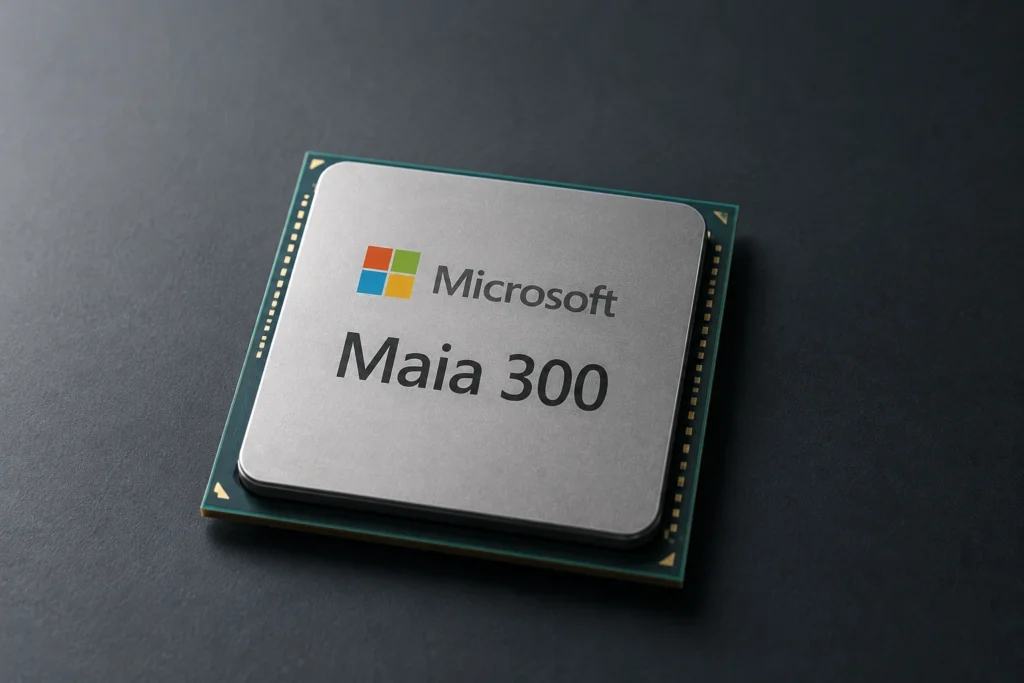
NVIDIA has become the company behind the AI hardware boom, but Microsoft does not want to depend on it forever. Its Maia 300 chip is the next step in Microsoft’s attempt to build its own AI hardware, lower costs and have more control over the machines running its models and Azure services.
If you have been following the AI hardware race, NVIDIA is almost impossible to avoid.
OpenAI uses NVIDIA hardware. Cloud companies buy NVIDIA hardware. Startups buy access to NVIDIA hardware. Even Microsoft, which is now designing its own AI chips, still works closely with NVIDIA.
So why is Microsoft spending years and huge amounts of money trying to build another chip when NVIDIA already makes some of the best ones in the world?
The simple answer is that buying NVIDIA chips works, but depending on someone else for one of the most important parts of your business is not a great long term plan.
And Maia 300 is Microsoft’s next big attempt to change that.
Microsoft Already Has Its Own Maia Chips
Maia is not a completely new idea.
Microsoft introduced the first Maia accelerator in 2023. It was designed specifically for AI workloads inside Microsoft’s Azure data centres.
Then came Maia 200 in January 2026.
That chip is much more interesting because Microsoft designed it specifically for AI inference, which is the part where a trained model actually responds to users.
Maia 200 uses TSMC’s 3 nm process, has 216 GB of HBM3e memory with 7 TB/s of bandwidth and 272 MB of on chip SRAM. Microsoft says it delivers 30 percent better performance per dollar than the previous generation hardware in its fleet.
That tells us something important about Microsoft’s strategy.
It is not simply trying to make a GPU that beats NVIDIA at everything.
It is designing hardware around the work Microsoft actually needs to do.
So What Is Maia 300?
Maia 300 is expected to be Microsoft’s next generation after Maia 200.
According to a recent Reuters report, Microsoft is planning to unveil the chip in September 2026. The company is also reportedly negotiating with TSMC for production capacity of more than 300,000 Maia 300 chips, with deliveries targeted for 2027. Microsoft has a much larger long term target as well.
The exact specifications are not public yet, so this is where we should be careful.
There is no point making up a list of cores, memory capacity or performance numbers before Microsoft announces them.
What we do know is more interesting anyway.
Microsoft wants Maia to become a real part of its AI infrastructure, not just a research project sitting inside a lab.
That means the chip has to work at huge scale, inside Microsoft’s data centres, with Microsoft’s models and Azure customers.
💰 NVIDIA Chips Are Extremely Good. They Are Also Expensive
This is probably the biggest reason companies are building their own hardware.
NVIDIA has built an enormous lead in AI accelerators, but that hardware is expensive and demand is huge.
When you are Microsoft and you are running AI services for millions of people and businesses, even a small improvement in the cost of running each request can become a very large amount of money.
Imagine running millions or billions of model requests.
If your own chip can perform the same job using less power or at a lower cost, the saving is not small anymore.
It becomes part of the economics of the entire business.
Microsoft has already said Maia 200 delivers 30 percent better performance per dollar than the latest generation hardware previously in its fleet. It also said Maia 200 was validated with GPT 5.5 and would be used for Microsoft 365 Copilot.
That is the kind of advantage Microsoft is chasing. Not necessarily, “Our chip is twice as fast as NVIDIA.” More like, “We can run our workloads for less money.”
Microsoft Can Design the Chip Around Its Own Models
This is another big advantage. A general purpose AI accelerator has to support a huge range of workloads.
Microsoft has a different situation. It has its own models, Azure, Copilot, Microsoft 365, GitHub Copilot and a growing collection of AI services.
Microsoft can look at what these workloads actually need and design the hardware around them. That is already happening with Maia.
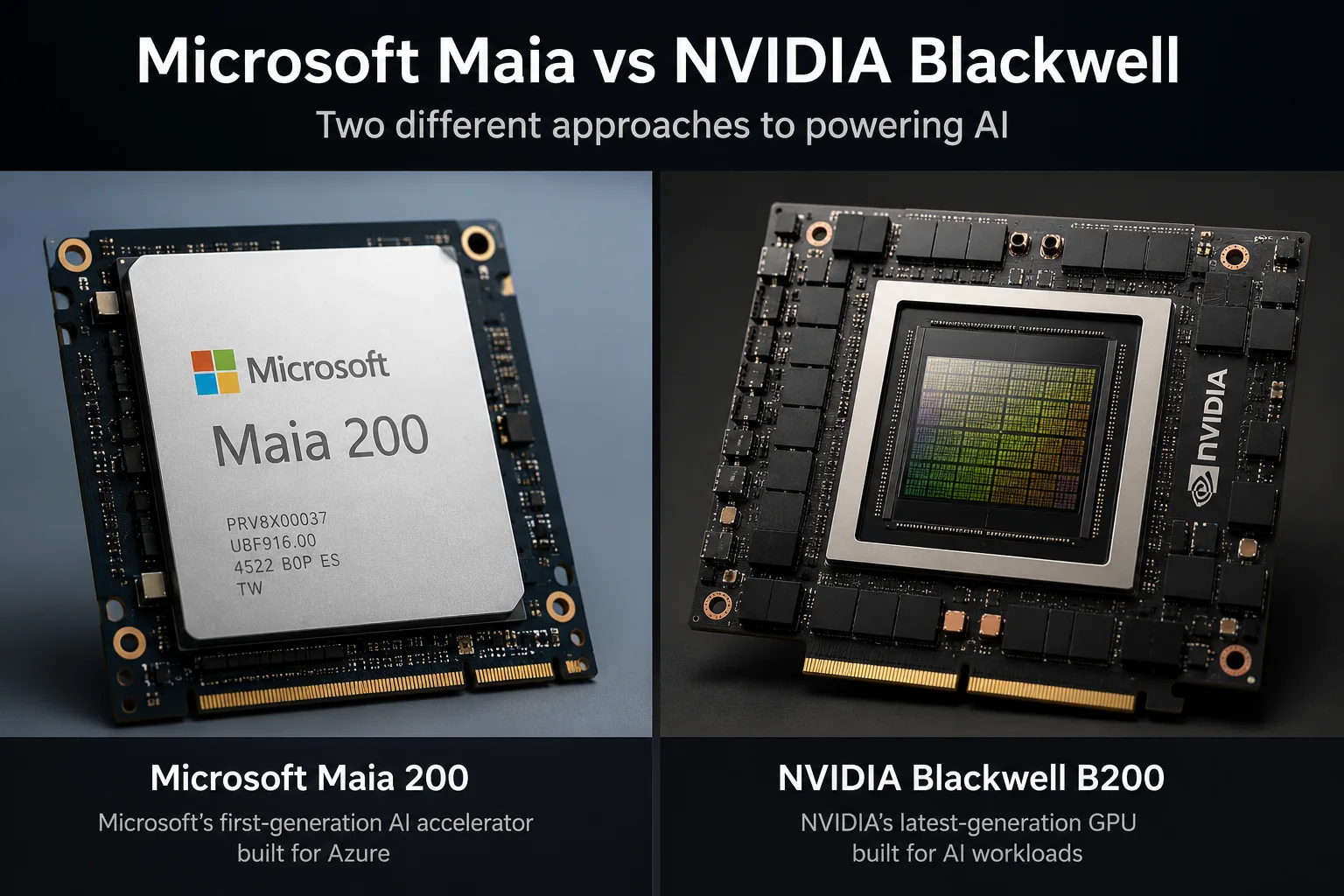
At Build 2026, Microsoft said its MAI models were being co designed with its own Maia 200 silicon. The company reported a further 1.4 times performance per watt improvement when running its MAI models on Maia 200 end to end.
This is the part that makes custom silicon so interesting. The chip and the software can be designed together.
Instead of buying a general purpose accelerator and then adapting everything around it, Microsoft can build the hardware with its own workloads in mind.
But Microsoft Is Not Leaving NVIDIA
This is where the headline can be misleading. Microsoft is not dumping NVIDIA.
In fact, Microsoft continues to use NVIDIA hardware heavily.
At Build 2026, Microsoft talked about working with NVIDIA on its next generation systems and said it had already brought NVIDIA’s Vera Rubin system into its infrastructure for validation. Microsoft is also expanding its AI infrastructure with AMD hardware.
So this is not really Microsoft versus NVIDIA. It is Microsoft trying to have more choices. That distinction matters.
If Microsoft can run some workloads more efficiently on Maia, it can use Maia.
If another workload benefits more from NVIDIA, it can use NVIDIA.
If AMD makes more sense for something else, Microsoft can use AMD.
That gives Microsoft much more control over its data centres.
Google Started This Game Earlier
Microsoft is not the first cloud company to realise that custom chips can make sense.
Google has its TPUs.
Amazon has Trainium and Inferentia.
Microsoft now has Maia.
The reason is fairly simple.
These companies are not just selling software anymore. They are operating enormous data centres where electricity, cooling, networking and accelerator costs all matter.
Owning more of the hardware stack gives them another lever to pull.
Google can optimise its models around TPUs.
Amazon can optimise around Trainium.
Microsoft can do the same with Maia.
And that creates a very different competition from the one we usually see between phone or PC chips.
📊 NVIDIA Still Has One Huge Advantage
There is a reason Microsoft is not simply replacing NVIDIA everywhere.
NVIDIA has something that is extremely difficult to recreate.
An entire software ecosystem.
CUDA has been developed for years. Developers know it. AI frameworks support it. Tools are built around it. Companies have trained their teams around NVIDIA hardware.
A new chip can have excellent raw performance and still struggle if developers cannot easily move their workloads onto it.
Microsoft understands this.
That is why Maia is being developed as part of Microsoft’s broader Azure infrastructure rather than as a standalone product that everyone has to buy.
Microsoft controls the environment where the chip will run. That makes the problem much easier.
Maia 300 Is Really About Control
The interesting thing about Maia 300 is not just the chip itself. It is what the chip represents.
Microsoft wants more control over how much it pays for AI computing, how much power its data centres consume and how its own models run.
It also wants less dependence on one supplier for a technology that is becoming central to almost every part of its business.
That does not mean NVIDIA suddenly becomes irrelevant. Quite the opposite.
NVIDIA is still pushing its own hardware forward at an incredible pace, and Microsoft will probably continue buying and deploying it.
But Microsoft does not want NVIDIA to be the only answer.
Why Does Everyone Want Their Own AI Chip?
This is happening across the industry for the same basic reason.
AI is no longer a small feature added to a product. It is becoming an enormous infrastructure business.
Every time someone asks ChatGPT a question, generates an image, uses Copilot, searches with an AI system or runs an AI agent, some machine somewhere has to process that request.
Multiply that by millions of users and suddenly the chip running those requests becomes a major part of the company’s costs.
That is why companies that once happily bought hardware are now asking a different question.
What if we build the hardware ourselves?
Google, Amazon and Microsoft are already answering that question in different ways.
The Bigger Picture
Maia 300 will not suddenly kill NVIDIA. That is not really the point.
Microsoft is building a second option for itself.
If Maia becomes good enough, Microsoft can use more of it. If NVIDIA remains better for certain workloads, Microsoft can keep using NVIDIA. If AMD offers a better option somewhere else, Microsoft can use that too.
That flexibility is valuable when AI infrastructure is becoming one of the biggest technology expenses in the world.
And this is probably the bigger story behind all these custom AI chips.
The AI race is no longer only about who builds the smartest model. It is also about who can run those models cheaply, efficiently and at enormous scale.
NVIDIA has spent years building the hardware and software platform that made the current AI boom possible.
Now the companies buying all that hardware are starting to ask whether they should keep renting the engine or build some of it themselves.
Maia 300 is Microsoft’s answer to that question. And NVIDIA is going to have to keep moving fast, because for the first time, some of its biggest customers are also becoming chip designers.