HARDWARE • OCTOBER 2026
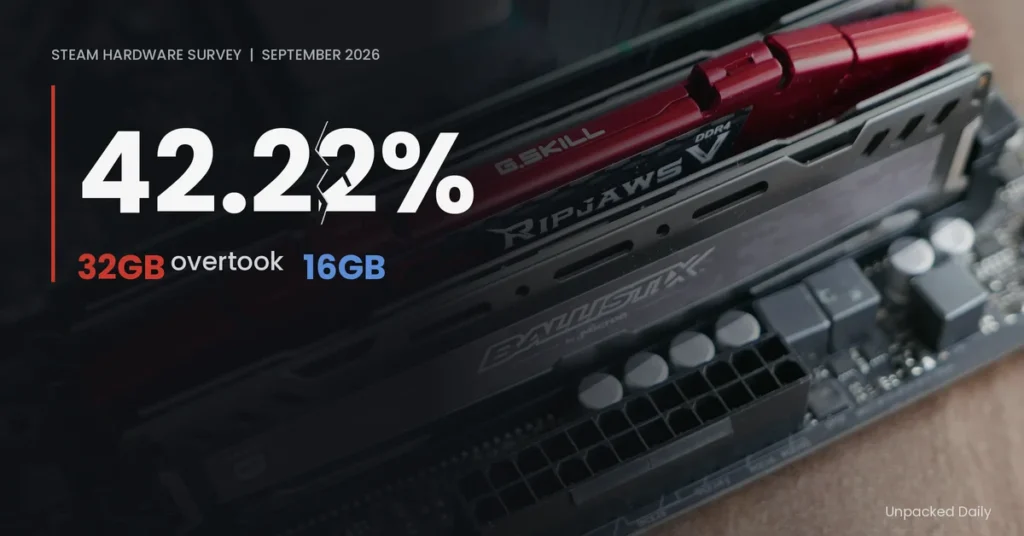
The latest Steam hardware survey makes it look as if PC gamers crossed a hardware line overnight. 32GB RAM jumped to 42.22% of surveyed systems in September 2026, overtaking 16GB in a single month.
The numbers are in Steam’s official report. The difficult part is working out what caused such a sharp move. The survey also recorded sudden changes in graphics cards, screen resolution, and the language used by respondents.
The result is real. The explanation is still open.
One month’s survey is a useful signal, but it is not proof that millions of people upgraded their PCs at once.
THE SEPTEMBER SNAPSHOT
32GB did take the lead. Look at the size of the jump.
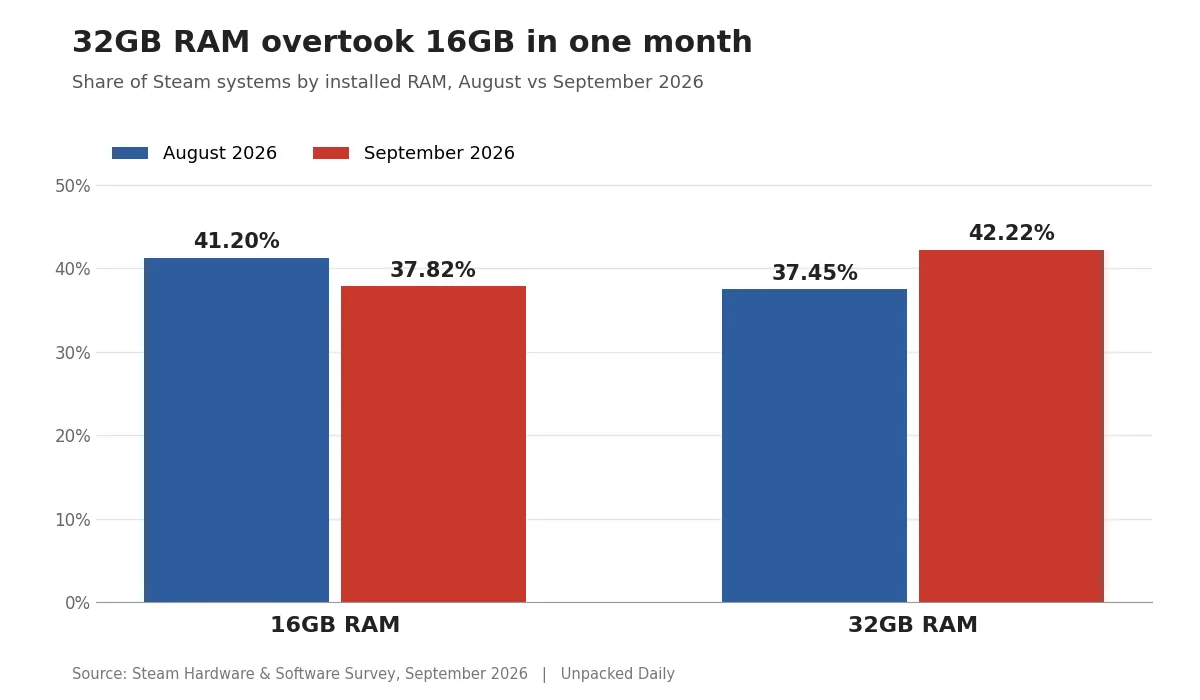
The survey reports shares of participating systems, not hardware sales. These are the main changes from August to September.
Source: Valve’s September 2026 Steam Hardware and Software Survey. Bars show each category’s reported share, not the month-to-month change.
The first thing to notice is not that 32GB is now ahead. It is how much the chart changed in a single month. The reported share of 32GB systems rose by 4.77 percentage points, while the 16GB share fell by 3.38 points. A shift of that size can happen in a survey without meaning the same share of all PC owners went out and upgraded their memory.
Hardware upgrades happen over time. People replace a PC when it breaks, when a new game pushes their old system too hard, or when the price finally makes sense. The public report does not show the same fixed group of computers being tracked from one month to the next, so the percentage change alone cannot tell us how many people actually upgraded.
THE CLUE IS THE PATTERN
RAM was not the only thing that jumped.
Several separate parts of the survey moved sharply at the same time. That is why the month deserves a second look.
Simplified Chinese
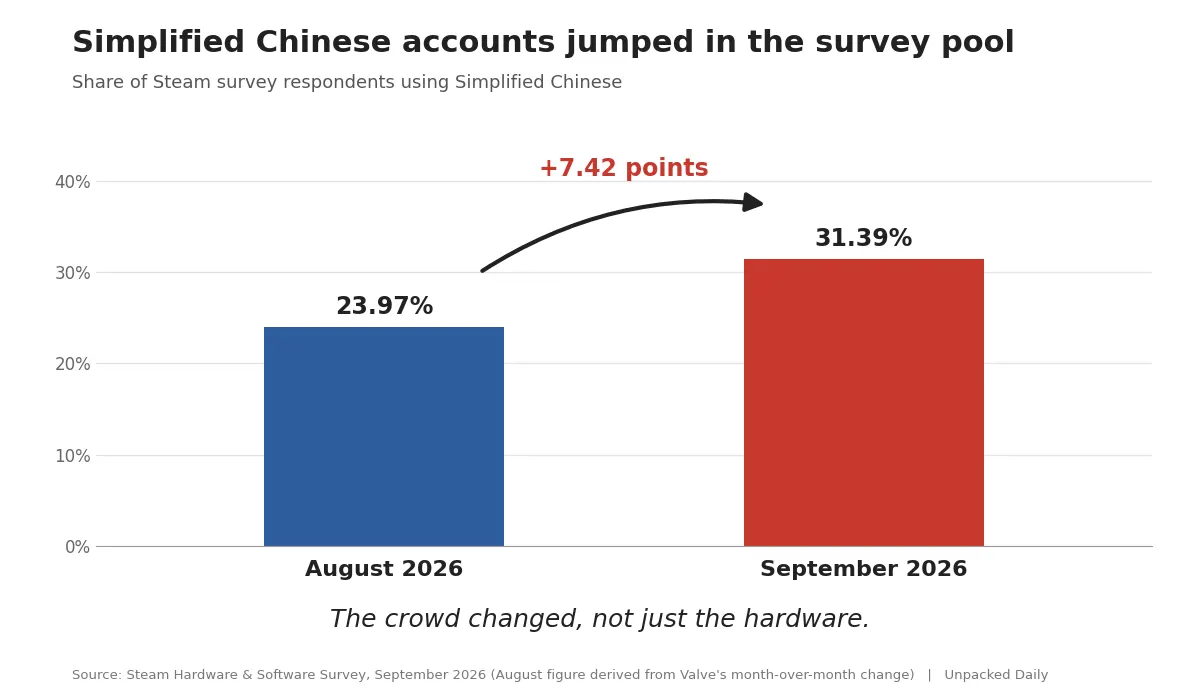
Reached 31.39% of survey responses.
1440p resolution
Rose to 27.04% of reported main displays.
1080p resolution
Fell to 47.91% of reported main displays.
GeForce RTX 5070
Reached 5.86% of the combined GPU listing.
These movements do not prove one cause. They do show why treating each jump as a separate market trend is risky.
The change in language is the biggest clue, but it is not proof of what happened. Simplified Chinese rose to 31.39% of responses, up 7.42 points, while English fell to 34.20%. At the same time, 1440p displays gained share, 1080p lost share, and several RTX 50-series cards rose in the GPU table. Those changes point in the same direction: September’s group of respondents may have looked different from August’s.
That is a reasonable explanation to test, not a fact to announce. A survey language does not tell us where a player lives, whether the PC is personally owned, or what hardware that person has. Valve does not publish a table showing RAM configurations by language or region, so we cannot say that a particular group caused the 32GB jump.
READ THE CHART CAREFULLY
A survey share is not a sales chart.
What it tells us
- What hardware was reported by people who took part in the survey.
- Which configurations are common among those respondents.
- Whether a pattern continues across several months.
What it cannot tell us on its own
- How many RAM kits or graphics cards were sold.
- How many of the same people upgraded since last month.
- Whether a language group or region caused a change.
- Whether most PC owners now need 32GB.
Valve says participation is optional and anonymous. The public report gives percentages, but it does not publish a respondent count or margin of error beside these results.
Valve describes this as a monthly survey with optional and anonymous participation. Its report is useful because it gives us a view of the hardware used by participating Steam customers. It is not a census of every gaming PC, and it does not say how many units were sold that month.
That distinction matters. A change from 37.45% to 42.22% is a change in the reported share of respondents. It does not mean 4.77% of all PC gamers bought new RAM in September. We do not know how much of the difference came from real upgrades, changes in who responded, or both.
So calling the survey a confirmed glitch would go too far. Calling the result proof that the whole PC market suddenly moved to 32GB would also go too far. The honest position is that September’s result needs another month or two of data before we treat the size of the jump as a trend.
THE BIGGER HARDWARE STORY
A noisy survey does not make memory prices cheap.
Separate evidence
There is a real memory supply problem outside the Steam survey. Reuters reported on October 7 that AI infrastructure demand was keeping memory supply tight. TrendForce expected conventional DRAM contract prices to rise 10% to 15% in the fourth quarter, after a surge of roughly 60% in the second quarter.
Those are contract prices for memory chips, not a promise that every RAM kit in every shop will rise by the same amount. Retail prices depend on the product, stock, region, and seller. But the pressure on the supply chain is real, and that is a much stronger basis for discussing PC affordability than one month’s Steam chart.
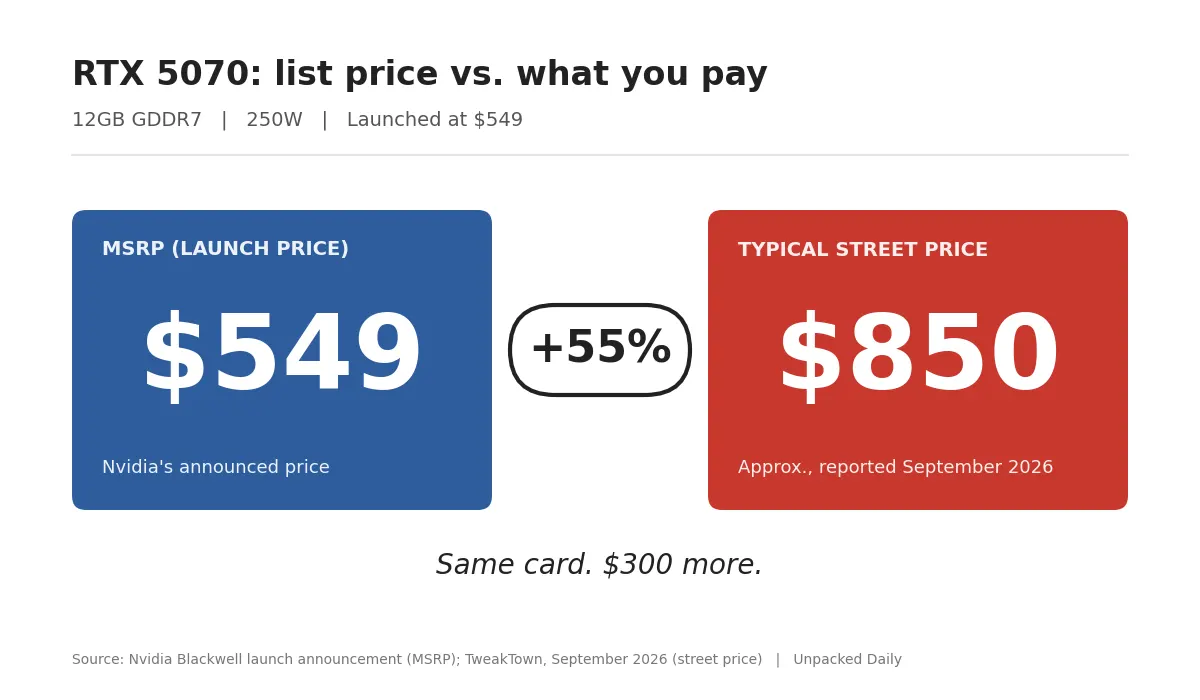
The graphics card numbers need the same care. NVIDIA announced the RTX 5070 with a US starting price of $549, but its 5.86% Steam share does not reveal the card’s current street price or how many units retailers sold. A popular card is not automatically an affordable card.
Sources: Reuters on memory chip prices, October 7, 2026 and NVIDIA’s RTX 50 launch announcement.
WHAT THE NUMBER MEANS FOR YOUR PC
32GB makes sense for some builds. That is not the same as saying everyone needs it.
There are good reasons to choose 32GB for a new gaming PC. Newer games can ask for more memory, and having a browser, voice chat, launchers, and a game open together adds to the load.
Microsoft Flight Simulator 2024 is a useful example. Its published PC requirements list 16GB as the minimum, 32GB as recommended, and 64GB as ideal. That is a demanding simulation, not a rule for every game on Steam.
The fair reading is that 32GB has become a sensible target for a more capable gaming build. It does not follow that 16GB suddenly became useless, or that the average person must buy more RAM because a survey crossed a line.
See the official Microsoft Flight Simulator 2024 PC requirements.
One game’s requirements show where extra memory helps. They do not define the needs of every player.
WHAT WE ARE WATCHING NEXT
Three checks matter more than another hot headline.
Does 32GB stay ahead?
If the share remains near this level over the next few reports, the case for a lasting shift gets stronger. One month cannot tell us that by itself.
Do the other jumps hold?
If language, resolution, and GPU shares return towards their earlier levels together, that would support the idea that September’s respondent mix played a large role.
What happens to real component prices?
Street prices for RAM, SSDs, and graphics cards will tell buyers more about affordability than a survey ranking ever can.
The next Steam report is the first useful test. If 32GB holds its lead after the language mix settles, September will look more like a milestone. If several of these numbers swing back together, it will be a reminder that a monthly sample can move faster than the hardware market.
For now, 32GB is a sensible target for many new gaming PCs, especially if the budget allows it. But the survey does not prove that 16GB has become obsolete, and it does not prove that people are being forced into more expensive builds. The budget PC question is real. September’s chart just cannot answer it on its own.
SOURCES AND FURTHER READING
Where the numbers come from
- Valve, Steam Hardware and Software Survey, September 2026 Primary source for the RAM, GPU, language, and display figures.
- The FPS Review, September Steam Survey analysis, October 3, 2026 Context on the sudden changes across several survey categories.
- Reuters, memory chip prices and the continuing supply shortage, October 7, 2026 Market context on conventional DRAM contract prices.
- Microsoft Flight Simulator 2024, official PC requirements Example of a game listing 16GB minimum and 32GB recommended.
- NVIDIA, GeForce RTX 50 Series launch announcement, January 6, 2025 Source for the RTX 5070’s announced US starting price of $549.