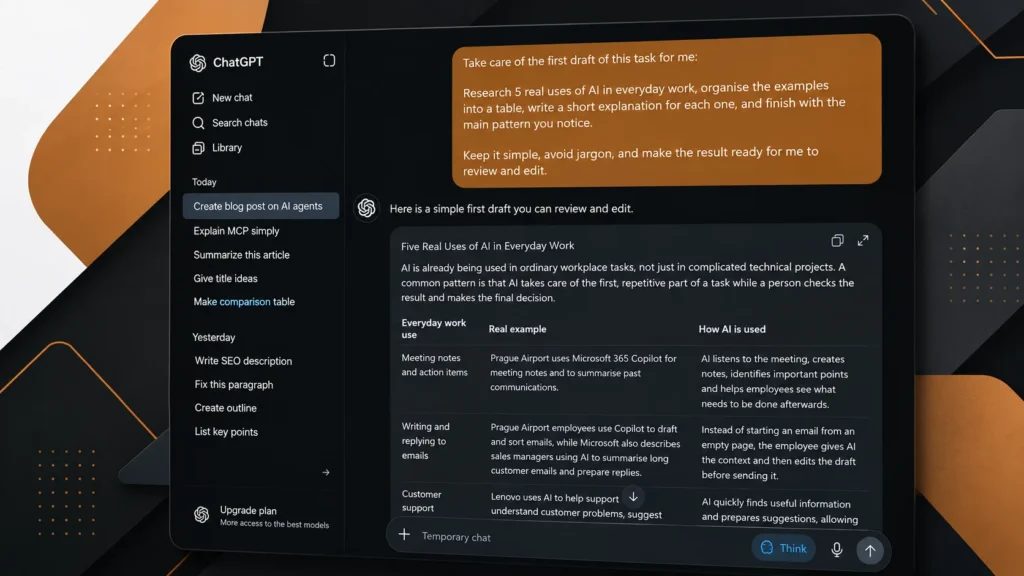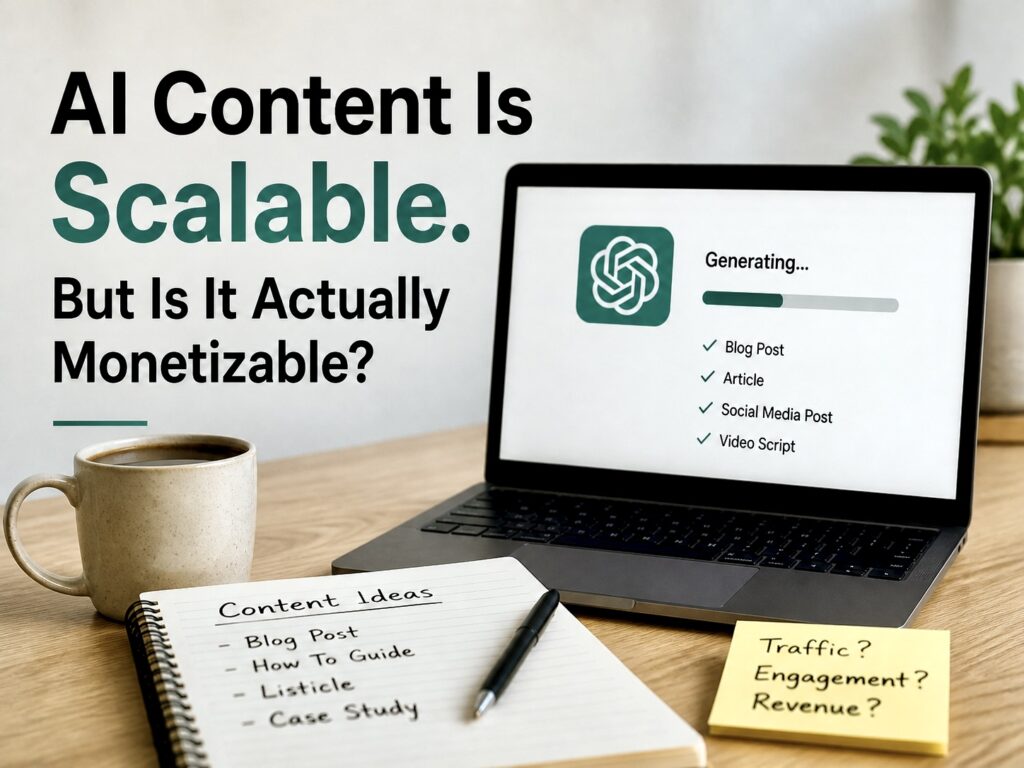
Right now, you can go to a tool like ChatGPT and generate 1,000 blog posts before you finish your morning coffee. Five years ago, that would have taken a team of ten writers a year to finish.
The barrier to “creating” is gone. People are flooding the internet with millions of pages of AI-generated text, thinking they’ve found a loophole to easy money. They assume that more content equals more traffic, and more traffic equals more revenue.
But here is the blunt truth: most of these sites are earning exactly zero dollars. They are digital ghost towns. Scalability is a technical problem that AI solved, but making money is a human problem that AI often makes harder.
What AI content actually is
When we talk about AI content, we’re talking about text, images, or videos created by machine learning models like GPT-4 or Claude. These systems don’t “know” facts. They are sophisticated math equations that predict which word should come next based on patterns they saw in their training data.
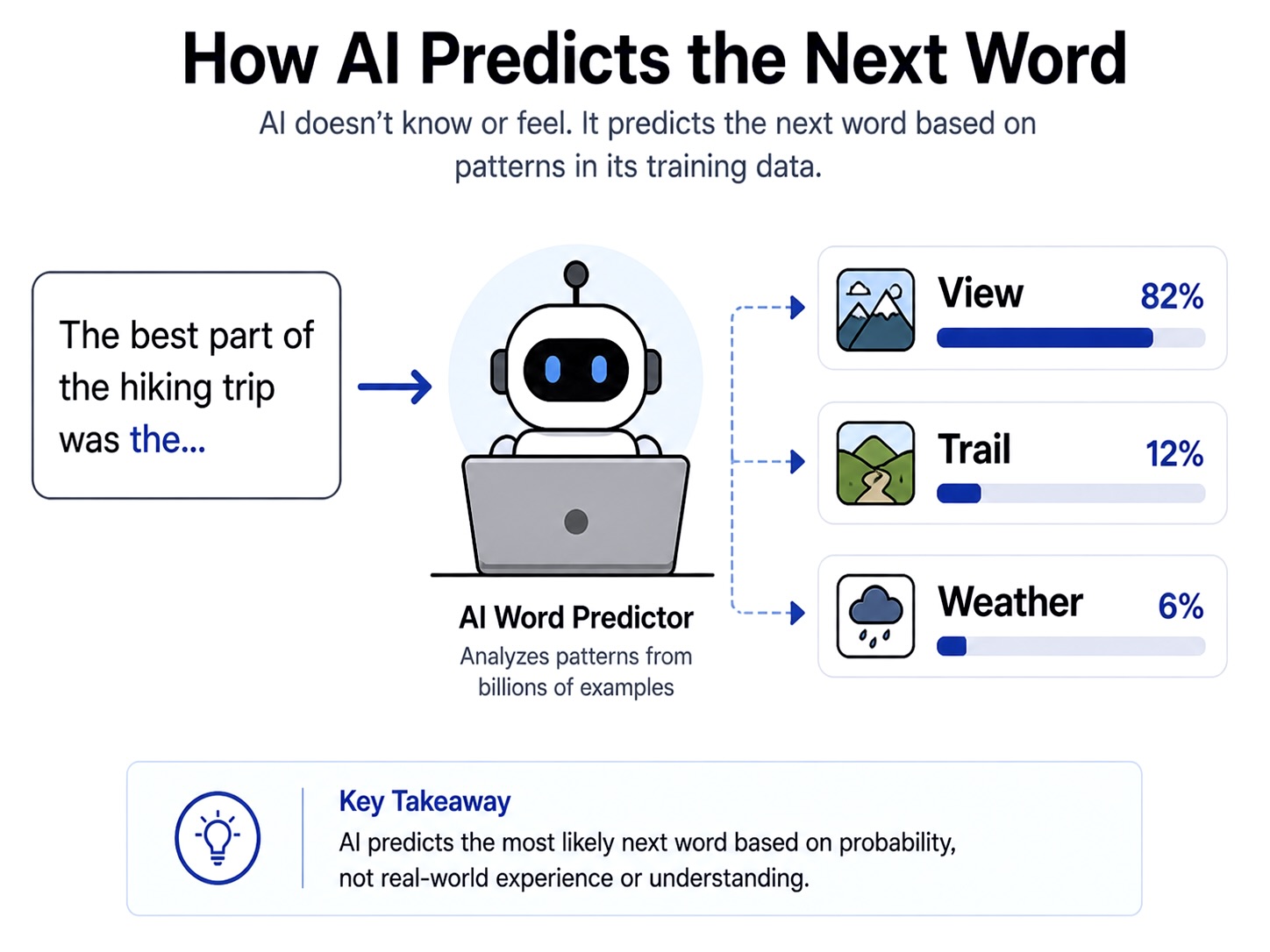
If you ask an AI for a recipe or a travel guide, it isn’t reflecting on a trip it took or a meal it cooked. It is averaging out everything it has ever “read” about that topic. It produces something that sounds correct, looks professional, and is technically readable.
Why AI content is scalable
The appeal of AI is obvious. It gives a single person the power of a media company. You can produce content in minutes that used to take hours of research and drafting.
After you set up your prompts or your automation workflow, the effort required to produce the next 100 articles is basically the same as the effort to produce one. You don’t need a team of writers, an editor, or a massive budget. Consistency, which used to be the hardest part of blogging or video creation, is now the easiest.
Why scalability does NOT equal money
This is where the illusion breaks. In a world where everyone can produce infinite content, the value of “standard” content drops to zero.
No scarcity means no value
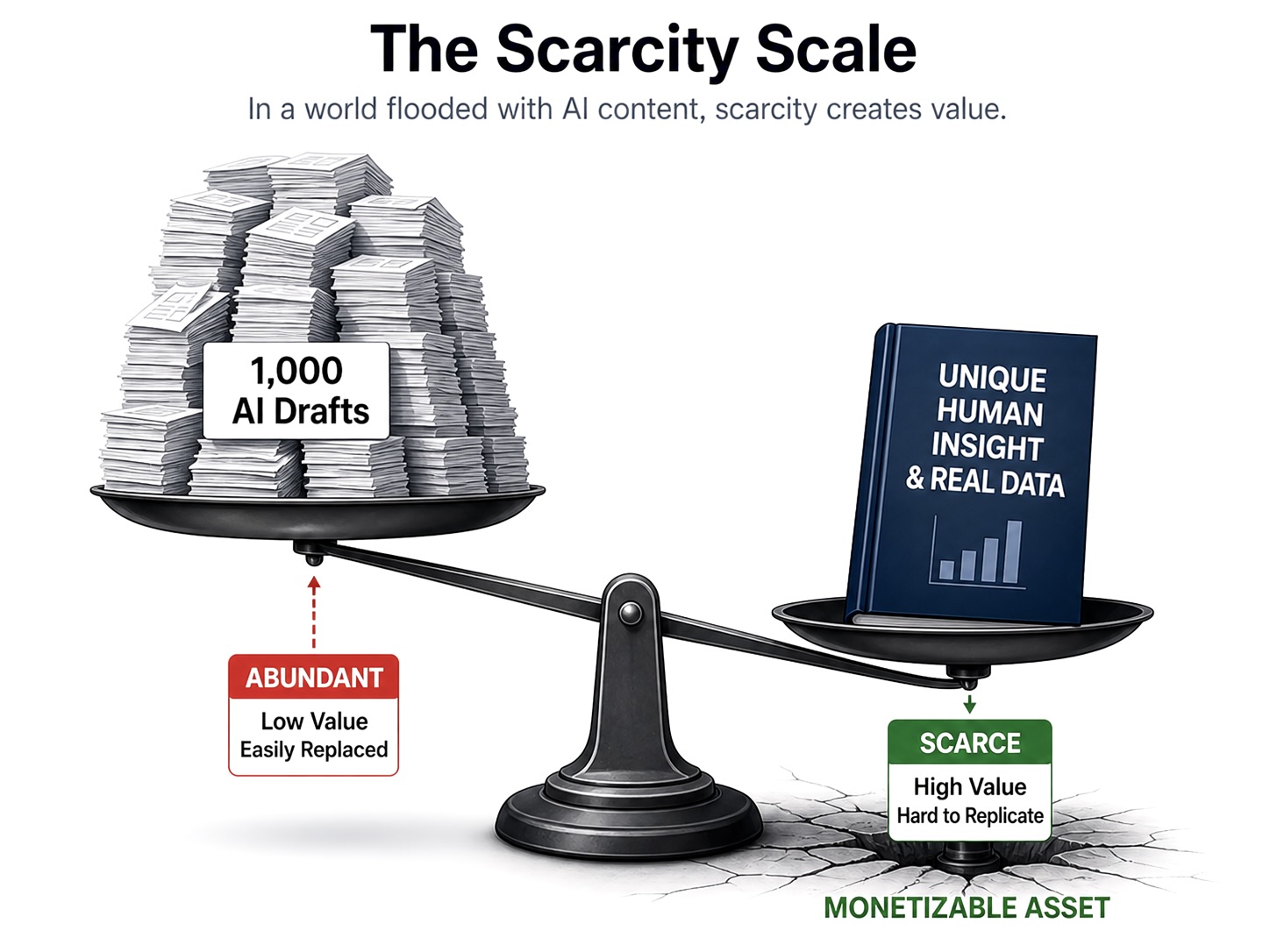
Basic economics says that when supply is infinite, price collapses. The internet is now being buried under a mountain of average, “okay-ish” content. If you are publishing generic articles that a thousand other people also generated with the same prompt, you aren’t creating an asset. You’re creating noise.
Platforms reward attention, not volume
Google, YouTube, and TikTok don’t care how many files you upload to their servers. They care about whether people find your content useful enough to stay on their platform.
If your content is a generic AI summary, users will click away in seconds. The algorithms see this “weak engagement” and quietly bury your site. You might have 10,000 pages indexed, but if no one reads them, you have no traffic. Without traffic, you have no revenue.
The gatekeeper crackdown
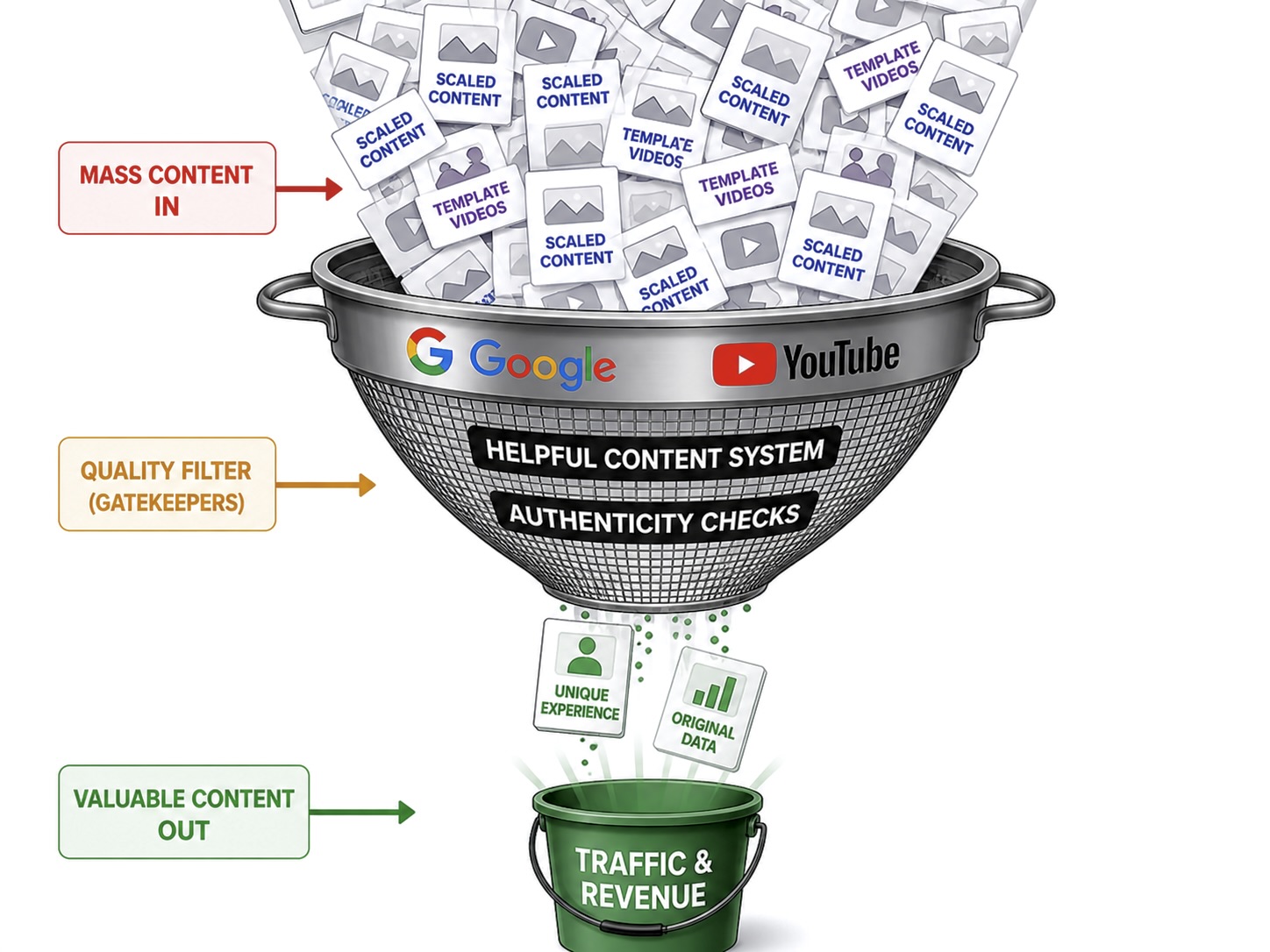
Gatekeepers like Google and YouTube have updated their rules to fight this flood of “low-effort” content. Google’s system now looks for “scaled content abuse”, which is basically their way of saying “publishing a ton of stuff just to trick us”. YouTube is demonetising “inauthentic” channels that just churn out mass-produced templates.
What the research actually reveals
If you look at the data, the situation is even more crowded than it feels. Recent studies show that roughly 30% to 40% of the text on the active web is now synthetic or AI-assisted. Some analyses of newly published web pages suggest that over 74% contain AI-generated material.
The internet is becoming a closed loop where AI models are being trained on data generated by other AI models. This creates a “recursive feedback loop” that erodes the diversity and quality of information.
This is why many AI-built websites fail shortly after launch. They might rank briefly for a few obscure keywords, but as soon as the search engine detects that the content is just “recycled slop” with no real experience behind it, the traffic falls off a cliff.
Common mistakes people make
Most people who fail at AI monetization follow a very predictable path.
Publishing without direction
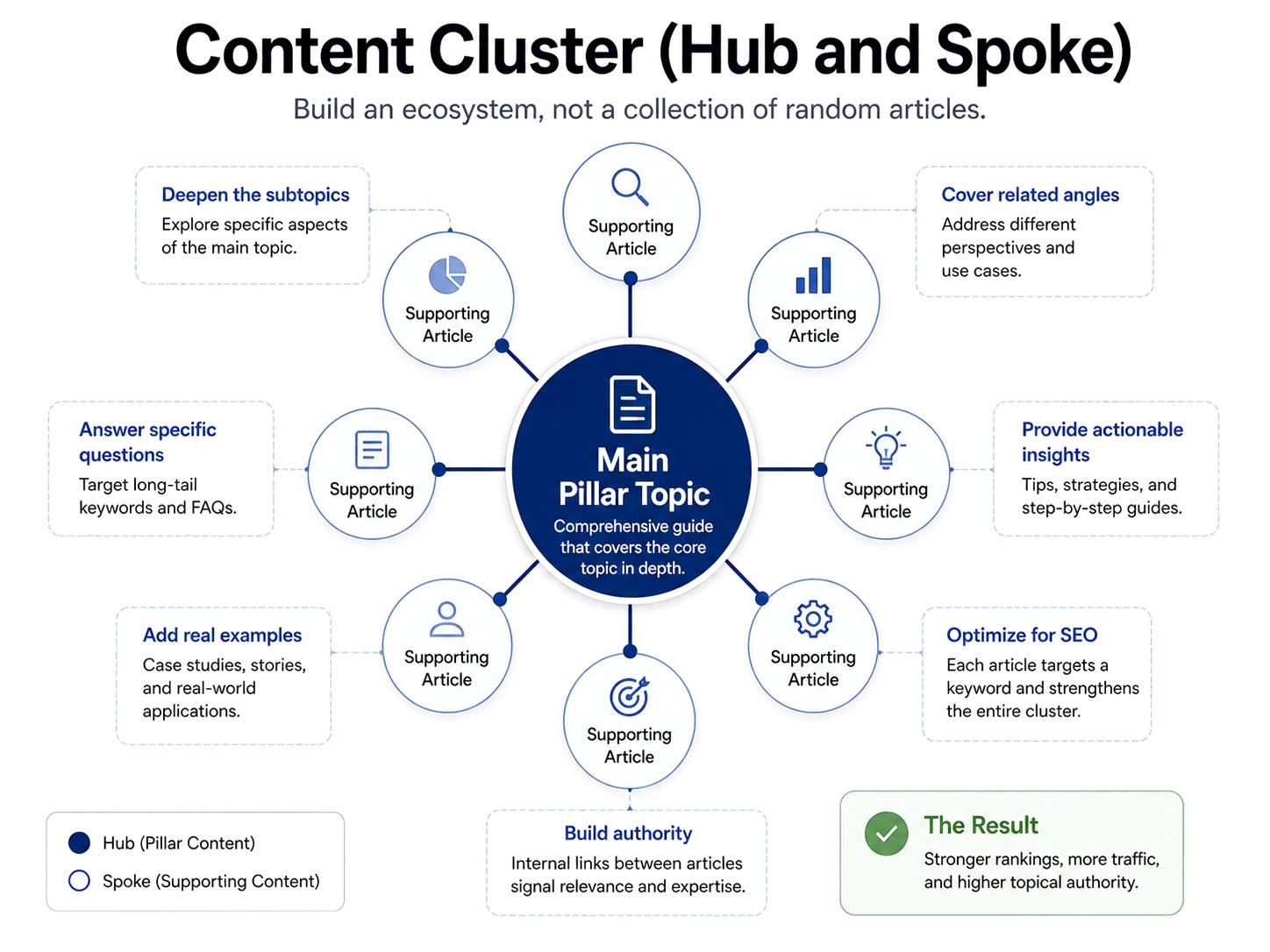
They pick a broad topic and tell the AI to “write 50 posts about fitness.” The result is a mess of disconnected information that doesn’t solve a specific problem for a specific person.
Chasing quantity over quality
They think that a site with 1,000 mediocre posts will beat a site with 10 great ones. In reality, search engines would rather show one page that actually answers a question than 1,000 pages that dance around it.
Ignoring distribution
They assume that if they build it, people will come. But search engines treat new, automated pages as “unproven.” If you don’t have a plan for how people will actually find and share your content, it will sit on a server and rot.
Expecting quick money
They see a “get rich quick” video on social media and expect to earn thousands in their first month. Real blogging and content creation usually takes 3 to 9 months of consistent, strategic work before the money starts to show up.
What actually works: The practical reality
If you want to actually make money using AI, you have to stop treating it like a “content button” and start treating it like a tool for a larger business strategy.
The niche is everything
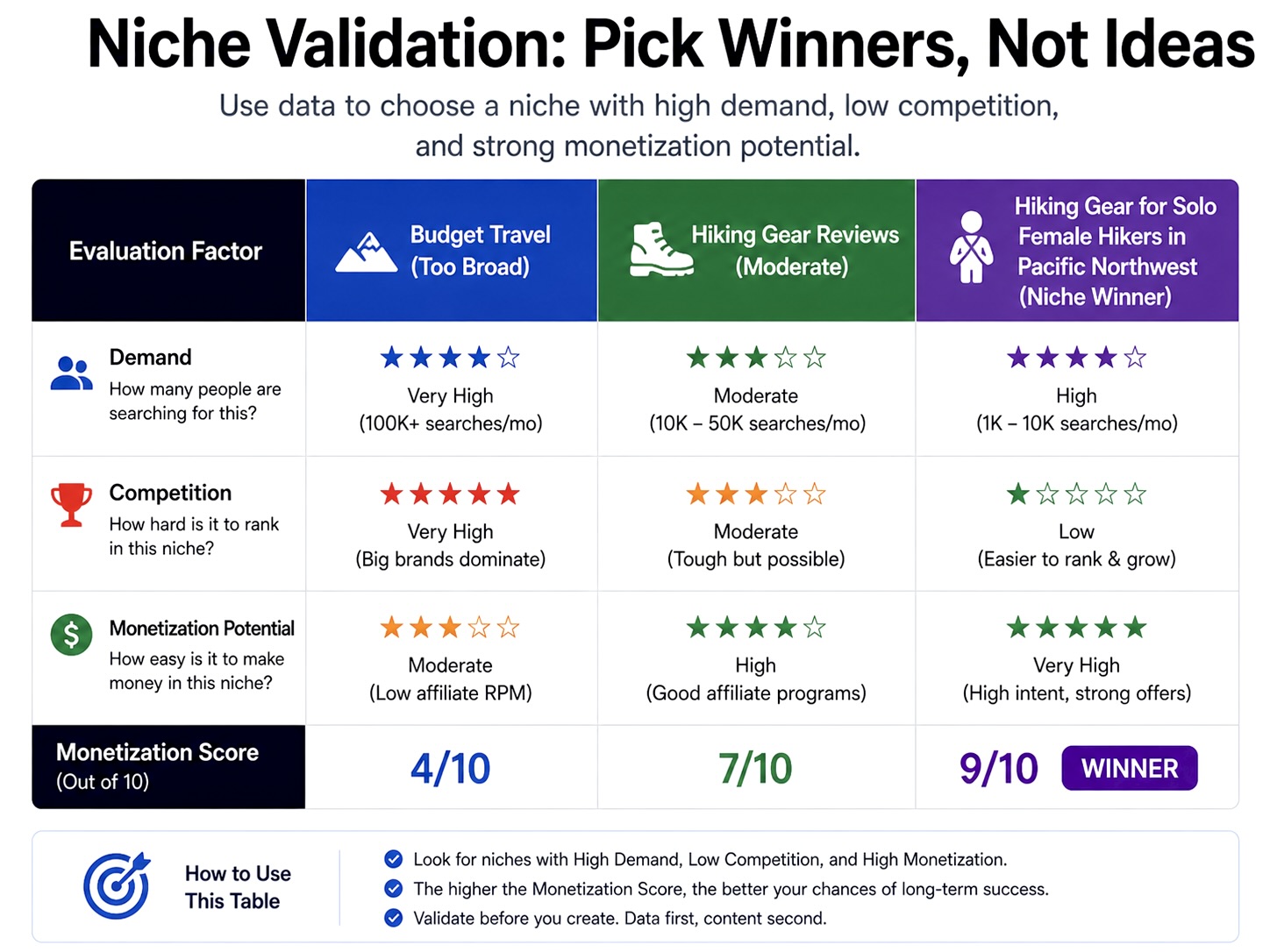
You can’t compete with big sites on broad topics. You have to find a sub-niche where competition is manageable and people are actually looking to buy something. “Budget travel” is too broad; “travel gear for solo female hikers in the Pacific Northwest” is a niche.
Add the “Human” signals (E-E-A-T)
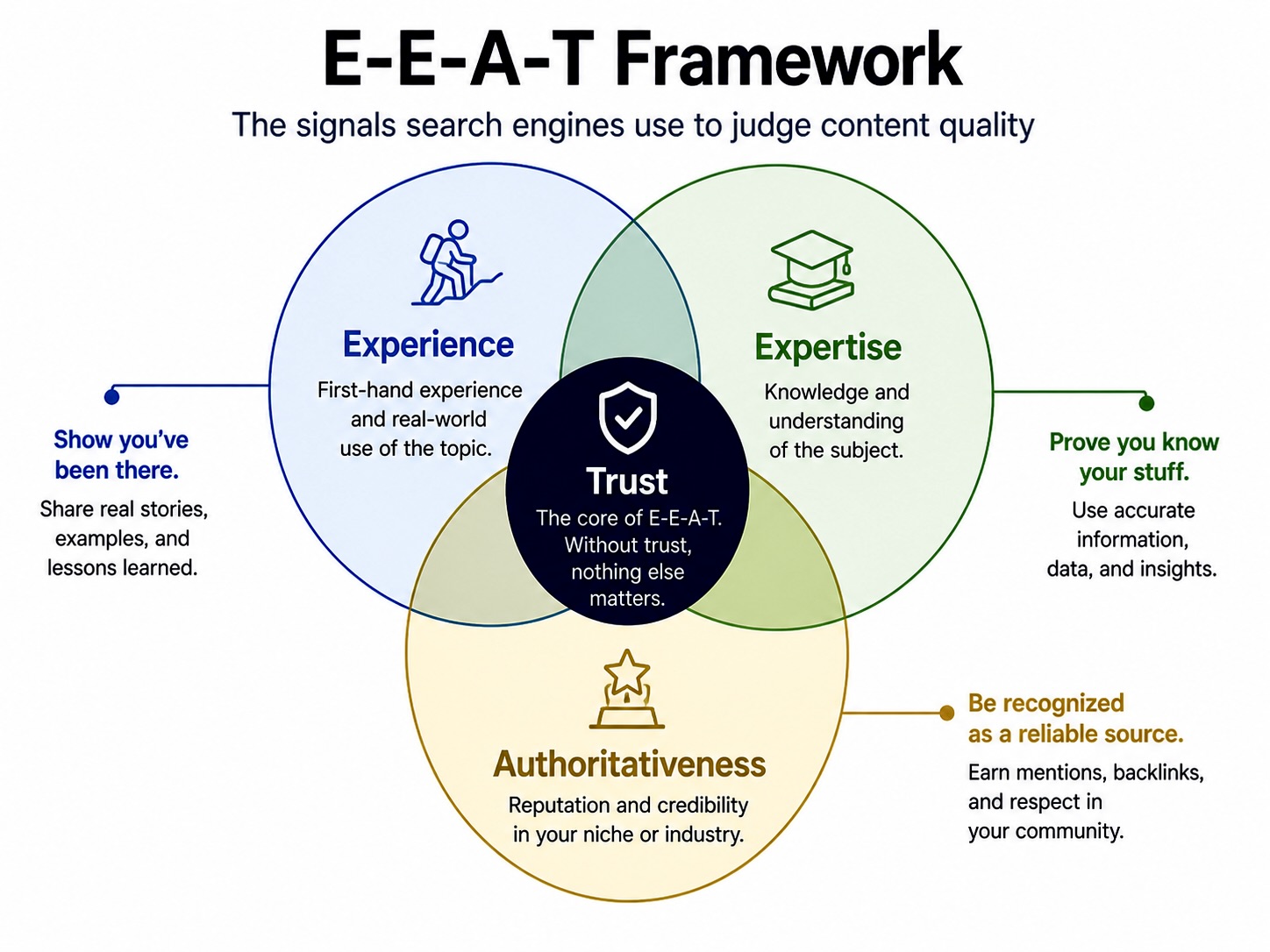
Google and users both look for Experience, Expertise, Authoritativeness, and Trust (E-E-A-T). AI cannot provide first-hand experience. It can’t tell you how a hiking boot felt after 20 miles or show you a screenshot of a real data test you ran.
The content that makes money is the content that adds human thinking, opinions, real-world examples, and unique data, on top of an AI draft.
Focus on the sequence
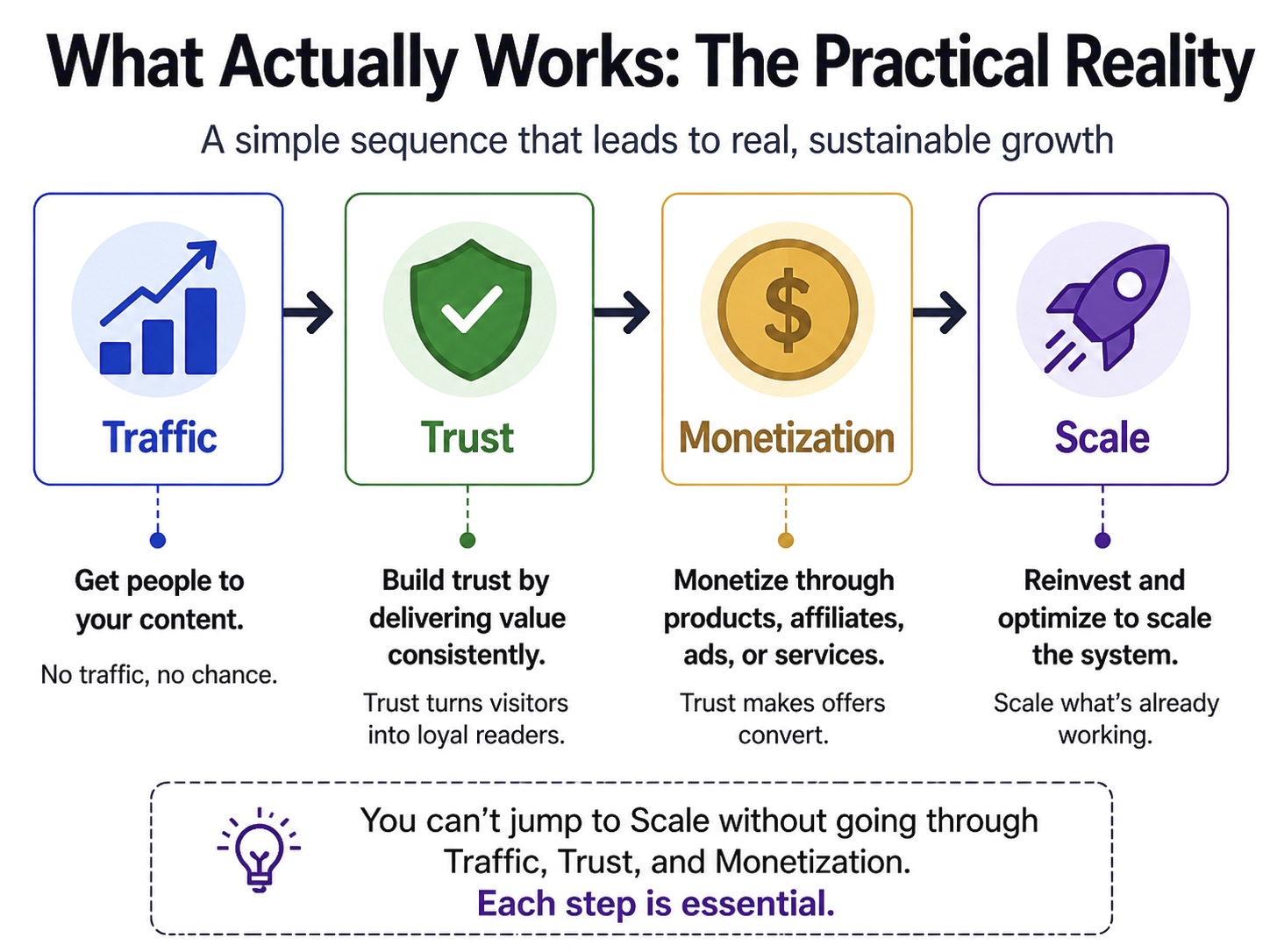
A profitable blog follows a specific order: Traffic -> Trust -> Monetization -> Scale. Most people try to jump straight to “Scale” without building any trust. If your readers don’t trust you, they won’t click your affiliate links or buy your products.
A real comparison
Think about two different websites in the gardening space.
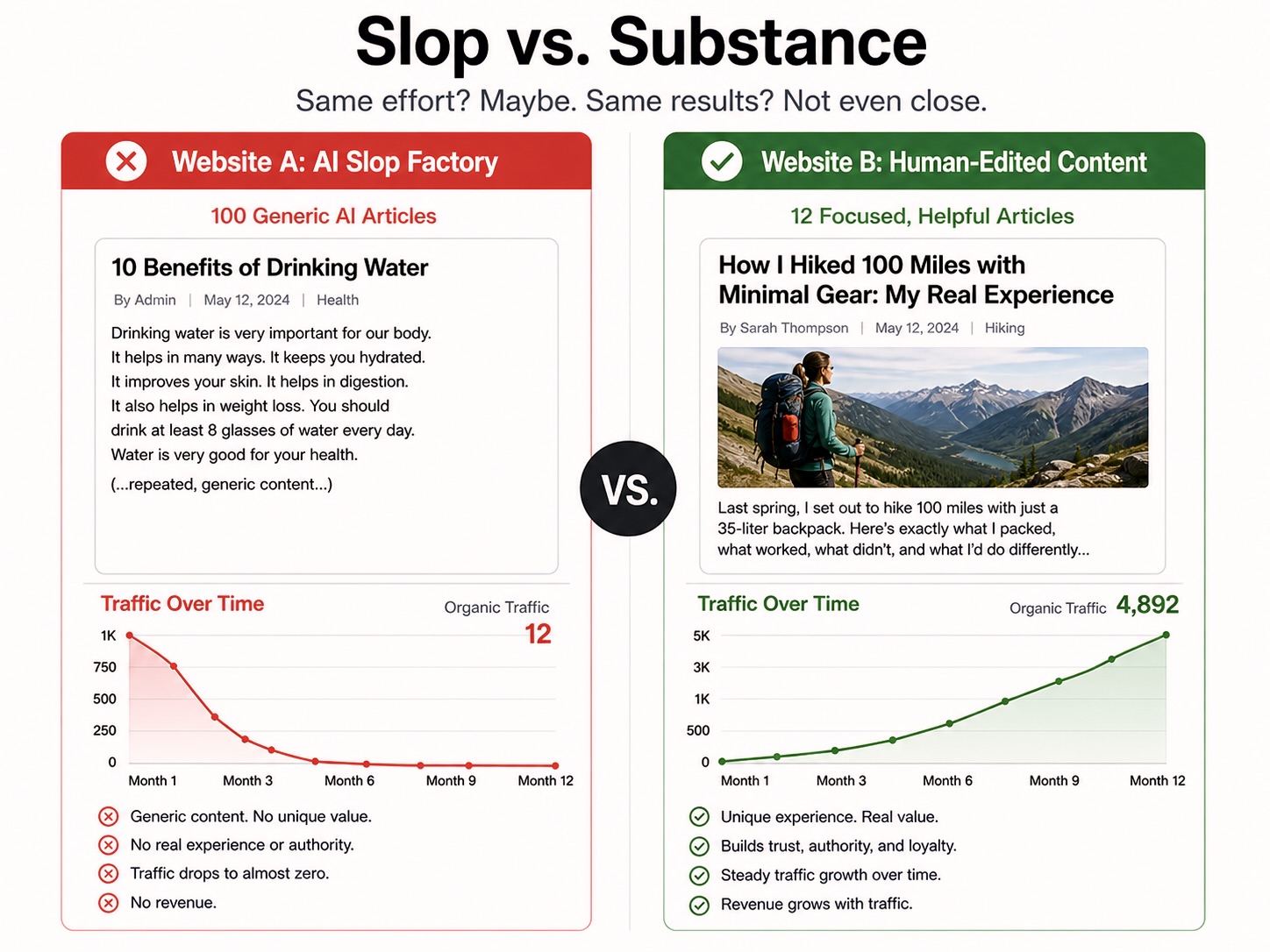
Website A uses an automated script to post 100 AI-generated articles a week about every plant imaginable. The articles are generic and have no original photos. After six months, this site likely has zero traffic because the content adds no value that doesn’t already exist on Wikipedia.
Website B posts two articles a week. The owner uses AI to help research and create a first draft, but they spend three hours personally editing each post. They add photos of their own garden and write about specific mistakes they made with their soil. Website B builds a small, loyal audience that trusts their advice. They start making $500 a month in affiliate commissions because people actually value what they say.
An actionable system for 2026
If you are going to use AI, do it like this:
- Pick one narrow niche where you have some personal interest or knowledge.
- Validate the demand. Use data to make sure people are actually searching for these topics.
- Use AI for the “grunt work.” Let it cluster your keywords, create outlines, and write your first rough drafts.
- Refine like a human. Rewrite the intro and conclusion. Insert your own opinions. Add real photos or unique data points that an AI couldn’t know.
- Build an “owned” audience. Don’t just rely on Google. Start an email list so you can talk to your readers directly.
Conclusion
AI has made the act of content creation cheap and easy. It has effectively commoditized the written word.
But AI did not make human attention or trust easy to get. In fact, by flooding the world with generic text, it made attention more expensive and trust more valuable.
The money isn’t in the volume of the content you can scale. It’s in the depth of the connection you can build with the people who read it. AI can help you build the machine, but you still have to provide the soul.
Frequently Asked Questions