AI Is Now a Utility, and OpenAI Should Be Worried
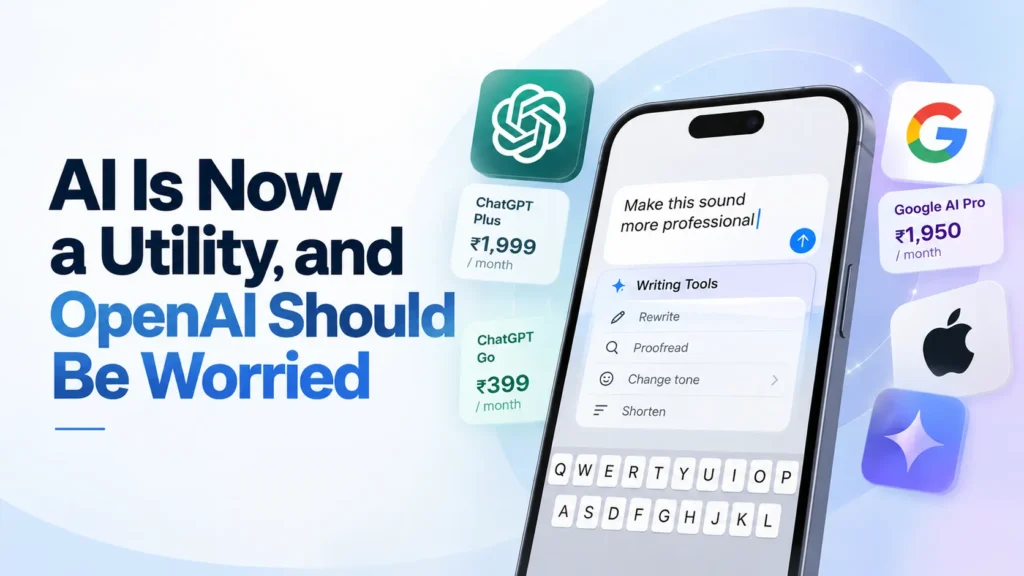
Built-in AI is changing what people expect from a paid AI app. ChatGPT Plus, the $20 tier, costs ₹1,999 a month in India. Google AI Pro costs ₹1,950, just ₹49 less. For two years, that price felt like the entry fee for using AI at all. OpenAI moved away from that idea when it launched ChatGPT Go at ₹399 a month, then offered eligible users in India 12 months at no cost.
The promotion opened in November 2025 and ended on January 21, 2026. Go is a lighter plan, not a discounted Plus, so the two prices buy different levels of access. For the earliest users who claimed the offer on day one, the free period ends on November 4, 2026. Unless they cancel, the ₹399 charge is due the following day.
That free year was a defensive move, not generosity. Perplexity had already partnered with Airtel to offer eligible customers free Perplexity Pro, while Google had a free year of AI Pro for students. Google and Reliance later announced 18 months of Google AI Pro for eligible Jio users, a plan Google valued at ₹35,100. Look at who is distributing these offers: telecom companies and the companies that control the phone. In India, premium AI is increasingly becoming a benefit attached to a SIM, a device or a wider subscription.
ChatGPT Plus and Google AI Pro sit in a similar price range. ChatGPT Go is a separate, lower-cost subscription.
How built-in AI is changing everyday phone use
The old routine was simple: open ChatGPT, type a prompt, copy the answer and paste it into WhatsApp, an email or a document. But it made AI a separate destination: open it, explain what you wanted and move the result back to the app where you were working. For a complicated question, that extra step is reasonable. For a sentence that sounds too blunt, it can feel like more work than the problem itself.
Gboard’s Writing Tools show what happens when that extra step disappears. On supported Android phones, users can proofread text, rephrase it, make it sound more professional or friendly, shorten it, expand it or add emojis without leaving the app where they are typing. The keyboard is no longer just a way to enter words. It is also a place where those words can be changed before they are sent.
Small jobs, immediate convenience
Someone may want to soften a message to a customer, correct a typo before sending an email or make a reply shorter. They need the sentence fixed and want to get on with what they were doing. Google’s support page lists these exact actions, including proofreading, rephrasing, changing tone, shortening and elaborating text. Google says processing happens in a secure, isolated environment on the device or in the cloud, and that input text is not shared with Google or the app.
The device limit still matters
There are limits. Gboard’s tools require a supported phone and Gboard as the default keyboard. The feature supports English in India, but it is not available on every Android device. It also edits existing text rather than acting as a general-purpose assistant; when a selection is too long, the tool works on a shorter segment. This is not a replacement for every ChatGPT task. It is a way of removing the need to open ChatGPT for some of the smallest ones.
The India AI price gap is about more than subscriptions
The price comparison makes the pressure visible. ChatGPT Plus and Google AI Pro are almost the same price in India, at ₹1,999 and ₹1,950 a month. ChatGPT Go sits much lower at ₹399. But competing offers around these products complicate the decision. A Jio customer who receives Google AI Pro as part of a promotion may not compare its full monthly price with ChatGPT Go at all. A person who already has writing features on a supported phone may not think of those features as a subscription product.
A standalone AI subscription has to justify itself every month. A bundled feature can be treated as part of a mobile plan or a device the customer has already bought. The AI still costs the company money to operate, but the user does not see a separate line on a bank statement. The cost is tucked inside a relationship that already exists.
The companies offering these bundles also have something OpenAI does not. Telecom operators want their plans to feel more valuable. Phone makers want their devices to offer features that competitors cannot easily match. Google can use its position in Android, Search, Gmail and Gboard to put its AI in front of people without asking them to build a new habit from scratch. OpenAI can make ChatGPT available across platforms, but it does not control the keyboard or the mobile operating system. Distribution is becoming part of the competition.
The advantage is not only the model. It is the existing relationship with the user.
Apple is moving AI closer to the operating system
Apple’s position has changed too. Its next generation of Apple Foundation Models was developed in collaboration with Google and Gemini, and the new Siri AI began rolling out with Apple’s 2027 software releases in September 2026. Apple describes Siri as having personal context understanding, onscreen awareness and more systemwide app actions. It can work across information in messages, emails and photos, and help users take actions in apps rather than only answering a question in a chat window.
ChatGPT is not shut out of the iPhone. Apple’s current support instructions still let users enable the ChatGPT extension for Siri and other Apple Intelligence features. But the relationship is different when the operating system has its own assistant and a foundation-model partnership with Google. ChatGPT becomes an available service within Apple’s environment, not the only obvious route to an AI answer. Its supported iPhones begin with iPhone 15 Pro and iPhone 16 models, and the published language list does not yet include Hindi. That puts a ceiling on how widely these features can spread in India today.
Models developed in collaboration for Apple’s AI experiences.
Can still be connected to Siri and Apple Intelligence features.
Where a separate AI app still earns its place
Is ChatGPT still better? On difficult tasks, a top-tier model can still justify a separate app and a monthly fee. Long coding sessions, multi-step research, file analysis and problems that need back-and-forth reasoning are not the same as correcting one sentence. Paid plans offer stronger models, higher limits and tools for work that a keyboard feature was never designed to do.
People who use AI as a serious work tool have reasons to care about model quality, reliability, context length and the ability to keep working through a complicated task. They may use Gboard for a quick edit and ChatGPT for an hour of research. Those behaviours can coexist.
But heavy users are not the only audience that matters. A large subscription business also needs people who pay for convenience, curiosity or occasional help. Those users are more likely to question a separate monthly bill when enough basic features are already available elsewhere. If the phone can handle the small request instantly, the user may save the paid assistant for the occasional difficult one. For OpenAI, that is a weaker path from free use to a recurring subscription.
- Fixing a sentence
- Changing the tone of a reply
- Shortening a message
- Basic writing assistance
- Long coding sessions
- Multi-step research
- File analysis
- Extended reasoning
OpenAI’s bigger problem is the everyday user
For OpenAI, the danger is not necessarily Plus subscribers cancelling. The danger is the mass tier. Go is where free users were supposed to become paying ones, and in India that moment arrives with a ₹399 charge landing next to a keyboard, a Jio bundle or a Gemini app that may already be included in another offer. The free year bought OpenAI a lot of users. It did not guarantee a habit that survives a bill.
OpenAI does not own the operating system or the keyboard. Google owns Android and Gboard, and its models now sit much closer to Apple’s next generation of software too. ChatGPT has to be invited into other people’s menus. But the everyday work may happen somewhere else, without the user consciously choosing an AI product at all. That is the part of the market OpenAI risks losing: not the people who need the best assistant, but the people who only needed a little help several times a day.