
EXPLAINED • AIR-GAPPED PC
An offline computer can still leak data, even without an internet connection. AIR-FI and RAMBO tested a more specific case: an air-gapped computer, deliberately isolated from networks and wireless links. Researcher Mordechai Guri showed that malware already running on a machine like this can encode data into electromagnetic emissions from its memory bus and send it to a nearby receiver.
That does not mean someone outside a building can remotely infect a clean laptop. The malware has to be inside first, and the receiver needs suitable hardware and decoding software. AIR-FI (2020) and RAMBO (2024) demonstrate a way out of a compromised machine, not a way in.
01 / THE PHYSICS
The RAM sticks are not the whole story.
RAM is the fast working memory that holds the data and instructions your computer is using right now. The processor has to keep moving information between itself and that memory, and it does that over electrical pathways on the motherboard called the memory bus.
Those pathways are not meant to act like a radio transmitter. But rapid changes in voltage and current create faint electromagnetic emissions as a side effect of moving data. The memory controller and activity on the bus both contribute to that signal.
Normally, the emissions are weak and mixed with electrical activity from the rest of the machine. A receiver sitting nearby does not automatically see a readable password. The trick in AIR-FI and RAMBO was to make memory activity follow a repeatable pattern that could be detected and decoded.
02 / THE SIGNAL
The malware gives the noise a pattern.
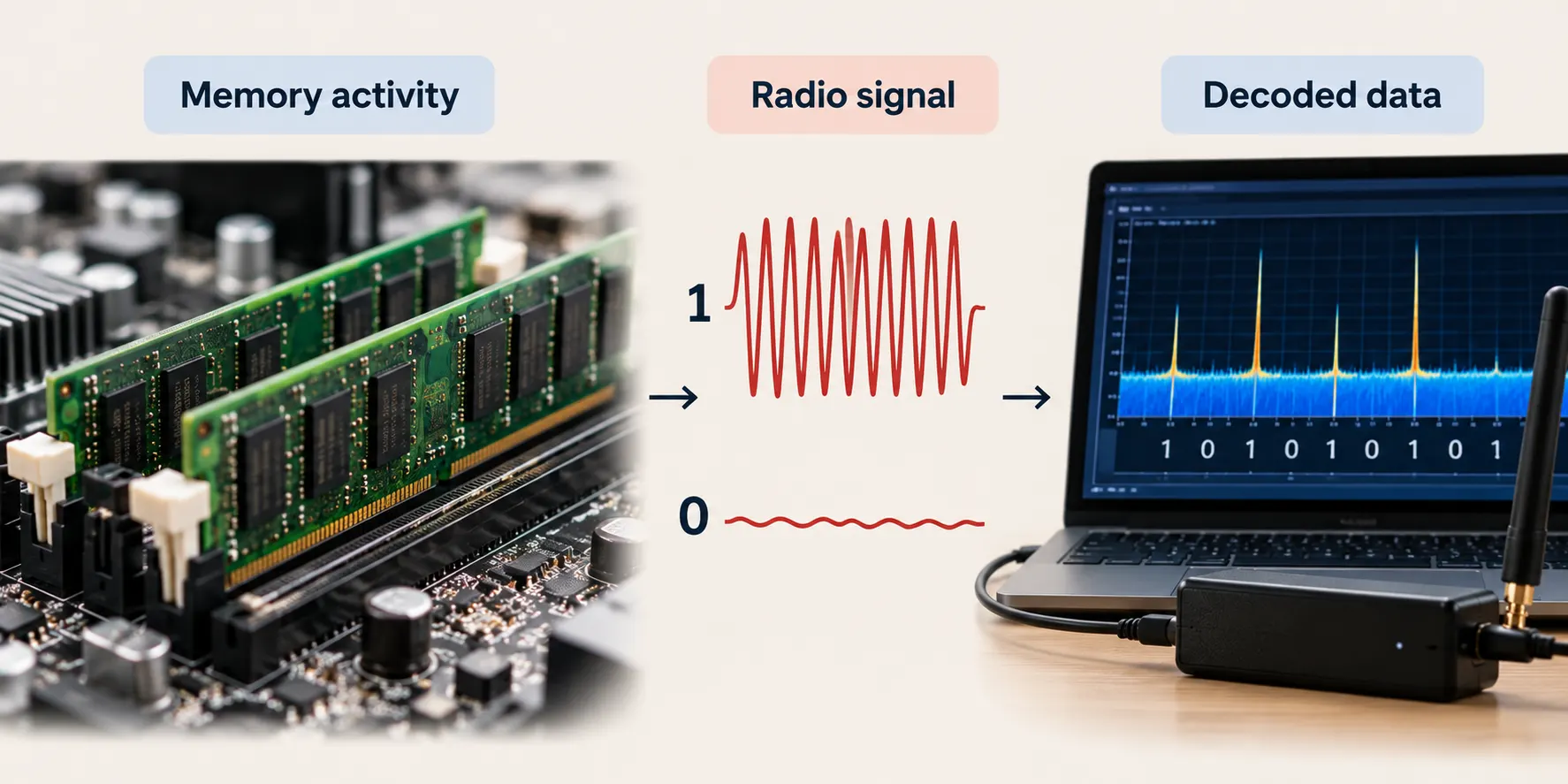
Think of a flashlight. Leaving it on tells someone across the street very little. Turning it on and off in a timed rhythm can send a message. AIR-FI used a similar on-off idea, except the receiver was measuring radio-frequency emissions rather than watching a light.
Memory activity rises
In AIR-FI’s basic mode, the program repeatedly copies data between two 1 MB memory buffers. That creates sustained activity on the memory bus, which produces a stronger, more detectable emission.
The program pauses
For the other bit, the program sleeps for a short window. The extra activity used to create the signal drops, giving the receiver a different pattern to detect.
The program repeats this sequence with carefully timed bits. The receiver then uses suitable hardware and decoding software to turn the pattern back into data. The whole memory bus does not fall silent between bits. The program is changing the particular activity it uses to make the signal.
03 / THE HARDWARE DETAIL
The CPU cache is one reason the trick is not automatic.
Not every memory operation creates the kind of signal these attacks need. Modern processors have a small, very fast store of recently used data called the CPU cache. When a program keeps using the same data, the processor can often serve those requests from cache instead of repeatedly moving the data across the motherboard to the RAM modules.
For a radio signal to stand out, the program needs to create enough activity on the physical memory bus. AIR-FI and RAMBO approached that problem differently.
Repeated large-buffer copies
AIR-FI repeatedly copied data between two 1 MB arrays. That workload was used to keep activity flowing across the memory bus while the transmitter encoded its bits.
Read the AIR-FI paper ↗A non-temporal store instruction
RAMBO used the x86 MOVNTI instruction, a non-temporal store that the researchers used to maintain activity on the RAM bus. It is more precise to describe this as a way to sustain the needed memory traffic than to say that it bypasses every part of the cache in every situation.
In the reported tests, the transmitting code could run without root or administrator privileges. That does not mean an ordinary app can read every other app’s protected data. The malware still has to be on the machine and able to access the particular information it wants to send.
04 / TWO DIFFERENT SETUPS
AIR-FI and RAMBO use different ways to receive the signal.
The basic idea is shared, but the frequency, receiver and test results differ. The numbers below come from separate laboratory setups, so they are not a direct head-to-head benchmark.
2.4 GHz Wi-Fi band
AIR-FI generated emissions in the same frequency band used by Wi-Fi. The isolated computer needed no Wi-Fi transmitter. A receiver still needed a way to inspect low-level Wi-Fi signals, such as modified firmware or driver access, or an SDR setup.
In one SDR test, the signal was detected up to 8 metres at 100 bits per second. A separate configuration recorded an 8.75% bit-error rate at 1.8 metres. Those figures came from different setups.
Primary paper ↗RAM-bus clock emissions
RAMBO used a software-defined radio (SDR) and an off-the-shelf antenna. The receiver captured the raw signal and processed it on a computer. An ordinary pocket AM/FM radio cannot decode the data.
The fast setting had a 2% to 4% bit-error rate at 3 metres. At 100 bits per second, the researchers reported error-free reception up to 7 metres in their tested setup.
Primary paper ↗The useful takeaway is not that every nearby phone can listen in. Both attacks need a receiver suited to the signal, software to decode it, and conditions that let the weak emissions be detected.
05 / THE LIMITS
Small secrets are a better fit than big files.
The headline data rates sound more impressive until you turn them into file sizes. Using decimal units, a 1 MB photo contains roughly 8 million bits. At 100 bits per second, the raw calculation gives about 22.2 hours of uninterrupted transmission.
Those are raw-rate estimates. They leave out framing, error correction and retransmission of corrupted bits, so an actual transfer could take longer. It is a poor channel for bulk theft, especially when the receiver is far away or the signal is unreliable.
What about passwords and keys?
This is where the technique becomes more relevant. The RAMBO paper models a 128-bit password payload at about 0.128 seconds in its fast setting and 1.28 seconds in its slow setting. It reports about 4.1 seconds for a 4,096-bit RSA key at the fast setting and about 42 seconds at the slow setting. Those are the paper’s estimates, under its test assumptions, not a promise that every real credential can be captured that quickly.
The researchers also modelled keystroke logging at 16 bits per key and reported that it could be transmitted in real time at the tested rates. That depends on the signal being received well enough and the malware having access to the keystrokes in the first place.
06 / THE PRACTICAL CATCH
Can an offline computer be hacked?
The answer depends on what you mean by hacked. Both AIR-FI and RAMBO assume malware is already running on the air-gapped computer and can access information worth stealing. Neither paper demonstrates the entire process of breaking into a clean machine and then extracting data as one automatic attack. The radio signal is the way out, not the way in.
An air-gapped PC has no internet connection to deliver malware in the usual way. But removable media, compromised hardware and people can still cross the physical boundary. The research discusses possible routes, including an infected USB drive, a compromised supply chain, or an insider with access to the room.
Stuxnet is the familiar example of malware crossing an air gap through removable media and contractor-linked systems. Public accounts differ on parts of the exact initial delivery chain, but the broader lesson is clear: isolated systems can still be exposed when people, files or hardware cross the boundary.
This is not something a stranger can do to a personal laptop simply by standing on the sidewalk. The computer must already be infected with suitable transmitting malware, the receiver has to be configured for the signal, and the physical environment has to allow it to be decoded. The papers report results from specific lab setups, not reliable data theft through arbitrary walls.
07 / THE BIGGER PICTURE
RAM is only one physical route.
Guri’s lab has studied other ways software can encode information in physical activity from a compromised computer. They are separate research demonstrations, not features that automatically let an outsider spy on any machine.
Fansmitter
Malware varies cooling-fan speed to change the sound it makes. A nearby microphone can try to recover the pattern from the shifts in acoustic noise.
LED-it-GO
Malware controls a hard-drive activity LED to send optical signals. A camera or light sensor with a view of the indicator can detect the changes.
PIXHELL
Specific pixel patterns can make components inside an LCD monitor vibrate and produce faint acoustic emissions. A microphone can attempt to pick up the resulting sound.
The common thread is not that every computer constantly broadcasts readable secrets. It is that software controls physical hardware, and carefully designed software can sometimes make side effects carry information.
08 / WHAT DEFENDERS CAN DO
An offline computer still needs layered defences.
The AIR-FI and RAMBO papers propose several ways to reduce the risk. The right combination depends on the environment, and these proposals should not be mistaken for proof that every high-security site already uses them.
Keep receivers away
Use physical separation rules for sensitive rooms and restrict phones, laptops and other radio-capable devices within defined zones.
Shield the equipment
Purpose-built electromagnetic shielding, including Faraday enclosures, can attenuate radio emissions. The result depends on the enclosure’s construction, and the researchers note that this approach can be costly.
Look for unusual memory activity
Monitoring can flag suspicious repetitive memory operations or unexpected radio activity. It is not a perfect detector: normal software also uses memory heavily, so these systems can produce false alarms.
Disrupt the pattern
The papers discuss adding background memory activity or external radio interference to make the signal harder to recover. These approaches have performance, cost and interference trade-offs.
Keeping an offline computer disconnected from networks remains useful because it removes ordinary network paths and makes remote attacks much harder. But if malware has already compromised it, the machine is still a physical system, with memory, power, light, fans and electromagnetic emissions. Unplugging the cable closes one route. It does not guarantee that an offline computer has no way left to leak information.
RESEARCH DESK
Sources and further reading
The main claims in this article are based on the original research papers. Their results describe specific laboratory equipment and configurations, not a universal range or transfer rate for every computer.
- AIR-FI: Generating Covert Wi-Fi Signals from Air-Gapped ComputersMordechai Guri, 2020. Primary source for the 2.4 GHz emissions, buffer-copy modulation, receiver requirements, virtual-machine tests and measured bit rates and distances.
- RAMBO: Leaking Secrets from Air-Gap Computers by Spelling Covert Radio Signals from Computer RAMMordechai Guri, 2024. Primary source for the SDR receiver, MOVNTI instruction, transmission rates, range tests, payload estimates and proposed countermeasures.
- PIXHELL: Leaking Sensitive Information from Air-Gap Computers via “Singing Pixels”Ben-Gurion University research record for the monitor-based acoustic side channel.
- The Hacker News: RAMBO research summaryIndependent reporting on the paper’s example payload timings and practical limitations.
Math note: the file-transfer examples use raw bit rates and decimal units: 1 MB ≈ 8,000,000 bits and 1 GB ≈ 8,000,000,000 bits. That gives about 22.2 hours at 100 bps and 92.6 days at 1,000 bps, before transmission overhead or errors. For the RSA-key example, this article rounds the RAMBO paper’s reported estimates to about 42 seconds at the slow setting and 4.1 seconds at the fast setting.